
Tips · 8 min read
Home Bar Essentials: What You Need and What You Don't
The four glasses, twelve bottles, and six tools a working home bar actually needs – and the gadgets you can skip.

 Arthur BulotaCo-founder & CEO, Glassique Cadeau
I have watched too many people buy a 24-piece bar set, use four pieces and let the rest gather dust. I want you to know what a working bar actually needs, so you spend on things that pour drinks instead of clutter.
Email me if you have any questions: shop@glassiquecadeau.com. I answer every email personally.

Four glass shapes, a dozen bottles, six tools – everything else is set dressing.
Walk into a serious cocktail bar and count the glass shapes behind the stick. You'll find four, maybe five. Then look at the 24-piece "complete home bar set" the internet keeps pushing at you. One of these approaches builds drinks. The other builds clutter.
TL;DR: The home bar essentials come down to four glass shapes – coupe, lowball, highball, spritz goblet – plus about twelve bottles and six real tools. That kit covers 90 percent of the classic cocktail canon. Start with our guide to types of cocktail glasses, then work down this list.
| Item | Spec | Why |
|---|---|---|
| Coupe (Paris Coupe) | 8 oz, set of 4 | Everything served up – martini, daiquiri, Manhattan |
| Lowball (Santorini) | 10 oz, set of 4 | Stirred drinks over ice and spirits neat – Old Fashioned, Negroni |
| Highball (Mykonos) | 14 oz, set of 4 | Long drinks – Collins, mojito, whiskey highball |
| Spritz goblet (Venice) | 17 oz, set of 4 | Aperol and Hugo Spritz, Spanish-style gin and tonic |
| Bottles | 6 core spirits + 6 modifiers | Twelve bottles pour the whole classic canon |
| Tools | Shaker, jigger, strainer, barspoon, muddler, Y-peeler | Measure, chill, strain, stir – nothing else earns counter space |
Why Glassware Comes First
Glass controls temperature and dilution – buy like bars do: few shapes, real capacities, matching sets of four.
A cocktail is mostly temperature and dilution. The glass controls both. A 4 oz martini in a 6 oz coupe stays cold to the last sip; the same drink in a 12 oz tumbler is warm by minute six. Bottles can wait a paycheck. Glasses decide whether the drink works tonight.
Here's our take: buy glassware the way bars do. Few shapes. Real capacity numbers. Matching sets of four or six, because cocktails are rarely poured for one. Bars break glasses weekly, so they buy plain – you don't, so you can afford one step nicer.
The Four-Glass Doctrine
Coupe, lowball, highball, spritz goblet – an 8 oz Paris, 10 oz Santorini, 14 oz Mykonos, 17 oz Venice cover the canon.
1. The coupe
The stemmed bowl for everything served "up" – martini, daiquiri, Manhattan, sidecar. The working range is 6 to 8 oz: room for a 4.5 oz drink, no dead air to warm it. Our Paris Coupe runs 8 oz at $49.99 for four and doubles as a champagne glass on New Year's Eve. One shape, dozens of recipes – test it with a proper gin martini, then browse the rest of our coupe glasses.
2. The lowball
Also sold as a rocks or Old Fashioned glass. Short, heavy, 9 to 10 oz, built for stirred drinks over ice and spirits served neat. The Negroni lives here – it has since 1919, when Count Camillo Negroni asked the bartender at Caffè Casoni in Florence to swap the soda in his Americano for gin. Our Santorini Lowball holds 10 oz and costs $36.99 for a set of four, which is the quiet bargain of the lowball collection. Master one drink in it: the Old Fashioned.
3. The highball
Tall and narrow, 12 to 14 oz, for long drinks – Tom Collins, mojito, whiskey highball, anything lengthened with soda. The narrow column protects carbonation, which is the entire point of these drinks. The Mykonos Highball gives you 14 oz for $39.99 a set. More shapes live in our highball and Collins collection.
4. The spritz goblet
A big stemmed balloon, 15 to 17 oz, for Aperol Spritzes, Hugo Spritzes, and Spanish-style gin and tonics. Aperol itself dates to 1919 Padua; the spritz habit is older, borrowed from Austrian soldiers who asked for their Veneto wine splashed with soda. The Venice Goblet holds 17 oz, $49.99 for four. See the full spritz glassware lineup for stemmed and gold-rim versions.
The Bottles: A Working Dozen, Not a Full Bar Liquor List
Six core spirits plus six modifiers – twelve bottles pour the whole classic canon, from Martini to Whiskey Sour.
Skip the 40-bottle "full bar liquor list" spreadsheets. Twelve bottles pour the canon.
Six core spirits: a London dry gin, a bourbon, a rye, a white rum, a blanco tequila, a vodka. Six modifiers: sweet vermouth, dry vermouth, Campari, an orange liqueur, Angostura bitters, and simple syrup you make yourself in four minutes.
That dozen covers the Martini, Manhattan, Negroni, Daiquiri, Margarita, Old Fashioned, and Whiskey Sour – a drink old enough that Jerry Thomas printed a recipe for it in 1862. Buy one good bottle per slot instead of three cheap ones. Nobody ever asked for the well pour twice.
Mixers, Citrus, and Ice You'd Actually Drink
Fresh lemons and limes squeezed same-day, five mixers, big weekly-refreshed ice cubes, and one bottle of Angostura.
The mixers list is short: real lemons, real limes, a tonic you respect, club soda, ginger beer. Squeeze citrus the day you pour it – bottled juice is how good gin dies. Simple syrup is one part sugar dissolved in one part hot water; it keeps two weeks in the fridge.
Ice gets ignored and shouldn't be. Big, fresh cubes melt slowly and dilute on schedule; the hotel-machine pebbles most freezers produce turn an Old Fashioned into whiskey water in eight minutes. And ice absorbs odor. If your freezer smells like last month's dumplings, your drink will taste like them. Dedicate a covered tray, refresh it weekly, done.
Bitters deserve one more line. A single bottle of Angostura – in production since Dr. Johann Siegert first compounded it in 1824 – seasons more drinks than any liqueur you could buy for triple the price. It's the salt and pepper of the bar. Start there before collecting the boutique stuff.
The Six Tools That Earn Counter Space
Shaker, jigger, Hawthorne strainer, barspoon, muddler, Y-peeler – under $60 in steel, and nothing else earns counter space.
Home bar tools are where budgets go to die, so hold the line at six: a shaker, a jigger with 1 oz and 2 oz sides, a Hawthorne strainer, a barspoon, a muddler, and a Y-peeler for citrus twists. Under $60 for the lot if you buy steel and skip the rosewood handles.
Worth saying: every tool on that list existed behind bars in the 1880s. The category was solved before electricity was common. Treat any "innovation" accordingly.
What You Don't Need
If a gadget doesn't measure, chill, strain, or stir, it's decor – skip the machines, cloches, and 24-piece kits.
No electric cocktail machine. No smoking cloche, at least not in year one. No 24-piece kit where 18 pieces are novelty pourers. No separate glass for every drink ever invented – we make 16 coupe silhouettes and we'll still tell you to start with one.
The test is simple. If a gadget doesn't measure, chill, strain, or stir, it's decor. Decor is fine. Just don't call it equipment.
The Year-Two Upgrade Path
Expand by drink, not impulse – one new shape per quarter, starting with whatever your house pours weekly.
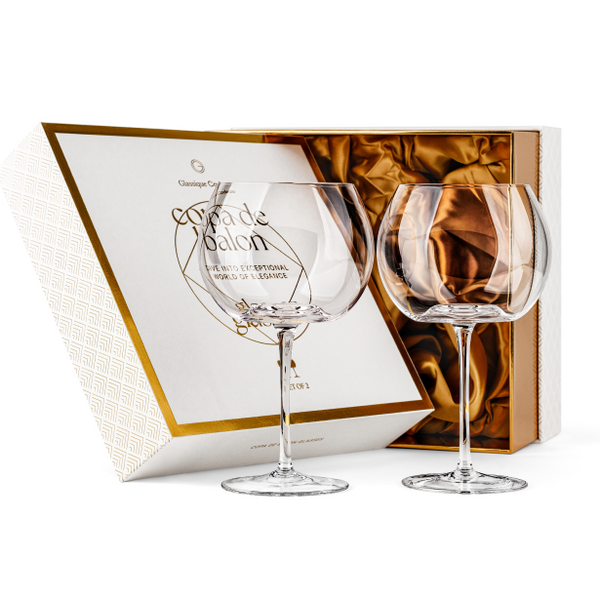
Once the four-glass doctrine is paying for itself in saved bar tabs, expand by drink, not by impulse. If your house pours martinis weekly, add a Nick & Nora set – 5 oz, $39.99 for four, and the shape spills less than a V-bowl when guests gesture mid-story. If gin and tonic is the house drink, a 25 oz Copa de Balón ($39.99 the pair) holds the ice mountain Spanish bartenders insist on. Whiskey drinkers graduate to proper tasting glasses with tulip bowls that focus aroma instead of scattering it.
One shape per quarter. That pace keeps the cabinet honest and the spending invisible.
Stocking a Home Bar on a Budget
Twelve working glasses cost $126.97, the full four-glass doctrine lands under $180 – then build bottles in stages.
Glass math, using real prices: the Santorini Lowball ($36.99), Mykonos Highball ($39.99), and Paris Coupe ($49.99) put twelve working glasses on your shelf for $126.97. Add the Venice Goblet later and the whole four-glass doctrine lands under $180. Then build bottles in stages – gin, sweet vermouth, Campari, and bourbon first, because those four alone pour Negronis, Manhattans, and Old Fashioneds all winter. Browse our bestsellers if you'd rather start where everyone else did.
Shop this guide
All 54 pieces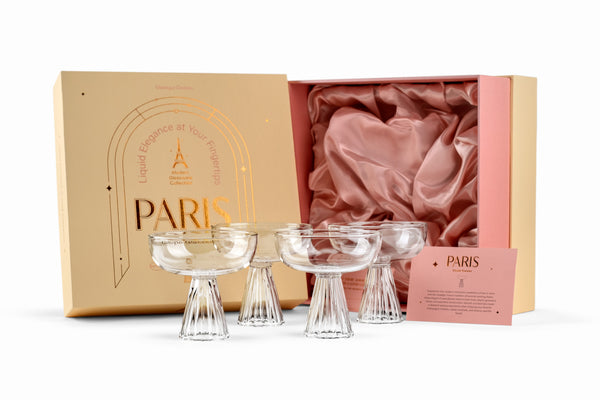
Limited Edition

Gift Ready

New Arrival
Our Pick
Home Bar Essentials: FAQ
What should be in every home bar?
Four glass shapes (coupe, lowball, highball, spritz goblet), six core spirits, six modifiers, fresh citrus, decent ice, and six tools: shaker, jigger, strainer, barspoon, muddler, peeler. Everything beyond that is taste, not necessity.
What do I need to build a home bar?
Start with glassware in matching sets – about $127 covers coupes, lowballs, and highballs from our drinkware collection – then add the six-tool kit and build your twelve bottles over two or three months. A cart or cabinet helps, but a kitchen shelf works.
What liquor should every home bar have?
Gin, bourbon, rye, white rum, blanco tequila, and vodka are the six core spirits. The supporting six – sweet and dry vermouth, Campari, orange liqueur, Angostura bitters, simple syrup – do more work than any seventh spirit would.
What to buy for a bar at home?
In order: four glass shapes, the six essential tools, then bottles in stages. Glasses first because they're permanent – a bottle empties, a cocktail party set outlives a decade of them.
What glasses do you need for a home bar?
A 6-8 oz coupe for drinks served up, a 9-10 oz lowball for stirred and neat pours, a 12-14 oz highball for long drinks, and a 15-17 oz goblet for spritzes. Four shapes cover nearly every recipe printed since 1862.
How many bottles do you need to start a home bar?
Four bottles pour real cocktails (gin, sweet vermouth, Campari, bourbon). Twelve pour the whole classic canon. Past twenty, you're collecting, not stocking – no judgment, but know which one you're doing.
Pair with: coupe glasses, lowball glasses, highball glasses, Aperol spritz glasses, Old Fashioned & Negroni glassware, and Glassique Cadeau bestsellers.
Build it once, build it right. Every Glassique Cadeau set arrives in our signature satin-lined gift box with a cocktail recipe printed on the lid – and orders over $89 ship free.
- Lead-free, hand-blown crystal
- 30-day satisfaction guarantee
- Arrives gift-ready in a satin-lined box


