
Tips · 8 min read
Types of Cocktail Glasses: The Complete Guide to 13 Shapes
Every glass shape that matters behind a serious bar – what it holds, what it's for, and why the shape changes the drink.

 Arthur BulotaCo-founder & CEO, Glassique Cadeau
Every time someone asked me which glass to buy, the honest answer started with a shape they had never heard of. I want you to walk away knowing what each shape actually does, so the next one you buy has a job waiting for it.
Email me if you have any questions: shop@glassiquecadeau.com. I answer every email personally.

Every glass has a job. Here are the thirteen that matter.
A Margarita out of a wine glass still works. A Manhattan out of a pint glass still works. But the right glass changes how a drink smells, how long it stays cold, and how it feels in the hand – which is most of what drinking well actually is. Here's the full lineup, what each shape does, and which drinks belong in it.
TL;DR: You need four glasses to cover 90% of cocktails: a coupe for anything served up, a lowball for spirit-forward drinks on ice, a highball for long drinks, and a stemmed wine-style goblet for spritzes. Everything past that is specialization – wonderful, but specialization.
The quick-reference version – every shape, size, and job:
| Glass | Capacity | Serve | Signature drinks |
|---|---|---|---|
| Coupe | 5–7 oz | Up | Daiquiri, Manhattan, Champagne cocktails |
| Martini (V-glass) | 4–6 oz | Up | Martini, Cosmopolitan |
| Nick & Nora | 4–5 oz | Up | Stirred classics |
| Lowball / rocks | 9–12 oz | Rocks | Old Fashioned, Negroni |
| Highball | 10–14 oz | Long | Mojito, Paloma, Collins |
| Flute | 6–8 oz | Sparkling | Champagne, French 75 |
| Copa de Balón | 20–25 oz | Iced | Gin & Tonic |
| Snifter | 15–21 oz | Neat | Brandy, whiskey |
| Tasting copita | 3–4 oz | Neat | Whiskey, tequila, port |
The stemmed family – served up, no ice
Four stems handle everything served without ice – the coupe, Nick & Nora, martini glass and Champagne flute.
1. Coupe
The wide, shallow, stemmed bowl that built cocktail culture. 6-8 oz capacity, designed for 4-5 oz of stirred or shaken drink served up. The coupe was the original Champagne glass in 18th-century France – the flute only displaced it in the 1980s – and the craft cocktail revival of the early 2010s brought it back as the default "up" glass in serious bars – our coupe glasses guide tells the full story.
Best for: Daiquiri, Sidecar, Gimlet, Champagne, Manhattan, anything "served up."
Our Paris Coupe runs 8 oz for modern pours – it sits in our modernism collection alongside the clean-lined, minimal shapes – while the Vintage Roaring 20s line keeps the classic 6 oz silhouette.
2. Nick & Nora
A coupe that went to finishing school. Smaller (4-5 oz), deeper bowl, narrower opening – which means less sloshing and slower warming. Named after Nick and Nora Charles, the cocktail-loving detective couple from the 1934 film 'The Thin Man'. Most bartenders would say this is the best stirred-cocktail glass ever made. We agree – browse the Nick & Nora collection and you'll see why it's the bartender's pick. Our roundup of the best Nick and Nora glasses compares the sets on bowl, rim, and balance.
Best for: Manhattan, Martini, Vesper, anything stirred and strong.
3. Martini glass
The V. Sharp-angled, iconic, slightly impractical (the wide rim spills if you walk with it – everyone knows, nobody cares). 6-8 oz in sane sizes; avoid the 12 oz monsters of the 1990s. The conical shape keeps the surface wide so the aromatics of gin botanicals or dry vermouth reach you before the sip.
Best for: Martini, Cosmopolitan, Espresso Martini. See our martini glasses.
4. Champagne flute
Tall and narrow to preserve the bead – the stream of bubbles – longer than any other shape. The trade-off: the narrow opening mutes aroma, which is why Champagne houses themselves have been drifting back to coupes and tulip shapes for tastings. Keep flutes for toasts, where the bubbles are the show. Our Champagne collection covers both camps.
Best for: Champagne toasts, French 75, Bellini, Mimosa.
The short family – ice-first drinks
The lowball (9–12 oz) and double rocks (12–14 oz) cover every spirit-forward drink served over ice.
5. Lowball (rocks / Old Fashioned glass)
The workhorse. 9-12 oz, heavy base, wide mouth. Named after the drink that made it famous. The weight matters – a proper lowball takes in-glass stirring and a 2-inch ice cube without feeling crowded. The Negroni has lived here since 1919, when Count Camillo Negroni asked a Florence bartender to strengthen his Americano with gin. Our lowball collection starts at $36.99 for a set of 4.
Best for: Old Fashioned, Negroni, Whiskey Sour, anything on the rocks.
6. Double rocks (DOF)
The lowball's bigger sibling – 12-14 oz for drinks with more ice, more mixer, or more ambition. If you only buy one short glass, honestly, buy this size. It handles everything the lowball does plus a Margarita on the rocks.
Best for: Margarita on the rocks, Paloma, generous Negronis.
The tall family – long drinks
Highball (10–14 oz) and Collins (14–16 oz) glasses keep carbonation lively in tall, mixer-heavy drinks.
7. Highball
10-14 oz, straight-sided, tall. Built for drinks that are mostly mixer – the carbonation stays livelier in a narrow column, the same physics as the flute. The 1920s highball was the glass of American hotel bars; our Art Deco 1920s Highball reproduces that exact profile at $59.99 for four, and the rest of the highball and Collins collection covers the 10–16 oz spread. The r/cocktails crowd argues endlessly about ideal highball dimensions, and the recurring verdict is: taller than you think, with a heavy base.
Best for: Gin & Tonic (the tall version), Mojito, Whiskey Highball, Paloma.
8. Collins
A highball that kept growing – 14-16 oz, slightly narrower and taller. The extra height exists for one reason: crushed ice drinks and long builds that need room for soda. The line between highball and Collins is blurry. Bartenders argue about it. Both camps are right. Browse Mojito & Tom Collins glasses.
Best for: Tom Collins, Mojito, fizzes.
The bowl family – aroma-first
Big bowls trap aroma – the Copa de Balón for gin, the snifter for brandy, the copita for tasting spirits.
9. Copa de Balón (gin balloon)
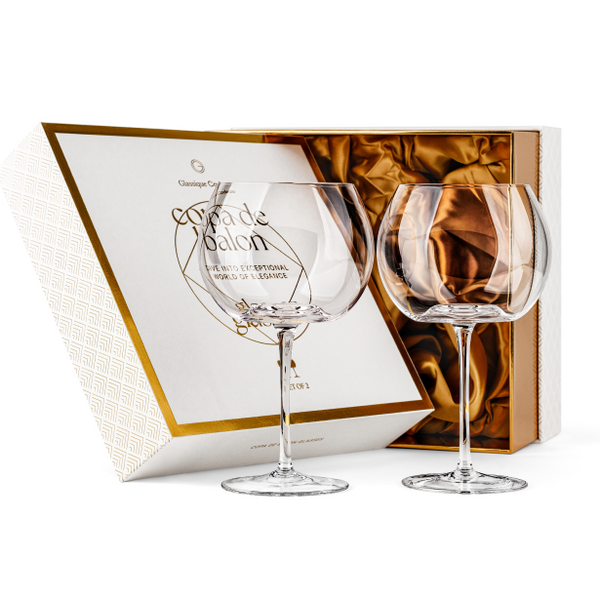
The Spanish G&T glass – a 20-25 oz balloon on a stem. The big bowl traps juniper and botanical aromatics above the drink; the stem keeps your hand off the bowl so the ice lasts. Spain turned the Gin Tonica into a national ritual in the 2000s and this glass is the reason it spread. Ours is 25 oz, set of 2 at $39.99.
Best for: Gin & Tonic, Hugo Spritz, big aromatic serves. More in the G&T goblet collection.
10. Snifter
The balloon bowl with a short stem, made to be cupped – your palm warms the spirit and opens the aroma. 15-21 oz for brandy and Cognac; the volume is headspace, not pour size. A proper pour is 2 oz. The rest is for your nose.
Best for: Brandy, Cognac, Armagnac, aged rum. See snifter glasses.
11. Tasting copita
The tulip. 3-7 oz, narrows at the rim to funnel aroma. This is the professional shape – distillery tasting rooms use copitas or Glencairns, not tumblers, because the narrow chimney concentrates everything a spirit has to say. Our tasting glasses cover whiskey, mezcal, port and grappa versions of the same idea.
Best for: Whiskey nosing, tequila and mezcal sipping, port, sherry.
The specialists
The spritz goblet (15–17 oz) serves the aperitivo hour; the cordial glass (2–4 oz) serves after-dinner pours.
12. Spritz goblet
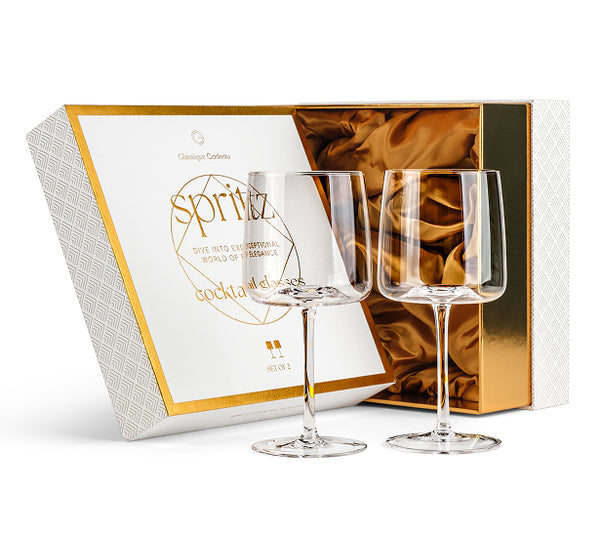
A stemmed wine-style glass, 15-17 oz, built for the Aperol ritual: 3-2-1 over ice, orange slice, golden hour. The stem matters more than people think – spritzes die warm. Our Crystal Aperol Spritz set is 15 oz, $39.99 for two.
Best for: Aperol Spritz, Hugo, wine cocktails.
13. Cordial glass
The smallest stem in the cabinet – 2-4 oz for limoncello, amaro and after-dinner pours. Italy serves limoncello in frozen 3 oz glasses for a reason: small, cold, gone in three sips, exactly as intended. See cordial & liqueur glasses.
Best for: Limoncello, amari, dessert liqueurs.
Which four to buy first
Buy a coupe, lowball, highball, then a spritz goblet or Copa – four shapes cover 90% of cocktail service.
Building a home bar from zero? Buy in this order:
- Coupe – covers every "up" drink plus Champagne. The most versatile stem that exists.
- Lowball – covers every spirit-forward rocks drink.
- Highball – covers every long drink.
- Spritz goblet or Copa – covers the aperitivo hour.
That's 90% of cocktail service in four shapes – enough to handle almost anything on the International Bartenders Association's official cocktail list. Hand-blown, lead-free crystal versions of all four run $36.99-$69.99 per set of 4 in our full collection – each in the signature gift box with the matching cocktail recipe printed on the lid.
Shop this guide
All 54 pieces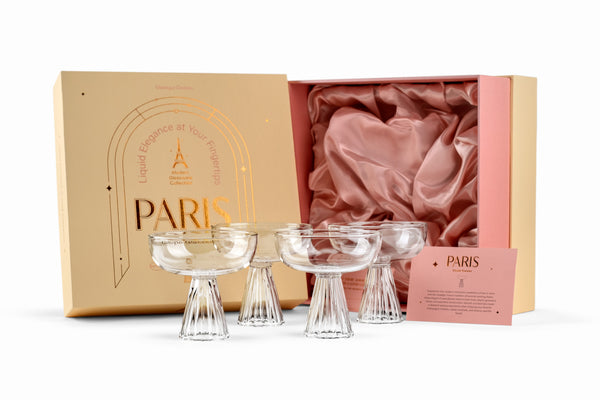
Limited Edition

Gift Ready
Our Pick
Gift Ready
FAQ
What are the main types of cocktail glasses?
Thirteen shapes cover serious cocktail service: coupe, Nick & Nora, martini, Champagne flute, lowball, double rocks, highball, Collins, Copa de Balón, snifter, tasting copita, spritz goblet and cordial glass. Four of them – coupe, lowball, highball, spritz goblet – handle 90% of drinks.
What's the difference between a coupe and a martini glass?
The coupe has a rounded bowl; the martini glass is a sharp V. The coupe spills less, warms slower and works for Champagne. The martini glass is more iconic for the Martini itself. Most bartenders reach for the coupe.
What glass does an Old Fashioned go in?
A lowball – the rocks glass literally named after the drink. 9-12 oz, heavy base, room for one large cube.
Why does glass shape matter for cocktails?
Three reasons: aroma (narrow rims concentrate, wide rims release), temperature (stems keep hands off the drink; heavy bases anchor ice), and proportion (a 4 oz cocktail looks right in a 5 oz glass and lost in a 12 oz one).
Is a champagne flute or a coupe better for cocktails?
Depends on the drink. A flute preserves carbonation longer, so it wins for a simple Mimosa or straight Champagne. A coupe drinks easier and looks more elegant, and it doubles for non-sparkling classics like the Daiquiri. For a sparkling cocktail like a French 75, either works – bartenders lean coupe for style, flute for fizz.
Why do gin and tonics come in those big balloon glasses?
The Copa de Balón (20-25 oz) came out of Spanish gin-tonic culture, and the size is functional. The huge bowl holds enough ice to keep the drink genuinely cold, plus botanicals and citrus, and its wide mouth concentrates the gin's aromatics like a wine glass. A cramped highball can't do any of that. Find them in our gin and tonic collection.
What cocktail glasses make the best gift?
A set of 4 coupes is the safest glassware gift – they work for cocktails and Champagne, so they get used at every celebration. Ours ship in a satin-lined gift box, recipe on the lid, free shipping over $89.
Pair with: coupe glasses, Nick & Nora glasses, lowball glasses, highball glasses, snifter glasses, best sellers.
Deutschsprachige Leser: Unser Ratgeber Sektschale vs. Champagnerschale erklärt die Coupe-Familie auf Deutsch.
- Lead-free, hand-blown crystal
- 30-day satisfaction guarantee
- Arrives gift-ready in a satin-lined box


