
Tips · 8 min read
Champagne vs Prosecco vs Cava: How to Pick the Bottle
Prosecco vs Champagne vs Cava, settled – region, method and grapes compared, the sweetness scale decoded in g/L, real price anatomy, and which bottle to buy for a toast, a mimosa brunch or a...

 Arthur BulotaCo-founder & CEO, Glassique Cadeau
I watched too many friends pay for a Champagne label when the occasion only called for something cold and sparkling. I want you to understand what you are actually paying for, so the choice feels like yours and not the shelf's.
Email me if you have any questions: shop@glassiquecadeau.com. I answer every email personally.

Three bottles, one question – what are you actually paying for?
| Champagne | Prosecco | Cava | |
|---|---|---|---|
| Region | Champagne, northern France – boundaries fixed by law in 1936 | Veneto and Friuli, northeast Italy – DOC since 2009 | Mostly Penedès, Spain, south of Barcelona |
| Method | Traditional – second fermentation in the bottle, 15 months minimum on lees (36 for vintage) | Charmat – tank fermentation, bottled within weeks | Traditional method, 9 months minimum aging |
| Grapes | Chardonnay, Pinot Noir, Pinot Meunier | At least 85% Glera | Macabeo, Xarel·lo, Parellada |
| Price | $45-60 realistic entry floor | $12-15 for a decent bottle | $12-18 – the strongest value in sparkling wine |
| Sweetness | Mostly Brut – under 12 g/L | Entry level mostly Extra Dry (12-17 g/L) – pick Brut for properly dry | Same EU sweetness ladder – Brut Nature through Doux |
This guide settles the rest – what the sweetness labels actually mean, why prices differ by a factor of four, how to serve each one, and which bottle belongs in your Champagne and sparkling glasses this weekend.
Three regions, three rulebooks
Champagne is legally bound to northern France, Prosecco to northeast Italy's Glera, Cava to Spain's Penedès.
Start with geography, because the law does. Champagne can only come from the Champagne region of northern France. The boundaries were legally fixed in 1936, and the Comité Champagne still takes producers to court for borrowing the name. The permitted grapes are Chardonnay, Pinot Noir and Pinot Meunier, blended in different proportions by every house.
Prosecco comes from the Veneto and Friuli regions of northeast Italy and must be at least 85% Glera – a grape that leans green apple, pear and honeysuckle. It received DOC protection in 2009, the same year the grape itself was officially renamed from "Prosecco" to Glera so the region could own the word.
Cava is Spain's entry, produced mostly in Penedès, just south of Barcelona, from Macabeo, Xarel·lo and Parellada. Josep Raventós bottled the first Cava in 1872 after touring Champagne and deciding Catalonia could do the same thing with local grapes. He was right. The price still reflects the fact that most shoppers haven't noticed.
The method is half the price tag
Champagne and Cava ferment in the bottle for months on lees; Prosecco ferments in a tank and bottles within weeks.
Champagne and Cava share the traditional method – méthode champenoise, if you're feeling formal. The wine goes through a second fermentation inside the bottle you eventually buy, then rests on its spent yeast cells (the lees) for months or years. That contact produces the bread, brioche and toasted-almond character people associate with real Champagne. The legal minimum is 15 months of aging for non-vintage Champagne, 36 months for vintage. Cava requires 9 months.
Prosecco uses the Charmat method, patented by Eugène Charmat in 1907. The second fermentation happens in a large pressurized steel tank, and the wine is bottled within weeks rather than years. Tank fermentation preserves the fresh, fruity side of Glera – which is the whole point. Nobody wants a bready Prosecco.
Neither method is "better." They're built for different grapes and different jobs.
The sweetness scale, decoded
Brut means under 12 g/L – and Extra Dry, at 12-17 g/L, is actually sweeter than Brut.
Every label carries a sweetness term, measured in grams of residual sugar per liter. Here's the full ladder:
- Brut Nature: 0-3 g/L – bone dry, no sugar added
- Extra Brut: 0-6 g/L
- Brut: under 12 g/L – where most Champagne lives
- Extra Dry: 12-17 g/L – confusingly, sweeter than Brut
- Dry (Sec): 17-32 g/L – sweeter still
- Demi-Sec: 32-50 g/L – dessert territory
- Doux: 50+ g/L – rare, and very sweet
The trap: "Extra Dry" is not extra dry. It's the second-sweetest common style, and it's where most entry-level Prosecco sits. If you want a properly dry Prosecco, look for Brut on the label. That single line of fine print settles half of all "Prosecco is too sweet" complaints.
Why one bottle costs $12 and the next costs $45
Million-euro-per-hectare land, hand harvesting, and 15 months of cellar time set Champagne's $45-60 floor; tank-method Prosecco lands at $12-15.
The price gap is structural, not just branding. Champagne vineyard land trades for over a million euros per hectare. Grapes must be harvested by hand – it's written into the appellation rules. Then every bottle sits in a cellar for at least 15 months earning nothing. Add the marketing budgets of the grandes marques and $45-60 becomes the realistic floor for entry-level Champagne.
Prosecco's tank method scales, Veneto land costs a fraction of Champagne's, and machine harvesting is allowed across most of the zone. That's how a decent bottle lands at $12-15 without anyone cutting corners.
Cava is the anomaly: traditional-method labor at Spanish land prices. Here's our take – a $15 Cava Reserva beats anything else with bubbles at that price, and it isn't close. The only reason it doesn't cost more is that demand hasn't caught up with the winemaking.
Which bottle for which occasion
Champagne for gifts, Cava for big toasts, Brut Prosecco for mimosas and a French 75 base.
The wedding toast. Champagne if the guest list is short, Cava if it's long. Nobody sips slowly during a toast, and traditional-method Cava pours, foams and photographs exactly the same. Outfitting the table too? Start with our wedding glassware.
Mimosa brunch. Prosecco. Always. Orange juice erases the toasty depth you paid for in Champagne, while Glera's apple-and-pear fruit actually likes the company. A $13 Brut Prosecco is the correct call.
A French 75 base. You need dry fizz and bright acidity – Brut Cava or Brut Prosecco both deliver, and Champagne is a flex rather than a requirement. Our French 75 recipe covers the ratios and the build.
A gift. Champagne, no debate. The name does half the gifting work before the cork moves. Pair the bottle with proper glasses – our gift guide for wine lovers has options at every budget, and every Glassique Cadeau set ships in a satin-lined gift box with the cocktail recipe printed on the lid.
Serve it cold, and rethink the flute
Serve at 45-48°F – three hours in the fridge – with flutes for the toast and coupes for everything after.
Target temperature is 45-48°F. That's three hours in the refrigerator, or 20-30 minutes in a bucket of half ice, half water. Skip the freezer – forgotten bottles burst, and over-chilled wine hides its aroma until it warms back up in the glass anyway.
Now the glassware question. Flutes hold carbonation longest because the narrow surface gives bubbles less room to escape – that's why they own the formal toast. But a coupe opens up the aroma, sits better in the hand, and turns the same $14 Cava into an occasion. (There's a reason the coupe owned the entire Gatsby era.) In our view, flutes are for the toast and coupes are for everything after – our coupe glasses guide makes the full case.
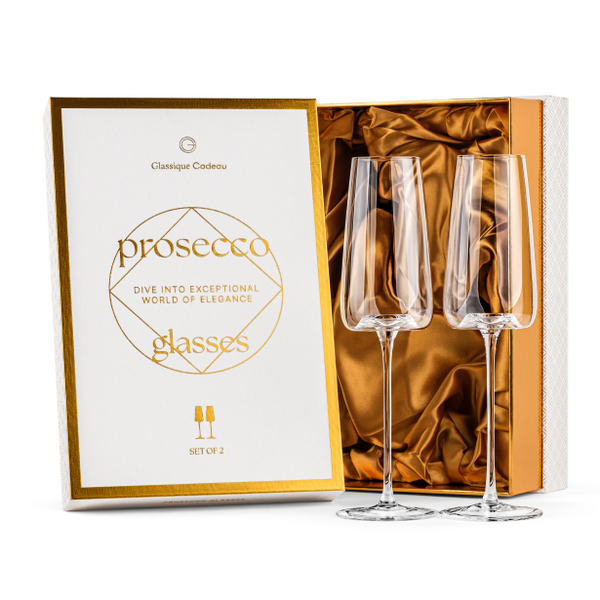
If you're building the cabinet: the French Champagne and Cocktail Coupe (set of 4, 6 oz) covers sparkling wine and stirred cocktails in one glass, the Crystal Prosecco and Champagne glasses (set of 2, 7 oz) are the tulip compromise sommeliers keep recommending, and the Gold Rimmed Champagne flutes handle the formal moments. Everything in our coupe collection is hand-blown, lead-free crystal – sets from $36.99, free shipping over $89.
Bottle math for parties
A 750 ml bottle pours six 4 oz glasses – one per six guests for a toast, one per two all evening.
A 750 ml bottle pours six 4 oz glasses. Plan from there:
- Toast only: one bottle per 6 guests
- Cocktail hour: one bottle per 3 guests
- Full evening: one bottle per 2 guests
- Mimosa brunch: one bottle per 3-4 guests, plus a quart of juice
Round up, always. Leftover bubbles become tomorrow's French 75, and an opened bottle with a proper sparkling-wine stopper holds its fizz for 2-3 days in the fridge. Running out mid-party has no fix.
Shop this guide
All 54 pieces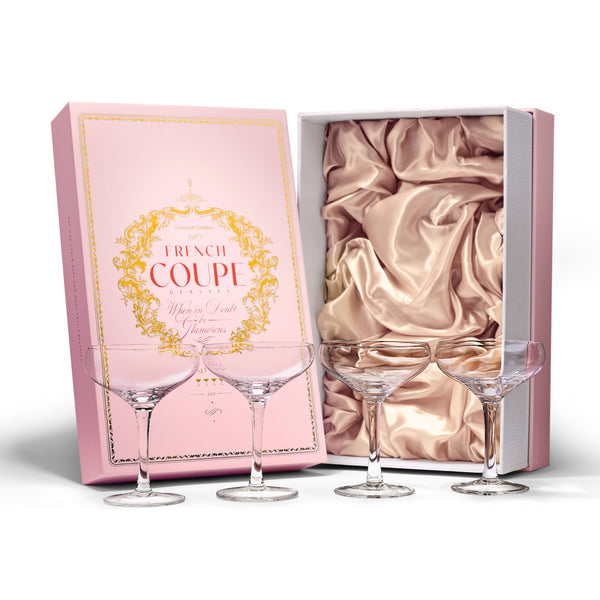
Wedding Favorite
Wedding Favorite

Wedding Favorite
Frequently asked questions
Is Prosecco just cheap Champagne?
No. Prosecco is a different wine from a different country – Glera grapes grown in northeast Italy, fermented in tanks rather than bottles. It's built to taste fresh and fruity, not bready and complex. The $12 price reflects a cheaper production method, not a failed attempt at Champagne.
Which is sweeter, Prosecco or Champagne?
Usually Prosecco, but only because most entry-level Prosecco is labeled Extra Dry (12-17 g/L of sugar) while most Champagne is Brut (under 12 g/L). A Brut Prosecco is just as dry as a Brut Champagne.
What is the best sparkling wine for mimosas?
Brut Prosecco. Orange juice flattens the fine bubbles and toasty character that make Champagne expensive, while Prosecco's apple-and-pear fruit works with the juice. Save at least $30 and get a better mimosa.
Is Cava as good as Champagne?
Cava uses the same traditional bottle-fermentation method as Champagne, with a minimum of 9 months of lees aging, so it shares the fine bubbles and some of the toasty depth. Different grapes and climate mean it tastes different – but at $12-18 it is the strongest value in sparkling wine.
Should Champagne be served in a coupe or a flute?
Flutes preserve carbonation longest, so they suit long toasts. Coupes open up aroma and suit parties and cocktails. For vintage Champagne with real complexity, a tulip glass beats both.
How many glasses of Champagne are in one bottle?
A standard 750 ml bottle pours six 4 oz glasses. Plan one bottle per six guests for a toast alone, or one bottle per two guests for a full evening.
Sources and further reading
The Comité Champagne publishes the appellation rules and aging requirements. Wikipedia's overview of sparkling wine production covers the traditional and Charmat methods in detail.
Pair with: Champagne coupes and flutes, New Year's Eve glasses, wedding gifts, anniversary gifts, cocktail party glassware.
- Lead-free, hand-blown crystal
- 30-day satisfaction guarantee
- Arrives gift-ready in a satin-lined box


