
Tips · 7 min read
The Art Deco Bar Cart: A Style Guide With Teeth
Five bottles, odd-numbered crystal, 30% empty space – the art deco bar cart styling rules, including what should never be on it.

 Arthur BulotaCo-founder & CEO, Glassique Cadeau
A bar cart is a stage, not a cabinet, and most people ruin the stage with clutter. I want you to take bottles off it, leave a third of the shelf empty, and see how much more glamour that buys.
Email me if you have any questions: shop@glassiquecadeau.com. I answer every email personally.

A bar cart is furniture that makes a promise. Art Deco is the promise kept.
The style got its name from the 1925 Paris Exposition Internationale des Arts Décoratifs, and it solved a problem your living room still has: how to make a small object feel like architecture. An art deco bar cart – chrome or brass, glass tiers, stepped lines – is the most efficient glamour per square foot you can buy. Then most people ruin it with clutter. This is the style guide, including the part nobody writes: what to take off.
| Element | Spec | Rule |
|---|---|---|
| Tray anchor | One rectangular tray, top shelf | Holds the working trio: spirit, vermouth, bitters |
| Bottles | Five maximum | Gin, rye, sweet vermouth, Campari, one wildcard – the rest live in a cupboard |
| Glassware | Two shapes on display, odd-numbered groups | Coupes and lowballs; three glasses up, spares in the box |
| Tall element | One | Shaker, stemmed decanter, or a single tall plant |
| Negative space | 30% empty | What separates a cart from a garage sale table |
| The cart | Two tiers, mirrored or glass top shelf | Metal in brass or chrome – not both |
Why the Art Deco Bar Cart Still Works
The cart is a stage, not a cabinet – reflective frame, glass shelves, contents arranged like a shop window.
Art Deco is geometry with confidence – sunbursts, steps, hard symmetry, surfaces that bounce light. The drinks trolley became a fixture in the 1930s, when cocktail hour moved into apartments and the bar needed wheels. A century on, the recipe is unchanged: reflective frame, glass shelves, and contents arranged like a shop window.
Worth saying: the cart is a stage, not a cabinet. If you need storage, buy a cabinet and close the door. The cart's whole job is display, which is why styling rules matter more here than anywhere else in the room.
The Cart Itself: Vintage, Repro, or Repurposed
Look for two tiers, a mirrored or glass top shelf, and metal in brass or chrome – never both.
Originals from the 1930s surface at antique dealers and auction sites, and the good ones – chrome Machine Age pieces, walnut trolleys with rubber-tired wheels – list anywhere from a few hundred dollars into five figures. Reproductions get you the silhouette for less. Either way, look for three things: two tiers (three gets busy), a mirrored or glass top shelf to double your light, and metal in brass or chrome – not both.
No cart at all? A tray on a console table runs the same playbook. The rules below don't care about wheels.
The Styling Rules: Top Shelf Is a Stage
One tray anchor, odd numbers, one tall element, five bottles maximum, and 30% of the shelf left empty.
- Anchor with a tray. One rectangular tray on the top shelf, holding the working trio: spirit, vermouth, bitters. The tray turns clutter into composition.
- Odd numbers only. Three coupes, five bottles, one lamp – the 3-5-7 styling rule exists because even groupings read as staged.
- One tall element. A cocktail shaker, a stemmed decanter, or a single tall plant. Height variance is what photographs.
- Five bottles maximum. Gin, rye, sweet vermouth, Campari, one wildcard. The other ten bottles live in a cupboard. A cart with twenty bottles isn't a bar; it's a liquor store with anxiety.
- Leave 30% empty. Negative space is what separates an art deco bar cart from a garage sale table.
What NOT to Put on It
No plastic, no mixers, no novelty mugs, no paper napkins, no era soup, and only two glass shapes.
Here's our take, and it has teeth:
- Plastic anything. Including "acrylic barware." The entire era was a war against cheap materials – don't lose it on your own cart.
- Mixers. Tonic, soda, juice – fridge items. Warm tonic on display is a confession.
- Novelty mugs and slogan glasses. The tiki mug has a home. It is a different home.
- Paper napkins. Cloth or none.
- Era soup. A mid-century globe bar, a farmhouse sign, and a Deco cart in one corner cancel each other out. Pick the decade and commit.
- The full glass rainbow. Two glass shapes on display, not six. Coupes and lowballs cover 90% of what anyone orders.
The Glassware Layer: Iridescent and Smoke Black
Run one iridescent set and one smoke black set – three glasses up, spares in the box.
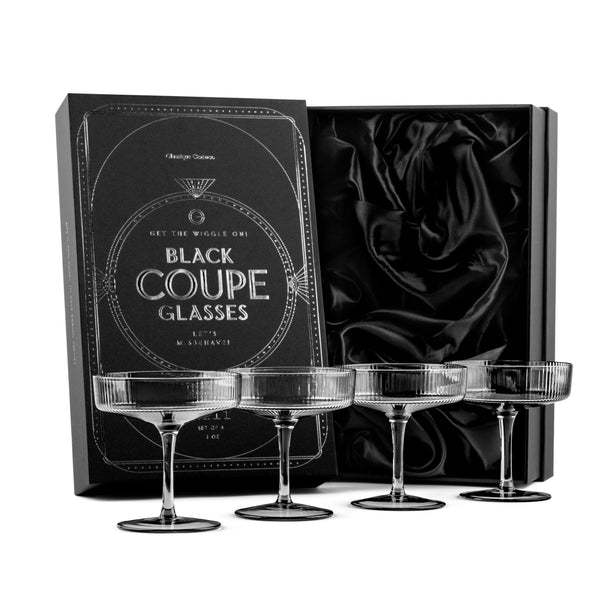
On a mirrored shelf, glass is the jewelry, and two finishes do the most work. The Iridescent Coupe (set of 4, $69.99) throws petrol-sheen color the moment any light hits it – on a chrome cart it reads as pure 1925. The Smoke Black Coupe (7 oz, set of 4, $69.99) is the opposite move: a dark silhouette that gives the metals something to contrast against. Run one set of each, three glasses up, the spares in the box.
Below them, a faceted lowball – the Gatsby Lowball (set of 4, $42.99) – handles the daily pours. All hand-blown, lead-free crystal; all from the same design decade, which is the point. The broader coupe collection and lowball lineup have the variations if your cart leans brass-warm or chrome-cool.
Stocking It: Five Bottles, Three Drinks
Five bottles pour three period-correct drinks – Negroni, Martini, rye Old Fashioned – in 24 inches of shelf.
The five-bottle cart above pours three period-correct drinks without restocking: a Negroni (born Florence, 1919 – equal parts, no shaker needed), a Martini (2½ oz gin, ½ oz dry vermouth if you keep a second vermouth), and a rye Old Fashioned. That's an entire cocktail program in 24 inches of shelf. Guests don't want options; they want the thing you make well, served in crystal, in under three minutes.
The Bar Cart as Gift Engine
Once someone owns the cart, every future gift occasion answers itself with a boxed crystal set.
One more reason the cart earns its corner: it converts every future gift occasion. Once someone owns the cart, the question "what do we get them?" answers itself for years – a coupe set for the anniversary, a lowball set from the housewarming collection when they move, a tasting set when the whiskey phase arrives. Each set ships in a satin-lined gift box sized to be handed over in person. You're not buying glasses; you're buying the next chapter of someone's favorite object.
Shop this guide
All 54 pieces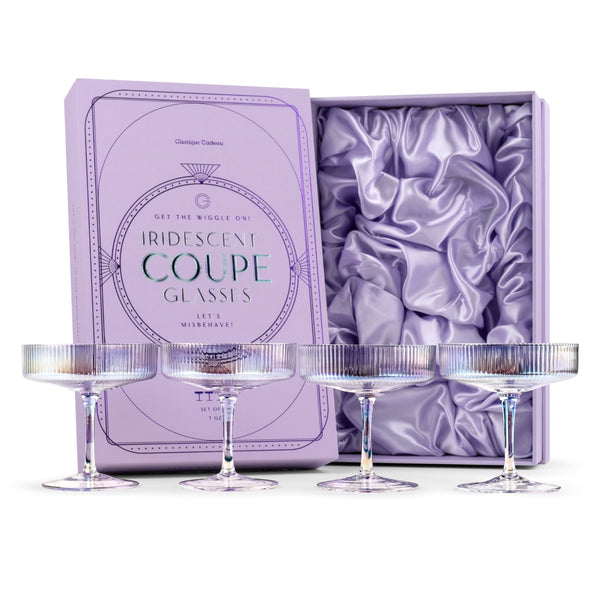
Bestseller
Perfect for Him

Limited Edition
Art Deco Bar Cart: FAQ
What is an Art Deco bar cart?
A wheeled drinks trolley in the 1920s-30s design language: chrome or brass frame, glass or mirrored tiers, stepped geometric lines. Originals date to the 1930s; reproductions copy the silhouette at accessible prices.
Are vintage Art Deco bar carts worth the money?
If the frame is sound and the finish original, yes – they hold value the way good furniture does, and 1930s pieces have already survived 90 years of parties. Check wheel condition and glass-shelf seating before paying vintage prices.
What do you put on an Art Deco bar cart?
A tray with three working bottles, two more bottles beside it, odd-numbered groups of crystal glasses, one tall element (shaker or decanter), cloth napkins, and 30% nothing. Bottom shelf takes backups and the ice bucket.
What should you not put on a bar cart?
Mixers, plastic barware, novelty mugs, paper napkins, more than five bottles, and decor from competing eras. If it wouldn't survive a 1930 hotel bar photograph, it goes in the cupboard.
What glasses go on an Art Deco bar cart?
Two shapes on display: coupes for anything served up, faceted lowballs for anything over ice. Iridescent or smoke-toned crystal earns the mirrored shelf; the rest of the set waits in the box until the party.
What's the difference between an Art Deco and a mid-century bar cart?
Deco (1920s-30s) is vertical, symmetrical, and shiny – chrome, mirror, stepped lines. Mid-century (1950s-60s) is horizontal, organic, and warm – walnut, splayed legs, brass details. Match your glassware's era to the cart's.
Pair with: Art Deco glassware, Glassique Cadeau coupes, gifts for his birthday, gifts for her birthday, our bestsellers, all drinkware.
Style the cart once, properly, and it hosts every party after that. Every Glassique Cadeau set ships in a signature satin-lined gift box with a cocktail recipe printed on the lid, and orders over $89 ship free.
- Lead-free, hand-blown crystal
- 30-day satisfaction guarantee
- Arrives gift-ready in a satin-lined box


