
Tips · 6 min read
Art Deco Glasses: The Collector-Grade Guide
What defines Art Deco glassware, antiques vs quality reproductions, how to spot a well-made glass, and which shapes belong on a 1920s-style bar cart.

 Arthur BulotaCo-founder & CEO, Glassique Cadeau
I wrote this because people kept asking me about art deco glasses. Every glass we make is lead-free crystal, hand-blown and dishwasher-safe, 54 pieces in all.
Email me if you have any questions: shop@glassiquecadeau.com. I answer every email personally.
- Art Deco glassware is defined by geometry: ribbing, stepped forms, strong symmetry, and the confident lines of the 1920s and 1930s.
- Original period pieces offer provenance and traditional lead crystal; quality reproductions offer lead-free crystal, matching sets and everyday durability. Both are legitimate choices.
- Quality shows in the details: clarity, weight balance, a cleanly finished rim, and crisp, regular ribbing.
- The period shapes that matter for a bar cart: the coupe, the lowball, and the highball. Prices shown in GBP.
Art Deco is the only design movement most people can identify from a drinking glass alone. Hold one up: the ribbed bowl, the stepped stem, the geometry that looks like a Manhattan skyline shrunk to hand size. No other style is that legible at that scale.
This guide is for people who want to buy Art Deco glasses properly, whether that means hunting original 1930s pieces at auction or choosing a reproduction set that will survive actual use. It covers what defines the style, the honest trade-offs between antique and new, how to judge quality in the hand, and how to style the result on a bar cart or drinks trolley.
What defines Art Deco glassware
Art Deco flourished in the 1920s and 1930s. The name derives from the Exposition Internationale des Arts Décoratifs et Industriels Modernes, the landmark decorative arts exhibition held in Paris in 1925, though the shorthand "Art Deco" only became common during the style's revival decades later.
In glass, the style translates into a handful of unmistakable signatures:
- Geometry over ornament. Where Victorian glass was cut with flowers and ferns, Deco glass is faceted, fluted and angular. The decoration is the structure.
- Ribbing. Vertical or radiating ribs that catch light in parallel lines, on bowls, stems and bases.
- Stepped forms. Tiered, ziggurat-like stems and feet, echoing the setback skyscrapers of the same era.
- Strong symmetry. Deco glass looks machine-precise even when it was made by hand, which is part of its glamour.
The shapes that existed in the period
| Shape | Typical use | Period notes |
|---|---|---|
| Coupe | Champagne, stirred cocktails | The definitive glass of the era's cocktail culture; broad, shallow bowl on a stem |
| Lowball / tumbler | Whisky, Old Fashioned, spirits over ice | Short, heavy-based; Deco versions carry ribbing or panel cuts |
| Highball | Long drinks, soda mixes | The tall companion to the lowball as mixed long drinks spread |
| Nick & Nora | Small stirred cocktails | A small stemmed coupe named after the couple in The Thin Man (1934); the name and modern revival came much later, but the silhouette is pure thirties |
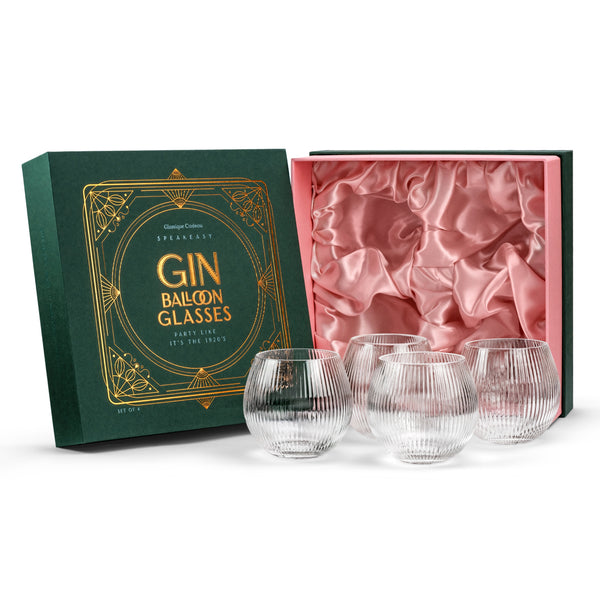
One useful honesty check when shopping: the balloon-style gin glass is a modern Spanish import, not a 1930s form. A ribbed crystal G&T copa is Deco in styling rather than Deco in origin, and there is nothing wrong with that as long as nobody is charging you antique prices for it.
Originals vs quality reproductions: the honest trade-offs
Original period glasses are wonderful objects, and this guide will not pretend otherwise. But the choice between antique and reproduction is a genuine trade, not a hierarchy.
What originals give you: provenance, a century of history in the hand, and often traditional lead crystal. Under the European crystal glass rules, glass sold as "lead crystal" contains at least 24 percent lead oxide, which is what gives old crystal its famous weight and refractive sparkle.
What originals cost you: fragility that has already survived ninety years and owes you nothing, incomplete sets (finding six matching 1930s coupes is a project measured in years), no dishwasher, ever, and the lead itself. Regulators advise against storing drinks long-term in lead crystal because small amounts of lead can migrate into the liquid, particularly with spirits left in contact for extended periods. Occasional drinking use is a different matter, but it is a fact worth knowing before you buy a decanter.
What quality reproductions give you: lead-free crystal with modern clarity, complete matching sets of four or six, replaceability when one breaks, and in some cases dishwasher-friendly durability. What they cost you is the story. A new glass has no past, only a future.
The collector's answer is often both: one or two original display pieces, and a reproduction set that does the actual work of Tuesday-night drinks.
How to spot quality, antique or new
The same five checks apply across a century of glassmaking.
Clarity. Hold the glass to daylight. Good crystal reads bright and colourless; cheap soda glass often carries a faint green or grey cast.
Ring. Flick the rim gently. Crystal sings; ordinary glass thuds.
Rim finish. Run a fingertip around the rim. It should be smooth and even, with no rolled thick lip and no sharpness.
Ribbing. On a Deco piece the ribs are the style, so judge them hardest. They should be crisp, evenly spaced and symmetrical around the glass.
Balance. A good lowball feels planted, with weight in the base. A good coupe balances on its stem without feeling top-heavy when full.
Styling a bar cart the Deco way
Deco glass is theatrical, so let it perform. Three principles do most of the work.
Group by silhouette, not by drink: a row of coupes, a cluster of lowballs, rather than a jumble. Give the glass light: near a lamp or window, ribbed crystal decorates itself. And keep the cart edited: six beautiful glasses, one decanter and a tray beat twenty mismatched pieces. The era's whole aesthetic was confidence through restraint of number and extravagance of line.
An honest note on our own glasses, and care
Everything in our Art Deco collection is hand-blown, lead-free crystal, and hand-blown means exactly that: each glass is a sibling of the others, not a clone. Expect minute variations between glasses in a set. That is the evidence of the making, the same evidence collectors prize in period pieces.
Care: hand-washing in warm water with a soft cloth is the gold standard for any crystal, and mandatory for antiques. Among our own sets, the G&T copas are dishwasher friendly; for stemmed pieces we still recommend the sink, the tea towel and the two spare minutes.
Shop this guide
All 54 pieces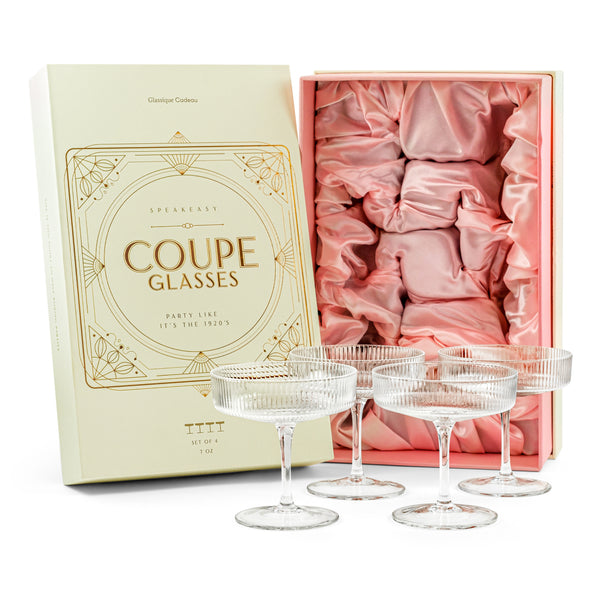
Bestseller

Gift Ready
Bestseller

Perfect for Her
Frequently asked questions
What era is Art Deco glassware from?
The style belongs to the 1920s and 1930s, taking its name from the 1925 Paris exposition of decorative arts. Pieces from that window are genuine period Deco; later pieces in the style are revivals or reproductions.
Is it safe to drink from vintage lead crystal?
Occasional use is generally considered a modest risk, but lead can migrate from crystal into drinks, so avoid storing wine or spirits in lead crystal decanters for long periods, and choose lead-free crystal for everyday glasses.
Are Art Deco glasses a good investment?
Buy them because you will use them. Complete, undamaged period sets by known makers hold value best, but the honest return on glassware is the decade of drinks, not the resale.
What cocktails suit Art Deco glasses?
The era's own menu: Champagne cocktails and Manhattans in the coupe, an Old Fashioned in the lowball, a Gin Rickey in the highball. The glasses were built for these drinks, which is why the pairings still feel inevitable.
The verdict
Art Deco glassware endures because it solved a problem permanently: how to make a drinking glass glamorous without making it fussy. Buy originals for the story, reproductions for the service, and judge both by the same standards of clarity, ring, rim and rib.
If you are building the set rather than the museum, start with the working trio from our Art Deco collection: the Art Deco Coupe (7 oz to the rim, about 21 cl, set of four) for Champagne and stirred cocktails, the Art Deco Lowball (9 oz, about 27 cl, set of four) for whisky, and the G&T copas (13.5 oz, about 40 cl, ribbed Deco stems, dishwasher friendly) for the long drinks. All hand-blown, lead-free crystal, all gift-boxed, and together they cover every drink the 1930s thought worth making.
- Lead-free, hand-blown crystal
- 30-day satisfaction guarantee
- Arrives gift-ready in a satin-lined box


