
Recipes · 5 min read
How to Make a Martini: Ratio, Stir, Glass – Settled
Gin, vermouth, a 30-second stir and a chilled glass – every ratio explained, every myth retired, including the shaken one.

 Arthur BulotaCo-founder & CEO, Glassique Cadeau
I have listened to more strong opinions about the Martini than any other drink, most of them inherited rather than tested. I want you to strip away the doctrine and make one you can defend on taste alone.
Email me if you have any questions: shop@glassiquecadeau.com. I answer every email personally.

Four ounces of cold, clear conviction.
No cocktail carries more opinion per ounce than the Martini. Wet, dry, dirty, 50/50, vodka, gin, shaken, stirred – everyone's grandfather had a doctrine. Strip the noise and it's the simplest serious drink there is: spirit, vermouth, cold, glass. Here's the build, the ratios, and the one Bond myth that needs retiring.
TL;DR: Stir 2.5 oz gin and 0.5 oz dry vermouth with ice for 30 seconds, strain into a chilled martini glass or Nick & Nora, garnish with a lemon twist or olive. That's a 5:1 dry Martini – the modern standard. Adjust vermouth up for a wetter, friendlier drink.
What you need
London Dry gin, fresh dry vermouth kept refrigerated, a twist or olive, optionally one dash of orange bitters.
- 2.5 oz gin – a London Dry (Tanqueray, Beefeater) for the classic juniper spine. Vodka if you must, but you're making a different, quieter drink.
- 0.5 oz dry vermouth – Dolin Dry or Noilly Prat. Refrigerated after opening, replaced within 6 weeks. Dead vermouth kills more Martinis than bad gin ever has.
- Garnish – lemon twist for aromatics, olive for salt, cocktail onion if you're making a Gibson and feeling literary.
- Optional: 1 dash orange bitters – the pre-Prohibition touch that most modern bars quietly skip and shouldn't.
The ratios – pick your church
Start at 5:1 – 2.5 oz gin to 0.5 oz dry vermouth – and drift wetter as you learn.
| Style | Gin : Vermouth | Character |
|---|---|---|
| 50/50 | 1.5 : 1.5 oz | Soft, aromatic, lunch-appropriate |
| Wet | 2.5 : 1 oz | The pre-war classic, vermouth audible |
| Dry (standard) | 2.5 : 0.5 oz | Modern bar default |
| Extra dry | 3 : a rinse | Cold gin with a rumor of vermouth |
Worth saying: the drier-is-better arms race of the late 20th century (Churchill allegedly just glanced at the vermouth bottle) was fashion, not flavor. A 5:1 is balanced. A vermouth rinse is a gin shot with ceremony. Start at 5:1, drift wetter as you learn what vermouth actually does.
The method
Chill the glass, stir 30 seconds to roughly 25% dilution, strain up, garnish with intent.
- Chill the glass. Freezer, 10 minutes. Non-negotiable for a drink served this cold with no ice in the glass.
- Combine. Gin, vermouth (bitters if using) in a mixing glass, two-thirds full of ice.
- Stir 30 seconds. You're chasing roughly -2°C and 25% dilution – water is a structural ingredient here, not a casualty.
- Strain up into the chilled glass.
- Garnish with intent. Twist: express the lemon oils over the surface, rim the glass, drop or discard. Olive: one or three, never two (bar superstition, but why risk it).
Shaken vs stirred – retiring the Bond myth
Stirring keeps a Martini silk-clear and viscous – shaking clouds and thins it. Bond was wrong on purpose.
Bond ordered his Martinis shaken because Fleming wanted him modern, American-leaning and slightly wrong on purpose. Shaking a Martini aerates it – you get a colder but cloudy, thinner drink with ice shards on top. Stirring keeps it silk-clear and viscous. Every working bartender stirs it. Order it shaken in a good bar and they'll make it without comment, the way a tailor hems jeans.
One legitimate exception: the Vesper (gin, vodka, Lillet) – Bond's own invention from Casino Royale, 1953 – is traditionally shaken, because canon outranks physics exactly once.
The glass
A chilled 5–8 oz V-glass is the theater – the Nick & Nora is the engineering. Keep both.
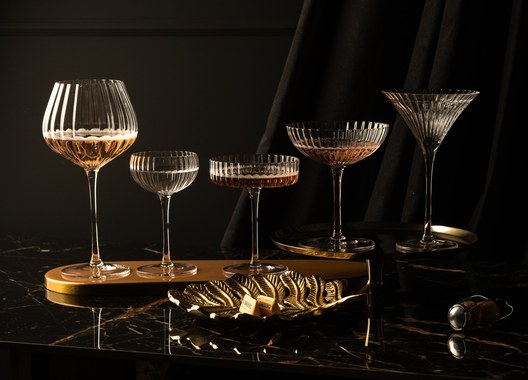
The V-glass is the Martini's signature – the silhouette IS the brand (see where it sits among the types of cocktail glasses). 5-8 oz is correct; the 10-12 oz fishbowls of the 1990s are why people remember warm Martinis. Our Modern Martini Glasses ($42.99 for a set of 4, 7 oz) hold a properly diluted 4 oz Martini at two-thirds full, exactly where the proportion looks right.
The bartender's alternative: a Nick & Nora ($39.99 for 4). Less spill, slower warming, and the deep bowl holds the gin's aromatics. The V-glass is theater; the N&N is engineering. Serious home bars keep both – our Martini & Manhattan collection covers the whole family.
Variations that earn their name
Dirty, Gibson, Vesper, Fifty-Fifty, and Vodka Martini are the five variations that earn the name.
- Dirty Martini – add 0.5 oz olive brine. Use good olives; the brine IS the drink.
- Gibson – swap the garnish for a cocktail onion. Same drink, different conversation.
- Vesper – 3 oz gin, 1 oz vodka, 0.5 oz Lillet Blanc, lemon twist. Shaken, per the book.
- Fifty-Fifty – equal parts gin and dry vermouth. The connoisseur's comeback order.
- Vodka Martini – swap the gin. Cleaner, quieter, and the reason the Espresso Martini could later borrow the name.
Quick history lesson
The Martini descends from the 1884 Martinez and dried into its modern form by 1922.
The Martini's parent is the Martinez – gin, sweet vermouth, maraschino, bitters, a gin-based cousin of the Manhattan – first printed in 1884 and served somewhere between San Francisco and the town of Martinez, California (both still claim it). As dry French vermouth replaced sweet Italian in the 1890s-1900s, the drink dried out and the name shortened. By 1922 the dry Martini was codified; by the 1950s it was the three-Martini lunch; by 1990 it had survived its own fishbowl era. The drink is around 140 years old and still settles arguments by existing.
Shop this guide
All 54 pieces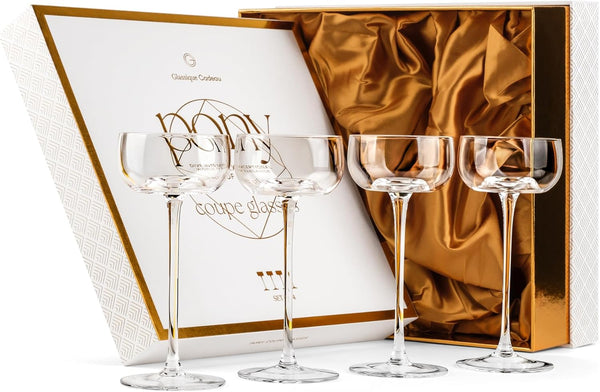
Gift Ready

New Arrival

Most Gifted
FAQ
What is the best Martini ratio?
5:1 – 2.5 oz gin to 0.5 oz dry vermouth – is the modern standard. Wetter (2.5:1) is friendlier; 50/50 is the aromatic sleeper pick.
Should a Martini be shaken or stirred?
Stirred, 30 seconds. Shaking clouds and thins it. The shaken order survives on Bond's charisma, not on taste.
Gin or vodka Martini?
Gin is the original and brings the botanicals. Vodka makes it a colder, cleaner canvas. Bars default to gin unless asked.
What glass do you serve a Martini in?
A chilled 5-8 oz V-glass, or a Nick & Nora if you prefer less spill and slower warming. Avoid oversized glasses – the drink warms before you finish.
Why is my Martini watery?
Over-stirring or wet ice. Use plenty of large, dry ice cubes and stop at 30 seconds.
What does 'dry' actually mean?
Less vermouth. An 'extra dry' Martini is mostly cold gin; a 'wet' one carries a full ounce of vermouth.
Pair with: martini glasses, Nick & Nora glasses, Martini & Manhattan glasses, coupe glasses, classic cocktail glasses, best sellers.
Every set ships in our signature gift box with the recipe printed on the lid. Free shipping over $89.
- Lead-free, hand-blown crystal
- 30-day satisfaction guarantee
- Arrives gift-ready in a satin-lined box


