
Recipes · 5 min read
How to Make a Manhattan: The 1880 Recipe That Never Needed Fixing
Rye, sweet vermouth, bitters – the 2:1 classic from 1880, stirred properly and served in the glass bartenders actually use.

 Arthur BulotaCo-founder & CEO, Glassique Cadeau
I ordered a Manhattan on a trip once and got something shaken, cloudy and warm, and I realized how rarely this simple drink is made with care. I want you to build one that a bartender from 1880 would recognize.
Email me if you have any questions: shop@glassiquecadeau.com. I answer every email personally.

Stirred, never shaken. Glass with weight.
The Manhattan is what happens when whiskey puts on evening wear. Three ingredients, one technique, zero room to hide. It predates the Martini, survived Prohibition, and remains the drink bartenders order to test another bartender. Here's the build.
TL;DR: Stir 2 oz rye, 1 oz sweet vermouth and 2 dashes Angostura with ice for 30 seconds. Strain up into a chilled Nick & Nora glass or coupe. Garnish with a brandied cherry. The 2:1 ratio is the spine – everything else is taste.
What you need
Two ounces of rye, one ounce of refrigerated sweet vermouth, two dashes Angostura, and a Luxardo cherry – nothing else.
- 2 oz rye whiskey – the original spirit. Rittenhouse 100 is the bartender's default; Wild Turkey 101 Rye if you want more muscle. Bourbon works (softer, sweeter), but rye is period-correct.
- 1 oz sweet vermouth – and here's the part nobody says loudly enough: the vermouth is half the drink's character. Carpano Antica makes a dessert of it, Dolin Rouge keeps it lean. Refrigerate the bottle after opening – vermouth is wine, and a Manhattan made with three-month-old counter vermouth is why people think they don't like Manhattans.
- 2 dashes Angostura bitters – non-negotiable.
- Brandied cherry – Luxardo or nothing. The neon-red dye bombs are for kids' sundaes.
The method
Chill the glass, stir all three ingredients 30 seconds, strain up, garnish with one brandied cherry.
- Chill the glass. Freezer, 5-10 minutes, while you work. A warm glass costs you 8-12°F of serving temperature.
- Combine. Rye, vermouth, bitters in a mixing glass. Fill two-thirds with ice.
- Stir 30 seconds. Smooth, quiet, around the wall of the glass. You want chill and roughly 25% dilution without aeration. Shaking a Manhattan clouds it and shreds the silk – this is the one rule with no exceptions.
- Strain up. Into the chilled glass. No ice in the serve.
- Garnish. One brandied cherry, dropped in. Some bartenders add a few drops of the cherry syrup. We won't tell.
The glass question
A Manhattan belongs in a chilled 4–5 oz Nick & Nora or coupe – never the giant martini V-glass.
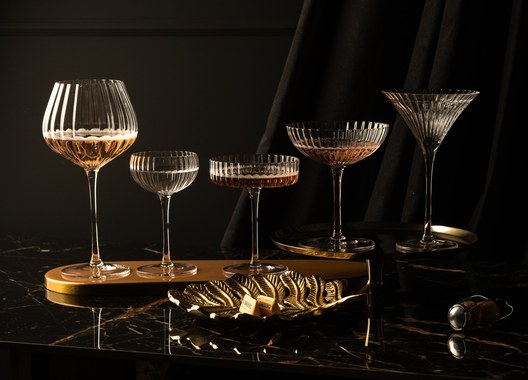
The Manhattan is a 4 oz serve once diluted – which is exactly why bartenders moved it into the Nick & Nora. The smaller bowl (4-5 oz) keeps the pour honest, the deep shape slows warming, and the narrow rim holds the vermouth aromatics where your nose is. Our Art Deco Nick & Nora ($49.99 for 4) is built for precisely this drink; the Retro Nick & Nora set of 6 runs under $10 a glass for dinner-party service. If you're weighing sets against each other, we ranked the best Nick and Nora glasses on bowl depth, rim, and balance.
A coupe works beautifully too – slightly wider, slightly showier – our coupe glasses guide makes the case. What doesn't work: the giant 10 oz martini V-glass, where a properly sized Manhattan looks lost and warms fast.
Ratios – the whole argument in one table
Start at 2:1 rye to sweet vermouth – the vermouth is the co-star, not a contaminant.
| Style | Rye | Vermouth | Character |
|---|---|---|---|
| Classic (ours) | 2 oz | 1 oz | Balanced, period-correct |
| Dry-leaning | 2.5 oz | 0.75 oz | Spirit-forward, modern bar default |
| Perfect Manhattan | 2 oz | 0.5 + 0.5 oz dry/sweet | Crisper, herbal |
Start at 2:1. Most bartenders would say the modern drift toward drier Manhattans lost something – the vermouth isn't a contaminant, it's the co-star.
Quick history lesson
The Manhattan dates to the Manhattan Club around 1880 – America's most-called cocktail by 1890.
The Manhattan Club, New York, around 1880 – that's the credible origin, per the club's own records. The romantic version (invented at a banquet Lady Randolph Churchill threw for Samuel Tilden in 1874) collapses on one fact: she was in England, pregnant with Winston, at the time. Bartenders kept the story anyway. Good stories pour drinks.
What's certain: by 1884 the recipe appears in print, by 1890 it's the most-called cocktail in America, and it crossed Prohibition intact because rye and vermouth hid a multitude of bathtub sins. The Old Fashioned is older; the Manhattan is the first cocktail with vermouth to conquer the world – the Martini followed its template, not the other way around.
Shop this guide
All 54 pieces
Perfect for Her

Most Gifted
Gift Ready
FAQ
What's the correct Manhattan ratio?
2:1 – 2 oz rye to 1 oz sweet vermouth, 2 dashes Angostura. Modern bars often pour 2.5:0.75 for a drier profile. Start classic, adjust from there.
Rye or bourbon in a Manhattan?
Rye is the original and gives the drink its spice backbone. Bourbon makes it rounder and sweeter. Both are correct; rye is more correct.
Should a Manhattan be shaken or stirred?
Stirred, 30 seconds. Shaking aerates and clouds it. Spirit-and-vermouth drinks are always stirred.
What glass does a Manhattan go in?
A Nick & Nora or a coupe, chilled, served up. The N&N's 4-5 oz capacity matches the drink's finished volume exactly.
Why does my Manhattan taste flat or sour?
Old vermouth, almost every time. Vermouth oxidizes like wine – refrigerate after opening and replace after 4-6 weeks.
What cherry goes in a Manhattan?
A brandied cherry – Luxardo is the standard. Skip the fluorescent maraschino.
Pair with: Nick & Nora glasses, Manhattan & Martini glasses, coupe glasses, whiskey glasses, anniversary gifts, best sellers.
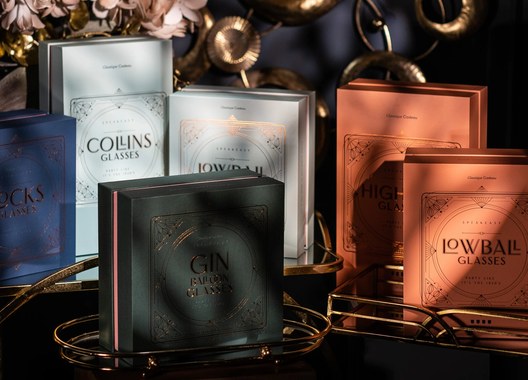
Every set ships in our signature gift box – the Manhattan recipe is printed right on the lid. Free shipping over $89.
- Lead-free, hand-blown crystal
- 30-day satisfaction guarantee
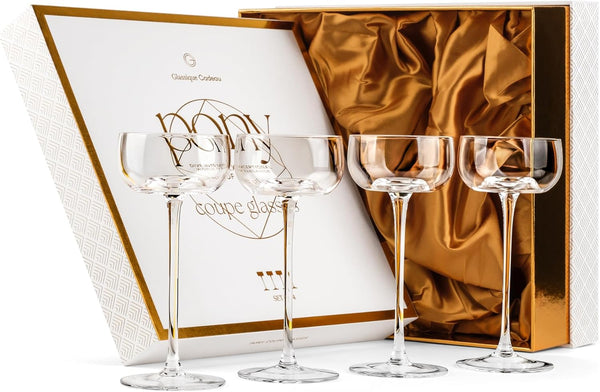
- Arrives gift-ready in a satin-lined box


