
Tips · 8 min read
How to Run a Whiskey Tasting at Home
Flight structure, tulip nosing copitas, the five-step tasting method, and a scoring sheet – a whiskey tasting you can host on a Tuesday.

 Arthur BulotaCo-founder & CEO, Glassique Cadeau
I wrote this because people kept asking me about how to run a whiskey tasting at home. Every glass we make is lead-free crystal, hand-blown and dishwasher-safe, 54 pieces in all.
Email me if you have any questions: shop@glassiquecadeau.com. I answer every email personally.
Three bottles, four copitas, one scoring sheet – and nobody says "smooth" all night.
A whiskey tasting at home beats most $90-a-ticket distillery events, because you control the pours, the pace, and the guest list. What it requires is structure. Random drams in random glasses is just drinking; a flight with a method is an education you can host on a Tuesday.
TL;DR: How to taste whiskey, short version: 0.75-1 oz pours in tulip-shaped nosing glasses, three to five whiskeys arranged light to heavy, nose with your mouth open, ignore the first sip, chew the second, then score nose, palate, and finish. Glass logic is covered in our glass shape and taste guide; this is the full run of show.
| Item | Quantity | Note |
|---|---|---|
| Whiskeys | 3 to 5, arranged light to heavy | Peated or cask strength always last |
| Pour size | 0.75-1 oz per whiskey | A four-pour flight totals about one standard drink and a half |
| Copitas | 24 for six guests | One glass per whiskey per guest, or rinse between rounds |
| Water carafes | 1 per three guests | Drops in the glass, glassfuls between pours |
| Palate resets | Plain crackers or baguette | No blue cheese mid-flight – it bulldozes everything |
| Timing | 15 minutes per whiskey | An hour for four, then one closing cocktail |
The Glass Does Half the Work
Use a tulip-shaped copita – the narrowing rim stacks aromas into a column, and the nose does half the tasting.
Whiskey tasting runs on the nose, and the nose needs a tulip. A bowl that narrows toward the rim stacks the aromas into a column instead of spilling them sideways – which is why every distillery lab pours into some version of the copita, and why the Glencairn glass conquered the industry within years of its 2001 debut.
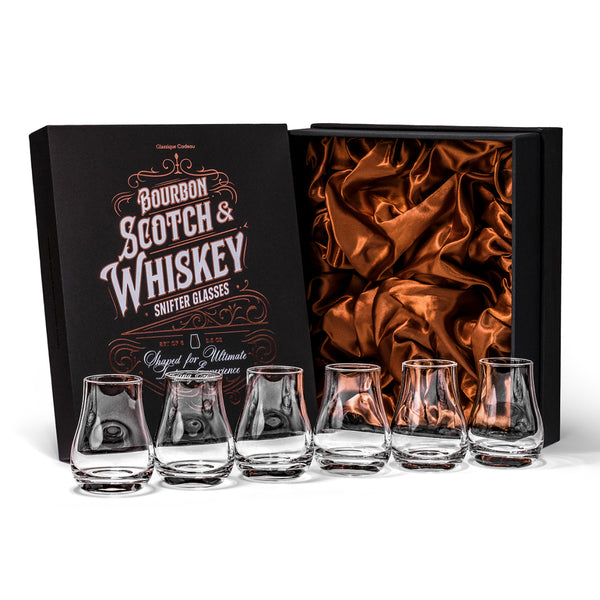
Our version of the lab glass: the Whiskey Tasting set – 4 oz tulip copitas, $46.99 for four, stemmed so hands stay off the bowl. The Cognac Copita set ($59.99) runs the same profile with a longer stem and moonlights for brandy night. If your table fears stemware, the stemless tasting set ($49.99) keeps the tulip where it counts. All three live in the tasting collection.
One glass per whiskey per guest if you can manage it. Side-by-side comparison is the entire advantage of a flight – re-using one glass smears bourbon three into bourbon four.
Build the Flight: Three to Five Pours
Three to five pours of 0.75-1 oz, arranged light to heavy, with peated or cask strength always last.
Five is the ceiling. Past that, palates file for overtime. The classic beginner structure:
- Pour 1 – the gentle opener: an Irish blend or a lighter bourbon, 80-90 proof.
- Pour 2 – the benchmark: a standard bourbon or Speyside scotch. This is the reference point everything else argues with.
- Pour 3 – the pivot: a rye or a sherry-cask scotch; something structurally different.
- Pour 4 – the heavyweight: cask strength or peated. Always last; smoke and high proof flatten everything after them.
Pours are 0.75 to 1 oz each – a four-whiskey flight totals about one standard drink and a half, which keeps the analysis sharper than the guests. Theme flights work once the format does: four bourbons by age, four regions of Scotland, one whiskey at four proofs. (Bourbon, by the way, has been legally "a distinctive product of the United States" since Congress said so in 1964 – a fine piece of trivia for pour two.)
How to Taste Whiskey: The Five Steps
Look, nose with your mouth open, ignore the first sip, chew the second, then judge the finish.
- Look. Tilt the glass against something white. Color hints at cask and age – pale straw says ex-bourbon barrels, deep amber says sherry wood or years. Watch the legs streak the glass; slow, fat legs suggest texture to come.
- Nose, mouth open. Start the glass at your chest and raise it slowly. Mouth slightly open so the ethanol has an exit. Three short sniffs beat one deep one – shove your nose in and inhale hard and you'll smell nothing but burn for five minutes.
- First sip: ignore it. A small sip, swallowed without judgment. It's a palate calibration, all ethanol shock. Every verdict formed on a first sip is wrong, including the good ones.
- Second sip: chew. A modest mouthful, rolled and lightly chewed for five to ten seconds so it touches every region of the tongue. Now ask three questions: what flavors (vanilla, dried fruit, oak, smoke)? What texture (silky, oily, thin)? Where does it sit (front of tongue, cheeks, back of throat)?
- The finish. Swallow and wait. Count what lingers and how it changes. A finish that evolves – caramel into spice into faint smoke – is the signature of whiskey worth writing down.
Water Is the Only Approved Additive
A few drops of room-temperature water after the first pass – never ice, which mutes the aromatics you came for.
A few drops of room-temperature water per pour, after the first full pass. Lowering the proof a few points unlocks esters you couldn't smell at 50 percent ABV – distillers do this professionally at much lower strengths. Use a straw or spoon to dose it; a heavy splash drowns the patient. Ice is for the after-party Old Fashioned, not the flight – cold mutes exactly the aromatics you assembled everyone to find. The deeper methodology rabbit hole lives at Wikipedia's whisky tasting entry; the version above is what works at a dining table.
The Scoring Sheet
Grid of nose, palate, finish, score out of 10, one-word verdict – and the word "smooth" is banned.
Print a grid: whiskey name, nose, palate, finish, score out of 10, one-word verdict. The one-word column is secretly the best part – "campfire," "flan," "regret" – and becomes the night's transcript. Ban the word "smooth"; it's the "nice" of whiskey vocabulary and tells you nothing.
Scores earn their keep on the reveal. Run the last flight blind – pour while guests are in the other room, foil-wrap the bottles, number the glasses. Watch the $30 bottle outscore the $90 one at least once a year. That result alone pays for the evening.
Host Logistics for Six Guests
Six guests need 24 copitas, water carafes, plain crackers, and 15 minutes per whiskey – an hour for four.
Glass math: six guests × four pours = 24 copitas, or one tasting set per guest pair if you rinse between rounds. Add water carafes (one per three guests), a dump bucket nobody mocks, and plain crackers or baguette – no blue cheese mid-flight, it bulldozes everything. Pour all of round one before anyone noses; synchronized tasting keeps the table comparing the same thing.
Time it: 15 minutes per whiskey, an hour for four. End with one cocktail as a closing number – an Old Fashioned in a proper lowball glass sends people home on a high note. If the group skews scotch-neat, our whiskey and neat-spirit glasses cover the after-hours pours.
Five Mistakes That Ruin a Flight
No perfume, no swirling, no chilled glasses, no heavy pours, and notes written before anyone speaks.
Perfume and scented candles. The nose does 80 percent of the work tonight; don't make it compete with a pumpkin-spice three-wick. Unscented table, unscented hands.
Swirling like it's Bordeaux. Wine swirling aerates; whiskey swirling weaponizes ethanol. A gentle tilt-and-roll coats the glass plenty.
Chilled glasses, chilled whiskey. Room temperature, always. Cold locks the esters in the liquid where your nose can't reach them.
Heavy pours out of generosity. A 2 oz pour times four whiskeys is a different kind of evening. Hospitality is the second bottle next week, not a double tonight.
Letting the loudest palate lead. Have everyone write notes before anyone speaks. The first confident "I get cherry" plants cherry in six brains – anchoring works on whiskey exactly the way it works everywhere else.
Shop this guide
All 54 pieces
Perfect for Him
Gift Ready

Gift Ready
How to Taste Whiskey: FAQ
What is the proper way to taste whisky?
Small pour in a tulip glass, nose with mouth slightly open, take a throwaway first sip, then chew a second sip across the whole tongue before judging the finish. No swirling, no ice during analysis, water in drops only.
What is the 3 finger rule for alcohol?
An informal pour measure: one finger against a standard rocks glass equals roughly 1 oz, so three fingers is about a 3 oz pour. For tastings, stay near one finger – 0.75 to 1 oz per whiskey.
Why can't I taste whisky?
Usually palate fatigue, a dry mouth, or nosing too aggressively. Drink water between pours, keep sips modest, and let high-proof drams sit a few minutes. If everything reads as "burn," add a few drops of water and retry – proof masks flavor.
What glass is best for tasting whiskey?
A tulip-shaped nosing glass – a copita or Glencairn-style bowl that narrows at the rim to concentrate aroma. A 4 oz stemmed copita keeps hands off the bowl and the column of scent aimed at your nose.
How much whiskey do you pour for a tasting?
0.75 to 1 oz per pour. A four-whiskey flight totals three to four ounces – about a drink and a half – which is the difference between a tasting and a Tuesday you regret.
How many whiskeys should be in a flight?
Three to five, arranged light to heavy with anything peated or cask-strength dead last. Four is the sweet spot: enough contrast to learn from, few enough that the last one still gets a fair hearing.
Pair with: tasting glasses, whiskey glasses, snifters, lowball glasses, his birthday gifts, and the classics collection.
Flight built, sheet printed, "smooth" banned. Every Glassique Cadeau set arrives in a satin-lined gift box with a cocktail recipe printed on the lid – and orders over $89 ship free.
- Lead-free, hand-blown crystal
- 30-day satisfaction guarantee
- Arrives gift-ready in a satin-lined box


