
Tips · 8 min read
Why Glass Shape Changes How a Drink Tastes
Aroma physics, temperature, rim feel, and honest psychology – the four ways a glass changes what you taste, and the limits of each.

 Arthur BulotaCo-founder & CEO, Glassique Cadeau
At every dinner party someone says the glass does not matter, and someone else insists it transforms everything, and I found both were wrong in interesting ways. I want you to know which effects are physics, which are perception, and why both count.
Email me if you have any questions: shop@glassiquecadeau.com. I answer every email personally.

Part physics, part psychology, zero snobbery – here's what the glass actually does.
Somebody at every dinner party says the glass doesn't matter. Somebody else paid $40 a stem and insists it transforms everything. Both are wrong in interesting ways, and the research is better than either of them thinks.
TL;DR: Does glass shape affect taste? Yes – through four mechanisms: aroma concentration (real physics), temperature control (real physics), rim and lip feel (part physics, mostly perception), and psychology (real, measurable, and nothing to be embarrassed about). Shape-by-shape applications live in our guide to cocktail glass types.
| Mechanism | What the glass does | Physics or perception? |
|---|---|---|
| Aroma concentration | Bowl geometry rearranges what reaches your nose – tapered bowls funnel vapor, wide tumblers scatter it | Real physics |
| Temperature control | Stems keep a 98.6°F hand off the drink; cold sharpens bitterness, warmth mutes it | Real physics |
| Rim and lip feel | A thin rim places liquid on the palate cleanly; the rest signals quality | Part physics, mostly perception |
| Psychology | Weight, look, and expectation shift how the same drink rates – measurably | Perception, and it still counts |
The Short Answer: Yes, Four Ways
Glass shape changes taste through four levers – aroma, temperature, rim placement, and psychology – two physics, one mixed, one perception.
Most of what you "taste" is smell. The tongue handles five crude signals; the nose handles thousands. So anything that changes what reaches your nose changes the drink – and glass geometry does exactly that. Then temperature shifts how sweetness and alcohol read, the rim decides where liquid lands first, and your brain quietly adjusts everything based on what the glass promises. Four levers. Two are physics, one is half-and-half, one is pure psychology. All four are real.
Aroma: The Bowl Is a Chimney
Tapered bowls funnel a ring of aroma vapor to the rim; straight tumblers scatter it – geometry rearranges what you smell.
In 2015, a Japanese research team imaged alcohol vapor rising from glasses with a camera system built for the job. The finding was lovely: a wine glass at cellar temperature forms a ring of ethanol vapor around the rim with a pocket of lower concentration in the center – so your nose reads fruit and botanicals instead of raw alcohol burn. A straight tumbler produces no such ring. The geometry literally rearranges what you smell.
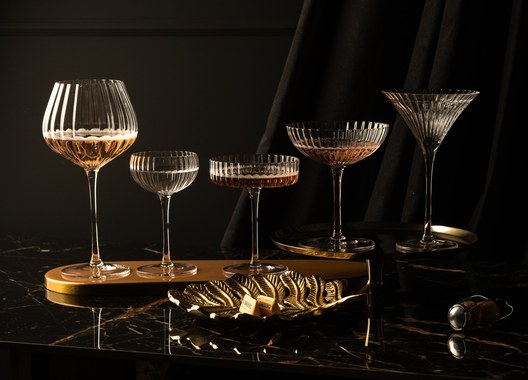
This is why tasting glasses taper. A tulip-shaped copita (4 oz, $59.99 for four) narrows from bowl to rim, funneling vapor into a column. A 15 oz snifter does the same trick with more air in the chamber. And the giant Copa de Balón bowl exists to trap juniper aromatics above a gin and tonic. Spirits houses have engineered around this for centuries – Riedel has been shaping glass since 1756 and built an empire on the principle.
Worth saying: the effect is strongest for aromatic spirits and stirred drinks, weakest for anything drowned in soda. Nobody's copita is rescuing a vodka Red Bull.
Temperature: Stems Exist for Your Hands
Stems keep your 98.6°F hand off the drink, so a 28°F martini uses all 15 of its cold minutes.
A hand wrapped around a bowl is a 98.6°F radiator. That's the entire case for stems. A martini leaves the mixing glass at roughly 28°F (brine and dilution push it below water's freezing point), and it has maybe 15 good minutes before warmth flattens it. Held by the stem in a 5 oz Nick & Nora ($39.99 for four), it uses all 15. Cupped in a tumbler, it loses half of them.
Size matters the same way. Cold sharpens bitterness and mutes sweetness; warmth does the reverse – which is why the last third of an oversized drink tastes like a different, sadder recipe. Smaller bowls from our coupe collection finish cold. The thick base of a lowball, meanwhile, is deliberate thermal ballast: it sits in your palm so the ice does its slow work up top.
The Rim: What Lip Thickness Actually Does
A thin rim places liquid on the palate cleanly; the rest of its effect is quality perception – which still counts.
A thin rim places liquid on your palate cleanly; a thick rolled edge makes you purse and sip, changing the entry point and the first half-second of flavor. That part is mechanics. The rest is perception – and we'll be straight with you: a thin rim mostly signals quality the way crisp bedsheets signal a good hotel. Blind, you might not score it. Holding it, you absolutely will.
Here's our take: that still counts. You drink with your hands and eyes attached, and hand-blown, lead-free crystal with a fine rim is part of why the first sip of a Manhattan lands the way it does. Just don't let anyone tell you the rim rewrote the recipe.
The Psychology: Measured, Real, and Slightly Embarrassing
Expectation is a real ingredient – heavier, better-looking glasses measurably raise ratings, and part of the effect fades when tasters go blind.
The honest section. In 2003, smell researcher Thomas Hummel tested wine across differently shaped glasses with 181 volunteers. Ratings shifted with the glass – but the differences shrank when tasters couldn't see what they were holding. Translation: part of the effect lives in the glass, and part lives in you.
Oxford's crossmodal research group has spent two decades documenting the "in you" part: heavier glassware makes drinks rate as higher quality, the same whisky reads differently by vessel, and color and weight shift perceived intensity. None of this is fraud. Expectation is a real ingredient in flavor – the brain blends prediction with sensation and serves you the mixture. A 1934-style coupe doesn't change the daiquiri's chemistry; it changes the drinker. The drinker is the one tasting.
What This Means for Your Cabinet
Match shape to drink – tapered bowls for neat spirits, small stems for stirred cocktails, columns for bubbles, wide bowls for G&Ts.
Apply the four levers and the buying logic writes itself:
- Aromatic spirits neat – tapered bowls: copitas and snifters from the tasting collection or whiskey glasses.
- Stirred, spirit-forward cocktails – small stemmed bowls, 5-8 oz: Nick & Noras, coupes from the Nick & Nora collection.
- Carbonated drinks – narrow columns that protect bubbles: highballs, flutes.
- Gin and tonics, spritzes – wide trapping bowls from the gin balloon collection.
- Whiskey over ice – heavy-bottomed lowballs; thermal mass below, aroma above. Pour an Old Fashioned and test the claim yourself.
One drink, two glasses, side by side. It's a 10-minute experiment and you'll never need convincing again.
Run the Two-Glass Test Yourself
Split one Manhattan between a Nick & Nora and a kitchen tumbler, then nose and sip both – the difference proves itself.
Don't take a glassware company's word for any of this. Build one drink, split it, and taste:
- Stir 4 oz of Manhattan (2 oz rye, 1 oz sweet vermouth, 2 dashes bitters, scaled up) and divide it between a 5 oz Nick & Nora and a kitchen tumbler.
- Nose both before sipping. The stemmed bowl should read as cherry and baking spice; the tumbler mostly as "whiskey."
- Sip both at the start, then again at the 10-minute mark. The tumbler version, warmed by your hand, will have gone flat and hot first.
- Optional, for the skeptics: have someone hand them to you with your eyes closed. The aroma gap survives the blindfold; some of the "feels nicer" gap won't.
That last result is the whole article in miniature. Physics carries part of the load, perception carries the rest, and your Manhattan doesn't care which department gets credit.
The Honest Limits
Glass is a multiplier, not a rescue – get the drink right first, then the right shape adds roughly 10 percent.
Glass shape will not fix bottled sour mix, warm gin, or a 9:1 martini made with good intentions. It's a multiplier, not a rescue. Get the drink right first – fresh citrus, real measurements, proper ice – and then the right glass makes a correct drink noticeably better. Roughly 10 percent better by feel, which happens to be the gap between "fine" and "make me another."
The wine glass took its modern stemmed form over centuries of trial and error. The trial and error is done. You just have to match the shape to the drink.
Shop this guide
All 54 pieces
Most Gifted
Gift Ready

Perfect for Him
Does Glass Shape Affect Taste: FAQ
Does the shape of a glass change the taste?
Yes. Shape controls aroma concentration (most of flavor is smell), temperature retention, and where liquid first hits your palate. Add measurable psychological effects from weight and look, and the same drink genuinely reads differently by glass.
Does wine glass shape actually matter?
Yes, with caveats. Vapor-imaging research shows bowls concentrate aroma at the rim, and a 2003 study found ratings shift by glass – though part of the effect fades blind. Physics does some work, expectation does the rest.
What is the 30 minute rule for wine?
"Thirty in or thirty out": red at room temperature goes into the fridge 30 minutes before serving; white at fridge temperature comes out 30 minutes before. Both land near their proper serving range.
Is it healthier to drink out of glass or stainless steel?
Both are food-safe; glass wins on taste. It's chemically inert, so nothing reacts and nothing carries over. Steel can lend a faint metallic edge to acidic drinks like citrus cocktails – fine for camping, wrong for a daiquiri.
Why do wine glasses have stems?
To keep your hand off the bowl. A palm warms wine measurably within minutes, and a stem also keeps fingerprints off the glass where aromas gather. Same logic applies to coupes, Nick & Noras, and martini glasses.
Do thin-rimmed glasses really feel better to drink from?
They deliver liquid more cleanly and signal quality your brain folds into the flavor. Blind, the difference shrinks; in hand, it's consistent. Since you never drink blindfolded, buy the rim you enjoy.
Pair with: tasting glasses, snifters, coupe glasses, Nick & Nora glasses, whiskey glasses, and copa de balón glasses.
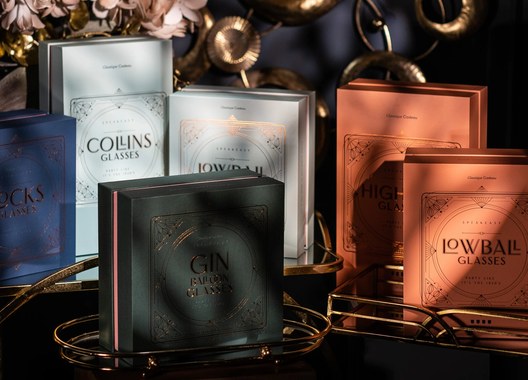
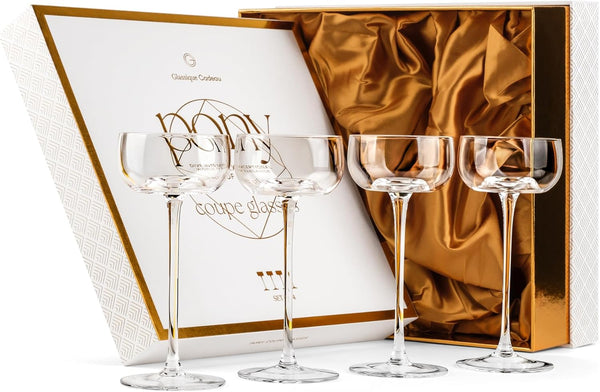
Run the two-glass experiment this weekend. Every Glassique Cadeau set arrives in a satin-lined gift box with a cocktail recipe printed on the lid – and orders over $89 ship free.
- Lead-free, hand-blown crystal
- 30-day satisfaction guarantee
- Arrives gift-ready in a satin-lined box


