
Tips · 9 min read
Roaring 20s Party Decorations & Ideas: The Stylish Host's Guide
A host's guide to roaring 20s party decorations, a period-correct 1920s cocktail menu, and the Art Deco glassware that turns a costume night into genuine Gatsby-era glamour.

 Arthur BulotaCo-founder & CEO, Glassique Cadeau
Feathers and gold are easy, but a room that actually feels like 1925 takes a little more thought. I want you to understand which details make the difference, so guests photograph the room all night instead of the beads.
If you have any questions, feel free to email me shop@glassiquecadeau.com

Feathers and gold are easy. A room that actually feels like 1925 takes a little more.
Everyone throws the same 1920s theme party. Dollar-store beads, a feather headband, a Spotify playlist, done. It reads as a costume. Honestly, the gap between that and a room your guests photograph all night comes down to a few deliberate choices – and most of them are cheaper than you'd think.
The decade earned its glamour the hard way. US Prohibition ran from 1920 to 1933, which meant the good parties went underground, behind unmarked doors, into candlelit speakeasies where a cocktail arrived in real glass because nobody was serving anything in a plastic cup. That's the mood you're chasing. Not a theme. A feeling.
What made roaring 20s party decorations actually work
Art Deco was the visual language of the age, and it has rules. Symmetry. Bold geometry. Metallics against deep, saturated tone. Get those three right and almost everything else falls into place.
Your palette should stay tight. Black, cream, and gold – with one jewel accent (emerald, sapphire, or oxblood) if you want depth. The moment you add four more colors, the room drifts toward carnival. Deco never drifted.
Patterns matter more than props. Sunbursts, chevrons, fan shapes, stepped ziggurat edges – these are the shapes that say 1925 without a single cardboard cutout. You'll find them echoed across our Art Deco & Gatsby collection, where the etched geometry on the glass does the same design work as the wallpaper behind it.
- Walls & backdrops: gold fringe curtains, a large sunburst mirror, or a black-and-gold geometric photo backdrop.
- Lighting: warm string lights, tea lights in gold holders, and one statement lamp. Kill the overheads entirely.
- Tabletop: black linen, gold chargers, a low feather-and-candle centerpiece (keep it below eye level so people can talk across it).
- Small touches: vintage playing cards, an old typewriter, faux pearls draped over a tray, a stack of jazz records as a prop.
Best for: hosts who want the room to look intentional in photos, not just busy.
The decorations checklist
✓ Warm string lights + tea candles (overheads switched off)
✓ One statement backdrop: sunburst mirror or black-and-gold geometric panel
✓ Black linen + gold chargers on the table
✓ Low feather-and-candle centerpiece (below eye level)
✓ Real crystal glassware at the bar – the one decoration guests hold
✓ Small props: playing cards, faux pearls, jazz records, a typewriter
✓ A tight three-colour palette – black, cream, gold, one jewel accent
Authentic Deco vs. cheap costume kit
Here's the honest distinction. Costume-party 1920s party decorations shout. Authentic Deco whispers, then lets the details reward a closer look.
The plastic kit gives you flimsy tinsel garlands, foil fringe that curls in an hour, and glittery gold that photographs orange. It's fine for a college night. It won't fool anyone over thirty.
| Element | Do this | Not that |
|---|---|---|
| Glassware | Real crystal coupes & lowballs | Acrylic cups, plastic flutes |
| Fringe & fabric | Real linen, one brass candlestick | Foil fringe, tinsel garlands |
| Lighting | Warm string lights, candles | Bright overheads left on |
| Palette | Black, cream, gold + 1 jewel | Five loud carnival colours |
| Object count | Fewer objects, better ones | Ten cheap plastic props |
Authentic Deco spends its budget differently. Fewer objects, better ones. A single heavy brass candlestick beats ten plastic ones. Real linen beats a printed tablecloth. And crystal glassware – the thing every guest actually touches – beats acrylic every single time. In our view, that's the highest-leverage swap you can make, because it's the one decoration that also does a job.
"Costume-party decorations shout. Authentic Deco whispers, then lets the details reward a closer look."
The glassware that upgrades the whole tablescape
Think about where your guests' eyes land. The bar. The drink in their hand. The table they set the glass down on. Three touchpoints, and glassware owns all three.

The coupe is the signature shape of the era. That wide, shallow bowl traces back to around 1663 in England – and no, it was not molded from Marie Antoinette's breast (she wasn't born until 1755, so the timeline alone kills the legend). It's a charming myth, nothing more. A coupe holds roughly 5 to 7 oz, which is perfect for a champagne pour or a stirred cocktail served up. Our 6 oz Art Deco coupe set handles both without missing a beat, and the full coupe glasses collection gives you room to mix styles.
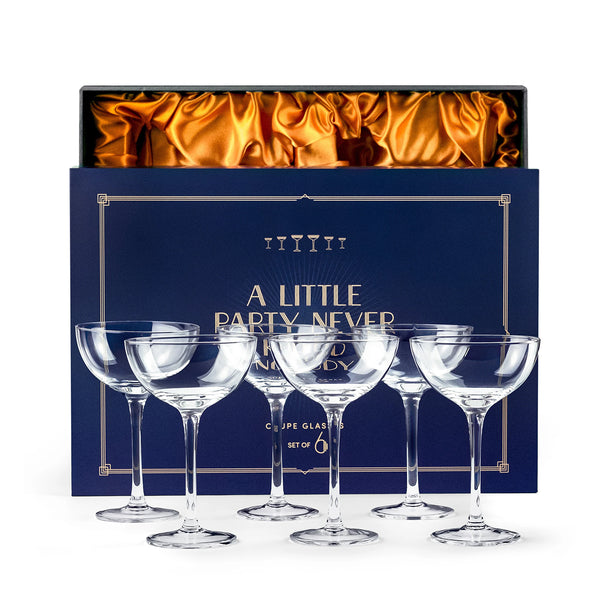
For the purist, there's the Nick & Nora. Named for Nick and Nora Charles, the martini-drinking couple from The Thin Man (1934), this stemmed 5 oz glass is tulip-shaped, elegant, and far more spill-proof than a classic martini. It signals that you know your history. Reach for the Nick & Nora coupe set and watch the cocktail nerds notice.
Then the workhorses. A lowball (roughly 9 oz) for anything on the rocks – an Old Fashioned, a whiskey neat, a Negroni. A highball (10 to 12 oz) for the long, fizzy pours. The Gatsby lowball set and the 1920s highball set cover the two ends of the bar. Browse the wider lowball collection if you want to build a matched flight.
Best for: the host who wants one decoration that guests can hold, admire, and drink from. Explore the full Art Deco cocktail glasses range to anchor the bar.
A period-correct 1920s cocktail menu
Serve drinks the decade actually drank. Speakeasy bartenders leaned on citrus, gin, and bubbles – partly for taste, partly to mask rough bootleg spirits. Keep the list short. Four cocktails, done well, beats a sprawling bar nobody finishes.
Four Cocktails, Done Well
French 75gin · lemon · champagne
Bee's Kneesgin · lemon · honey
Sidecarcognac · orange · lemon
Old Fashionedbourbon · sugar · bitters
- French 75 – gin, lemon, sugar, topped with champagne. Serve in a coupe. Bright, dangerous, elegant.
- Bee's Knees – gin, lemon, honey syrup. A Prohibition classic invented to hide bathtub gin. Coupe or Nick & Nora.
- Sidecar – cognac, orange liqueur, lemon. Sugar the rim. Coupe.
- Old Fashioned – bourbon, sugar, bitters, one big cube. Lowball, always.
Add a zero-proof option (a sparkling elderflower and lemon works beautifully in a highball), and you've covered every guest. For a champagne-forward table, the champagne coupe collection or a set of six vintage coupes keeps the pour flowing. Want gin front and center? The gin balloon glasses turn a simple G&T into the centerpiece.
Food, dress, and the playlist
Food should be finger-first. This was the age of the passed tray. Deviled eggs, oysters on ice, canapés, a cheese board, small skewers – anything a guest can eat with a drink in the other hand. Skip the sit-down dinner. It kills the mingling.
For dress, give guests a lane. Women: drop-waist flapper dresses, fringe, long pearls, T-strap heels, a feathered headband. Men: waistcoats, suspenders, bow ties, a fedora or newsboy cap. You don't need period-accurate tailoring. You need the silhouette. Put the dress code on the invite so nobody arrives in jeans.
The playlist is your undertow. Louis Armstrong, Duke Ellington, Bessie Smith, and Django Reinhardt for the real thing – or the Great Gatsby soundtracks if you want a modern edge. The novel landed in 1925; Baz Luhrmann's film arrived in 2013 (there was an earlier 1974 version with Robert Redford, for the deep cuts). Either film's score sets the mood in seconds.
How to host a roaring 20s party, step by step
- Set the palette (2 weeks out). Lock black, gold, and cream. Order linens and one statement backdrop.
- Stock the bar (1 week out). Gin, bourbon, cognac, champagne, citrus, honey. Pull your coupes, lowballs, and highballs from the martini and cocktail glassware shelves and wash them.
- Prep the food (day before). Anything that can be made ahead, make ahead. Deviled eggs, syrups, garnishes.
- Light it low (1 hour before). Overheads off. String lights and candles on. Test the room from the doorway.
- Pour with intention. Match each drink to its glass. That's the detail guests remember.
Best for: first-time hosts who want a calm timeline instead of a last-minute scramble. For the whiskey crowd, keep a snifter or two on hand for anyone who wants a cognac neat.
Shop this guide
All 47 pieces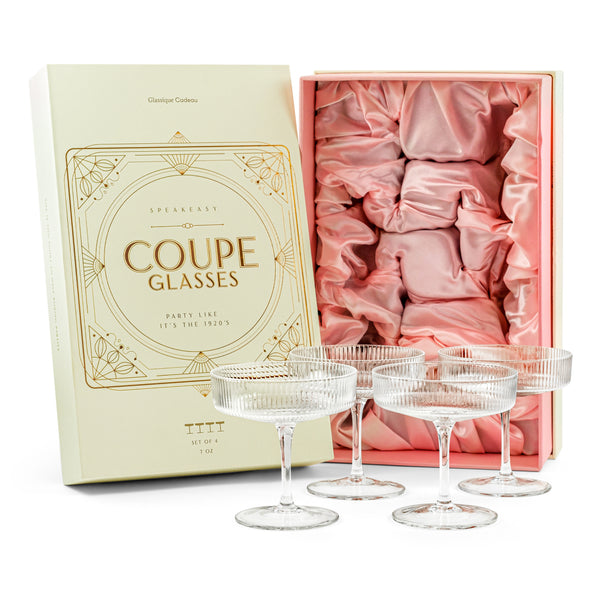
Bestseller

Perfect for Her

Limited Edition
Bestseller
Frequently asked questions
What are the best roaring 20s party decorations on a budget?
Spend on lighting and glassware, save on the rest. Warm string lights, tea candles, and one gold sunburst backdrop cost little and transform a room. Real crystal glasses are the one decoration guests hold all night, so prioritize those over disposable props.
What colors define a 1920s theme party?
Black, cream, and gold form the core Art Deco palette, with one jewel accent like emerald or sapphire for depth. Keep the scheme tight – too many colors pull the room toward carnival and away from Deco elegance.
What cocktails should I serve at a roaring 20s party?
Period-correct classics: the French 75, Bee's Knees, Sidecar, and Old Fashioned. All lean on gin, citrus, and champagne, which is exactly what speakeasy bars poured during Prohibition (1920–1933). Serve the stirred and shaken drinks in coupes, the spirit-forward ones in lowballs.
What glasses did they use in the 1920s?
The coupe was the signature glass, holding about 5 to 7 oz. The Nick & Nora (5 oz) came slightly later, named for the couple in The Thin Man (1934). Lowballs (around 9 oz) and highballs (10 to 12 oz) covered spirits and long drinks.
Is the coupe glass really shaped after Marie Antoinette?
No – it's a myth. The coupe traces to around 1663 in England, nearly a century before Marie Antoinette was born in 1755. The origin story is charming but historically impossible. The shape was designed for sparkling wine, nothing more.
How do I make my party look authentic and not costume-y?
Choose fewer, better objects. Swap plastic props for real linen, brass candlesticks, and crystal glassware. Keep the palette to three colors, kill the overhead lighting, and let genuine Art Deco geometry do the talking instead of glittery foil.
What should guests wear to a 1920s theme party?
Women: drop-waist flapper dresses, fringe, long pearls, and feathered headbands. Men: waistcoats, suspenders, bow ties, and a fedora or newsboy cap. Focus on the silhouette rather than perfect period tailoring, and put the dress code on the invite.
Pair with: Anchor the whole night with our Art Deco & Gatsby collection. Start with the 6 oz Art Deco coupes for champagne and stirred cocktails, add the 9 oz speakeasy lowballs for spirits on the rocks, and round out the bar with the 1920s highballs for the long, fizzy pours. That's a tablescape guests photograph – and remember.
- Lead-free, hand-blown crystal
- 30-day satisfaction guarantee
- Arrives gift-ready in a satin-lined box


