
Tips · 8 min read
Espresso Martini Glasses: What the Foam Actually Requires
Which glass an espresso martini belongs in – coupe, V-glass, or Nick & Nora – and why the crema layer decides. Sizes, chilling, and the picks.

 Arthur BulotaCo-founder & CEO, Glassique Cadeau
The crema is the whole show in an Espresso Martini, and I watched too many oversized or stemless glasses break it. I want you to know what the foam actually requires from a glass, and chill it hard.
Email me if you have any questions: shop@glassiquecadeau.com. I answer every email personally.

The drink is theater. The glass is the stage.
TL;DR: An espresso martini belongs in a 5–7 oz stemmed glass – a coupe or a classic V-shaped martini glass – chilled hard. The drink is about 4.5 oz after the shake, and the signature crema layer needs a still, open surface to settle on. Oversized glasses break the foam. Stemless glasses warm the drink.
| Attribute | Spec |
|---|---|
| Capacity | 5–7 oz; 6–7 oz is the sweet spot |
| Designed pour | About 4.5 oz after the shake – 2 oz vodka, 1 oz espresso, 0.5 oz coffee liqueur, 0.25 oz syrup |
| Shape | Coupe or V-shaped martini glass – a still, open surface for the crema |
| Stem | Required – the drink has no ice to defend its temperature |
| Prep | Freezer-chilled, 10 minutes minimum |
| Best for | Espresso Martini, Pornstar Martini, Grasshopper, foam-cap shaken drinks |
| Era/origin | Drink invented 1983 by Dick Bradsell, Soho Brasserie, London |
The espresso martini was invented in 1983 by Dick Bradsell at the Soho Brasserie in London, allegedly after a model asked for something to "wake me up". Forty years later it's the drink that dragged the stemmed cocktail glass back into every bar in the world. But the glass question – coupe or cone – actually has an answer, and it comes down to the foam.
Why the glass matters more for this drink than most
The crema is judged on sight and needs a still, open surface plus a freezer-cold glass to survive.
An espresso martini is judged in the first three seconds, on sight. The test is the crema: a dense, caramel-colored foam cap produced by a hard 15-second shake with fresh espresso. That layer needs two things from a glass.
A still surface. The foam settles as the drink stands, so a glass with a wide, open bowl lets the crema spread evenly and hold. Narrow glasses squeeze it into a thick plug; oversized bowls stretch it until it tears.
And cold. The drink leaves the shaker around 25°F after dilution. Espresso is brewed at 200°F. The shake wins that fight, but only barely – which is why the glass must come out of the freezer, not off the shelf. A warm glass costs you the temperature contrast that makes the drink feel sharp instead of syrupy.
What actually kills the crema
Stale coffee, cold brew, a slow shake, and a wet glass are the four crema killers – in that order.
The foam is not decoration and it is not luck. It's emulsified coffee oil and dissolved CO2, and four things destroy it.
Stale beans. Crema depends on carbon dioxide trapped during roasting, and beans off-gas steadily. Coffee roasted more than about four weeks ago produces a visibly thinner cap – the same shot, the same shake, half the foam. Beans between five days and three weeks post-roast are the window.
Cold brew. The most common substitution and the worst one. Cold brew is extracted without pressure, so it carries almost none of the dissolved gas and emulsified oil that build a crema. It makes a perfectly nice coffee cocktail with a flat, brown surface. If espresso is genuinely unavailable, moka-pot coffee foams better than cold brew.
A polite shake. Twelve to fifteen seconds, hard enough that the tin frosts and hurts a little. A gentle shake aerates too little to emulsify the oils, and the cap collapses inside a minute.
A wet glass. Residual water from rinsing thins the foam where it touches the wall and the disc tears at the edges. If you chill with ice and water rather than in the freezer, dump it and pour immediately – don't wipe, don't let it sit.
Get those four right and the crema holds for roughly five minutes, which is about as long as the drink survives anyway.
Coupe vs V-glass vs Nick & Nora for an espresso martini
All three work – the coupe is the modern default, the V-glass is the dramatic original, the Nick & Nora holds foam longest.
All three work. They give different results.
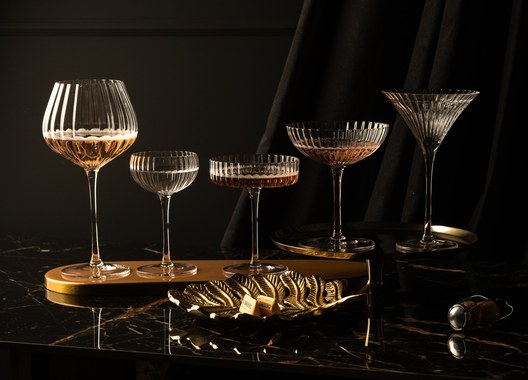
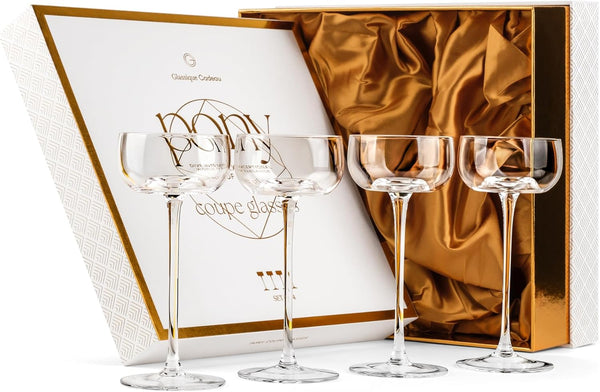
The coupe is the modern bartender's default. A 6–7 oz coupe takes the full 4.5 oz drink with room for the foam, the rounded bowl settles the crema into a perfect disc, and it's the glass you see in nearly every bar photo since the drink's revival. Our Paris Coupe – 8 oz, clean-lined, no ornament – is the one we'd pick for it.
The classic V-shaped martini glass is the original spec – it's in the name. (We unpacked the V-glass fully – shape, size, history – in our martini glass guide.) The cone shows the drink's gradient – dark body, pale cap – like a cross-section. If you serve espresso martinis as the finale of a dinner party, the V-glass is the dramatic option.
The Nick & Nora runs small at 4–5 oz. That means a slightly short pour or a very full glass – fine at home, and the deep bowl keeps the foam intact longest of the three. The quiet choice.
Best for: Espresso Martini, Pornstar Martini, Grasshopper, anything shaken with a foam cap.
The dark-glass move nobody expects
Serve it in a smoked black coupe – the near-black drink disappears and the crema floats like a spotlight.
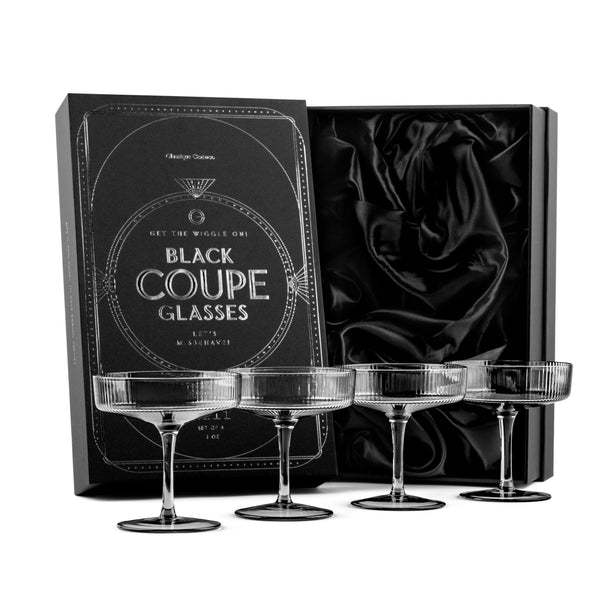
Here's our take: an espresso martini in smoked glass is the best-looking drink you can serve. The drink is nearly black; in our Art Deco Smoke Black Coupe (7 oz, hand-blown, gold rim) the body disappears into the glass and the crema floats like a spotlight. It photographs absurdly well. For a Halloween or winter dinner party, there is no better pairing on our shelf.
Size and pour math
The build lands around 4.5 oz after dilution, so a 6–7 oz glass is the sweet spot.
The standard build – 2 oz vodka, 1 oz espresso, 0.5 oz coffee liqueur, 0.25 oz syrup – lands around 4.5 oz after shake dilution. Glass math from there:
A 5 oz glass gives you a brimming pour with the foam at the rim. A 6–7 oz glass is the sweet spot – full-looking drink, foam contained, no spill on the walk from the kitchen. Anything past 8 oz makes a correct pour look mean, and doubling the recipe to fill it means the second half of the drink is warm. Not worth it. Capacities for every other shape are in our cocktail glass size chart.
Chill the glass like you mean it
Freeze the glass 10 minutes minimum – or pack it with ice water while you pull the espresso.
Freezer, 10 minutes minimum, 30 if you have the patience. The frosted surface does real work: it slows the temperature climb and it makes the first sip feel colder than it measures. If freezer space is tight, pack the bowl with ice and water while you pull the espresso, dump it, wipe nothing, pour immediately. We wrote the full method in our espresso martini recipe – including the dry-shake myth and why fresh espresso beats cold brew.
Buying for gifts: the December problem
Espresso martini glassware peaks as a December gift search and sets sell out – buy in October.
Quick practical note. Espresso martini glassware peaks as a gift search every December – the drink owns the holiday party season. Sets sell out. If you're gifting a set of coupes with an espresso-martini card in the box, buy in October, not the week of the 18th. Every Glassique Cadeau set ships in a satin-lined gift box with a cocktail recipe printed on the lid – for this drink, that's the recipe card they'll actually use. Sets start at $36.99, and orders over $89 ship free – which two sets clear neatly. Browse the best sellers if you want the safe pick, or the Christmas cocktail glasses once the season turns.
Shop this guide
All 54 pieces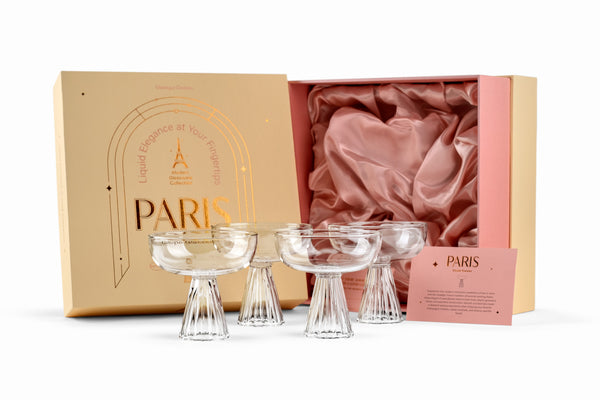
Limited Edition
Perfect for Him
Gift Ready
Frequently asked questions
What kind of glass do you use for an espresso martini?
A chilled 5–7 oz stemmed glass – either a coupe or a classic V-shaped martini glass. The coupe is the modern bartender's default; the V-glass is the original spec from the drink's 1983 invention.
Can you serve an espresso martini in a coupe?
Yes – most cocktail bars now do. A 6–7 oz coupe holds the 4.5 oz drink perfectly and the rounded bowl settles the crema into an even layer.
Why does an espresso martini need a chilled glass?
The drink contains hot espresso knocked down by a hard shake. It arrives barely cold enough, and a room-temperature glass warms it within two minutes. Freeze the glass 10 minutes before serving.
How big is an espresso martini?
About 4.5 oz after shaking – 2 oz vodka, 1 oz fresh espresso, 0.5 oz coffee liqueur, 0.25 oz sugar syrup, plus shake dilution.
Why doesn't my espresso martini have foam?
Usually stale beans or cold brew. Crema comes from CO2 and emulsified oils that fade about four weeks after roasting, and cold brew is extracted without pressure so it carries almost none. A too-gentle shake is the third cause – go 12 to 15 seconds, hard.
Why are there three coffee beans on an espresso martini?
Tradition borrowed from Sambuca service: the three beans represent health, wealth, and happiness. One or three is correct – never two.
Do espresso martini glasses need a stem?
Yes, in practice. The stem keeps your hand off the bowl, and this drink has no ice to defend its temperature. Stemless glasses work for whiskey – not for anything served up.
Sources and further reading
Dick Bradsell's own account of the 1983 invention is preserved at Difford's Guide, alongside the standard specification.
Pair with: crystal coupes, martini glasses, Nick & Nora glasses, cocktail party glassware, birthday gifts for her.
- Lead-free, hand-blown crystal
- 30-day satisfaction guarantee
- Arrives gift-ready in a satin-lined box


