
Tips · 7 min read
The Martini Glass: Why the V-Shape Exists and What Size to Buy
What a martini glass is, why the cone shape exists, the right size (4–6 oz, not 10), and which cocktails belong in it – the bartender's guide.

 Arthur BulotaCo-founder & CEO, Glassique Cadeau
I kept meeting the oversized martini glass of the 1990s and the warm drink it always leaves you with. I want you to understand why the V-shape exists, what size to buy, and when a different glass serves you better.
Email me if you have any questions: shop@glassiquecadeau.com. I answer every email personally.

The most recognizable silhouette in drinking.
| Attribute | Spec |
|---|---|
| Capacity | 4–6 oz (oversized 8–12 oz versions are a 1990s relic) |
| Designed pour | About 3 oz after dilution – 2.5 oz spirit plus a 30-second stir |
| Shape | Conical bowl opening at roughly 90 degrees |
| Stem | Long stem, flat foot – keeps body heat off a drink served near 28°F |
| Best for | Martini, Cosmopolitan, Gimlet up, Espresso Martini, Vesper |
| Era/origin | Art Deco – appeared around the 1925 Paris Exposition |
Ask ten people to draw a cocktail. Nine will draw this glass. The V-glass is so tied to the idea of a cocktail that it became the neon sign outside every bar in America. And yet most of the martini glasses sold in the last thirty years are the wrong size. Here's the whole story – shape, size, history, and what actually belongs in one.
What is a martini glass?
A stemmed glass with a conical bowl opening at roughly 90 degrees, holding 4–6 oz for cocktails served up.
A martini glass has three working parts: a conical bowl that opens at roughly 90 degrees, a long stem, and a flat foot. The bowl holds the drink. The stem keeps your hand off the bowl, because a martini is served at just above freezing and body heat is its enemy. The foot keeps the whole architecture standing.
Capacity is where glasses differ. A classic martini glass holds 4–6 oz and is built for a 3 oz cocktail with room to spare. Our Martini Cocktail Glasses follow that spec deliberately. Plenty of retailers still sell 10–12 oz cones. Avoid them. A 3 oz drink in a 10 oz glass looks lost, and a 10 oz drink is not a martini – it's three martinis without the intermission.
Best for: Martini, Cosmopolitan, Gimlet up, Espresso Martini, Vesper.
Why the V-shape exists
The wide cone pushes botanicals to your nose, the stem keeps body heat off a 28°F drink, and garnishes stay put.
The cone isn't decoration. Four things are happening:
The wide opening exposes maximum surface area, which pushes the gin's botanicals – juniper, coriander, citrus peel – up toward your nose before every sip. The steep walls carry the aromatics to the rim instead of letting them drift off sideways. The wide mouth also lets you drink from the surface, where the coldest layer sits.
The stem is temperature engineering. A stirred martini leaves the mixing glass at around 28°F (-2°C). Held by the bowl, it gains roughly a degree a minute. Held by the stem, it stays cold to the last sip.
And the geometry holds a garnish exactly where it should be. An olive on a pick leans into the point of the cone. A lemon twist rides the rim. Try either in a rocks glass and watch it drown.
A short history: from coupe to cone
The martini predates its glass – the Art Deco cone appeared around the 1925 Paris Exposition, long after the 1880s drink.
The martini predates its glass. The drink shows up in bartending manuals by the 1880s, when it was served in whatever stemmed glassware the bar owned – usually a small coupe. The conical glass we know is an Art Deco object: it appeared around the 1925 Paris Exposition that gave Art Deco its name, machine-age geometry applied to drinking.
Then came the 1990s. The martini-bar boom supersized the glass to 8, 10, even 12 oz to justify $14 flavored martinis. (The appletini era has a lot to answer for.) The craft cocktail revival of the 2000s corrected course – bartenders went back to small stems, and many defected to the Nick & Nora entirely.
Worth saying: James Bond kept the V-glass famous through all of it. The Vesper in 'Casino Royale' (1953) is specified in a "deep champagne goblet", but the films put a cone in his hand, and that image stuck.
What size martini glass should you buy?
Buy a 4–6 oz glass – a proper martini is about 3 oz after dilution, and anything over 7 oz goes warm.
The math is simple. A properly made martini is about 3 oz of liquid after dilution – 2.5 oz spirit plus what the ice gives back during a 30-second stir. Add an olive and you want a glass that holds 4–6 oz comfortably.
Two size checks before you buy:
If the glass holds more than 7 oz, your drink will either look underpoured or go warm before the bottom. If the bowl sits directly on the foot with no stem, it defeats the entire cooling logic – stemless works for whiskey, not for drinks served up.
What cocktails belong in a martini glass?
Any drink served up without ice qualifies – Martini, Cosmopolitan, Espresso Martini, Gimlet, Vesper, and Sidecar all belong here.
Any drink served up without ice is a candidate. The Martini and the Cosmopolitan are the headline acts. The Espresso Martini works beautifully in a V-glass – the cone shows off the crema layer. The Gimlet, the Vesper, and the Sidecar all sit happily in one, though honestly, most bartenders now reach for a coupe or Nick & Nora for stirred classics like the Manhattan. Browse our Martini, Manhattan & Cosmopolitan collection for the glasses matched to that family of drinks.
Martini glass vs coupe vs Nick & Nora
The V-glass gives maximum aroma and theater, the coupe resists spills, and the 4–5 oz Nick & Nora is the bartender's choice.
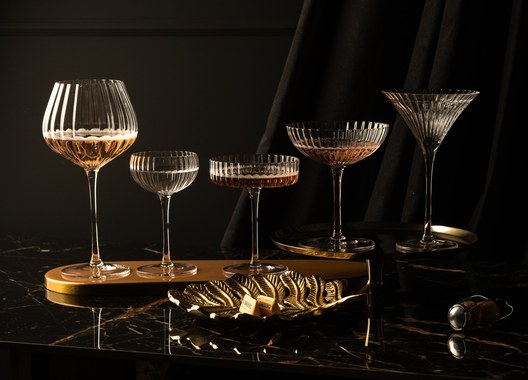
Three stemmed glasses, three personalities. The V-glass is angular, Art Deco, maximum aroma exposure. The coupe is rounder, softer, harder to spill while walking (the reason caterers love it). The Nick & Nora is the smallest of the three – 4–5 oz, deep bowl, the working bartender's choice since the Rainbow Room revived it in 1987.
In our view: own the V-glass for the drinks that are about theater – the Cosmo, the Espresso Martini – and a set of coupes or Nick & Noras for everything stirred. We compare all three properly in our coupe vs martini vs Nick & Nora guide.
Crystal martini glasses worth owning
Hand-blown, lead-free crystal sized for a 3 oz pour – sets start at $36.99 and ship in a gift box.
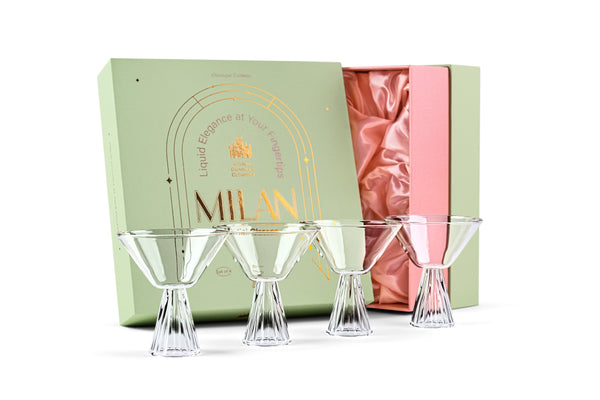
Our Martini Cocktail Glasses are hand-blown, lead-free crystal with a thin rim and a weighted foot – sized for a 3 oz pour, not a fishbowl. Sets start at $36.99, which works out to under $10 a glass, and every set ships in our signature gift box with a cocktail recipe printed on the lid. If you're gifting a cocktail person, that's the difference between a present and a package. Pair them with something from our cocktail party glassware if you host in volume.
How to care for crystal martini glasses
Hand-wash in warm water, dry with a lint-free towel, store upright, and freeze the glass 10 minutes before use.
Hand-wash, warm water, no citrus detergent. Dry with a lint-free towel while slightly warm. Store upright – resting a thin rim on a shelf for months is how rims chip. And chill the glass before every use: 10 minutes in the freezer, or fill with ice water while you stir. A warm glass undoes a cold drink in about ninety seconds.
Shop this guide
All 54 pieces
New Arrival
New Arrival
Gift Ready
Our Pick
Frequently asked questions
How many ounces is a martini glass?
A classic martini glass holds 4–6 oz, designed for a 3 oz cocktail. Oversized versions run 8–12 oz but are considered a relic of the 1990s martini-bar era.
Why are martini glasses shaped like a cone?
The wide cone maximizes aromatic surface area, carries botanicals to the rim, holds garnishes in position, and pairs with a stem that keeps body heat away from a drink served near freezing.
Is a martini glass the same as a cocktail glass?
Nearly. "Cocktail glass" historically meant any small stemmed glass, including the coupe. The V-shaped cone became so dominant that the terms are now used interchangeably.
Can you serve a Manhattan in a martini glass?
You can – it's served up, so it qualifies. Most bartenders now prefer a coupe or Nick & Nora for stirred whiskey drinks, saving the V-glass for the Martini and Cosmopolitan families.
Should martini glasses be chilled?
Always. Ten minutes in the freezer or ice water in the bowl while you stir. A room-temperature glass warms the drink noticeably within two minutes.
What's the difference between a martini glass and a Nick & Nora?
Size and shape. The Nick & Nora is a smaller (4–5 oz), deeper, rounded bowl with a narrower rim – less spill, less aroma flash. The martini glass is a wide, angular cone built for maximum presentation.
Sources and further reading
The IBA's official Dry Martini specification and the cocktail glass entry on Wikipedia cover the drink's spec and the glass's evolution respectively.
Pair with: martini glasses, Nick & Nora glasses, crystal coupes, stirred classic glasses, best sellers.
- Lead-free, hand-blown crystal
- 30-day satisfaction guarantee
- Arrives gift-ready in a satin-lined box


