
Tips · 8 min read
Coupe vs Martini vs Nick & Nora: Which Glass When
Three stemmed glasses, one decision table – when the coupe, the V-shaped martini, and the Nick & Nora each earn the pour.

 Arthur BulotaCo-founder & CEO, Glassique Cadeau
Three stemmed glasses look interchangeable on a shelf, and I kept seeing people treat them that way in the hand. I want you to understand what each one is for, so the choice becomes a habit rather than a guess.
Email me if you have any questions: shop@glassiquecadeau.com. I answer every email personally.

Three stems, one decision, and a century of strong opinions.
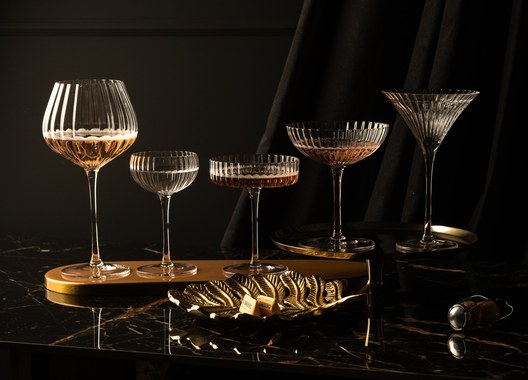
Every up cocktail – stirred or shaken, strained, served without ice – lands in one of three glasses: the coupe, the V-shaped martini, or the Nick & Nora. They look interchangeable on a shelf. They don't behave interchangeably in the hand. Here's the working logic bartenders actually use.
TL;DR: The coupe vs martini glass question comes down to shape and job: a martini glass is a 6–12 oz open V-cone built for drama, a coupe is a 5–8 oz rounded saucer that handles shaken and sparkling drinks, and a Nick & Nora is a 4–5 oz bell that keeps stirred drinks cold and unspilled. Start with our coupe collection and build from there.
The Decision Table
A coupe is a 5–8 oz saucer, a martini a 6–12 oz V-cone, a Nick & Nora a 4–5 oz bell.
Pin this one to the bar cart. Everything below expands on it.
| Feature | Coupe | Martini glass | Nick & Nora |
|---|---|---|---|
| Capacity | 5–8 oz | 6–12 oz | 4–5 oz |
| Bowl shape | Shallow, rounded saucer | Open V-shaped cone | Small rounded bell |
| Born | England, 1660s | Usually traced to 1920s Paris | Named in 1987, after the 1934 Thin Man film |
| Best for | Shaken, frothy, sparkling | Classic Martini presentation | Stirred, spirit-forward |
| Spill risk | Moderate | High | Low |
| Temperature hold | Middle | Shortest | Longest |
| Doubles as | Champagne glass | Dessert coupe (in a pinch) | Small champagne pour |
The Coupe: The Saucer That Started It
Born in 1660s England for sparkling wine, the coupe's wide bowl flatters shaken, frothy, and sparkling drinks.
The coupe is the senior partner – English glassmakers were producing the shallow saucer around 1663, originally for sparkling wine. (The story that it was molded on Marie Antoinette is a good one and false; the glass predates her by more than a century.) It spent the Jazz Age holding champagne towers and most of the 20th century's shaken drinks.
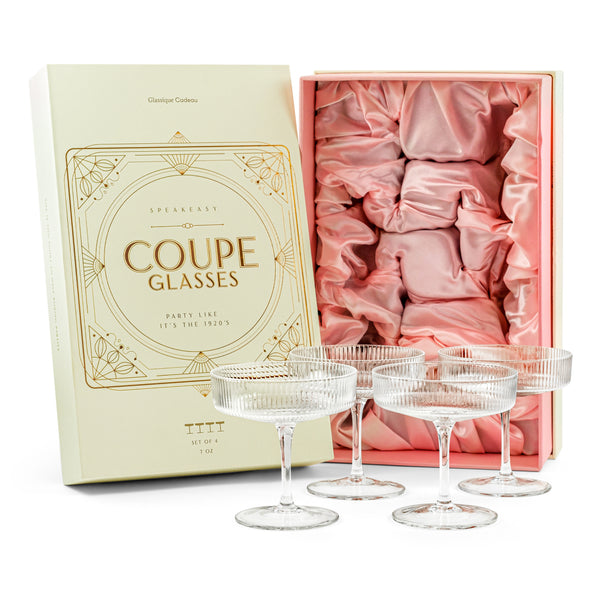
The wide, rounded bowl is the point. Shaken cocktails carry froth, air, and citrus oils, and the coupe's open face gives all of it somewhere to sit – an egg-white sour or an espresso martini looks architectural in a coupe and cramped in anything else. The curve also forgives a confident walk across the room better than a V-cone. Our Art Deco Coupe set of 4 (6 oz, $69.99) is the house benchmark, and the full coupe glasses guide goes deeper – we make 16 coupe silhouettes, so we have opinions.
The Martini Glass: The V-Shaped Icon
The 1920s Paris V-cone wins on presentation and aroma – right-sized around 7 oz, it stays cold and carryable.
The hard-angled cone – the shape on every cocktail-bar neon sign since the 1930s – is usually traced to 1920s Paris, where modernist glassmakers wanted something sharper than the rounded cocktail glass of the day. It photographs better than any glass ever made. It also spills better than any glass ever made.
The V earns its keep on presentation: a clear, spirit-forward Martini sits in that cone like an exhibit, and the steep walls funnel botanical aromas upward. The trouble arrived in the 1990s, when capacities ballooned from a civilized 5 oz to 10 and 12 oz – pours too big to stay cold and too full to carry. The fix isn't abandoning the shape; it's right-sizing it. Our Modern Martini set of 4 ($42.99) holds 7 oz, which keeps the geometry and loses the swimming pool. Browse the rest of the martini collection if the silhouette is non-negotiable for you – for some drinkers it rightly is.
The Nick & Nora: The Bartender's Pick
The 4–5 oz bell, named in 1987 by Dale DeGroff, keeps stirred drinks cold and unspilled.
The smallest of the three and the newest by name. The shape is 1930s; the christening happened in 1987, when Dale DeGroff revived a small bell-shaped glass from an old catalog for New York's Rainbow Room and named it after Nick and Nora Charles, the Martini-devoted couple of the 1934 film The Thin Man.
At 4–5 oz with an inward-curving rim, it solves both of the martini glass's problems: nothing sloshes, and the small volume means the last sip is still cold. That's why stirred drinks – Manhattans, Martinis, Boulevardiers – migrated into it at serious bars through the 2000s. Our Nick & Nora set of 4 ($39.99) is the entry point; the full story lives in our Nick & Nora glass guide, and we ranked the best Nick and Nora glasses set by set if you want the shortlist first.
Which Glass for Which Drink
Shaken and sparkling drinks take the coupe, stirred spirit-forward drinks the Nick & Nora, and Martinis the V-glass for theater.
The honest cheat sheet, drink by drink:
- Gin or vodka Martini – V-glass for theater, Nick & Nora for temperature. Both are correct; pick your priority.
- Manhattan – Nick & Nora first, coupe second. The bell flatters whiskey aromatics.
- Daiquiri, Gimlet, sours – coupe. Shaken drinks with citrus want the open bowl. (Our gimlet & daiquiri collection is built around this.)
- Espresso martini – coupe, despite the name. The foam crown needs the wide face.
- Champagne and sparkling cocktails – coupe again, the original job. A flute holds bubbles longer; a coupe makes the evening look better. See the champagne collection for both camps.
- Sidecar – coupe, with its 1920s Paris pedigree intact.
- Vesper, Boulevardier, anything stirred and brown – Nick & Nora.
If you want one glass to cover the most ground, buy coupes. If you want the glass bartenders reach for when nobody's filming, buy Nick & Noras. If James Bond lives in your head, you already own martini glasses.
Can You Swap Them?
Yes – all three serve up drinks interchangeably; the only bad trade is a Martini warming in an oversized V-glass.
Functionally, yes – all three are stemmed, chilled, ice-free vessels, and no drink is ruined by landing in its cousin. Worth saying: bartenders swap them constantly based on what's clean. The differences are real but they're percentages, not categories. A Manhattan in a coupe is still a Manhattan. A Daiquiri in a Nick & Nora is a slightly cramped Daiquiri. A Martini in a 12 oz V-glass is a warm Martini by minute eight – that's the only genuinely bad trade.
The practical rule: match the glass to the drink's construction. Shaken and frothy wants width. Stirred and boozy wants containment. Sparkling wants either a flute or a coupe and a short memory. For the full taxonomy beyond these three, our guide to the types of cocktail glasses covers the whole shelf.
One Habit That Outranks the Glass Choice: Chill It
Ten minutes in the freezer buys more cold-drink time than any shape distinction between the three glasses.
Whichever shape wins your argument, a warm glass loses it. An up cocktail leaves the mixing tin at roughly 28–30°F and has no ice to defend itself, so the glass is the only insulation it gets. Ten minutes in the freezer before pouring buys you several extra minutes of cold drink – a bigger difference than any of the shape distinctions above. No freezer space? Fill the glass with ice and water while you build the drink, then dump it just before straining.
Material matters here too. Thin-walled, hand-blown lead-free crystal chills faster and holds frost more evenly than thick machine-pressed glass, and the fine rim reads better on the lip. Every up glass in our classics collection is built that way. Fragments of frost on a stem, a drink at the right temperature – that's most of what "bar quality" means at home.
Shop this guide
All 54 pieces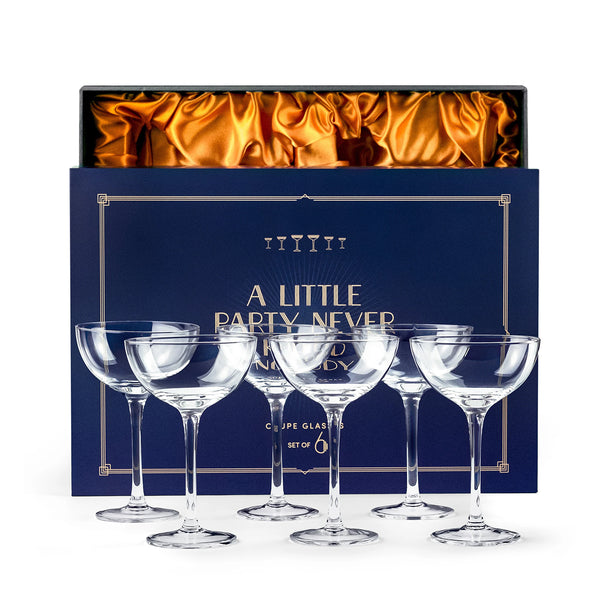
Bestseller

New Arrival
Gift Ready
Bestseller
Coupe vs Martini vs Nick & Nora FAQ
What is the difference between a martini and a coupe?
Shape and attitude. A martini glass is an open V-shaped cone, usually 6–12 oz, with maximum presentation and maximum spill risk. A coupe is a rounded, shallow saucer of 5–8 oz that carries shaken and sparkling drinks more securely. Both keep your hand off the drink via the stem.
What are coupe glasses best for?
Shaken cocktails with froth or citrus – Daiquiris, sours, espresso martinis – plus champagne and sparkling cocktails. The wide bowl displays foam, releases aroma, and the inward curve makes it the easiest of the up glasses to carry across a room.
When to use a coupe vs Nick and Nora?
Use the coupe for shaken drinks and anything with foam or bubbles; use the Nick & Nora for stirred, spirit-forward drinks like Manhattans and Martinis. The Nick & Nora's smaller 4–5 oz bowl keeps a stirred drink colder; the coupe's width serves texture.
Can I put a martini in a coupe glass?
Yes. A Martini in a coupe loses nothing but the V-shaped silhouette. Plenty of cocktail bars serve Martinis exclusively in coupes or Nick & Noras because they spill less and stay cold longer. The drink defines the Martini – the glass just frames it.
Should I get martini or coupe glasses?
Coupes, if you're buying one set: they handle shaken drinks, champagne, and Martinis credibly. Add martini glasses when you want the classic look for clear, spirit-forward drinks, and Nick & Noras when stirred whiskey drinks become a habit. Most home bars end up with all three.
What sizes are coupe, martini, and Nick and Nora glasses?
Coupes run 5–8 oz, martini glasses 6–12 oz (vintage examples closer to 5), and Nick & Noras 4–5 oz. A standard 2.5 oz cocktail lands near 4 oz after shaking or stirring with ice, which is why the smaller glasses fit classic recipes best.
Pair with: coupe glasses, martini glasses, Nick & Nora glasses, the Martini & Manhattan lounge, Art Deco & Gatsby glassware, cocktail party sets.
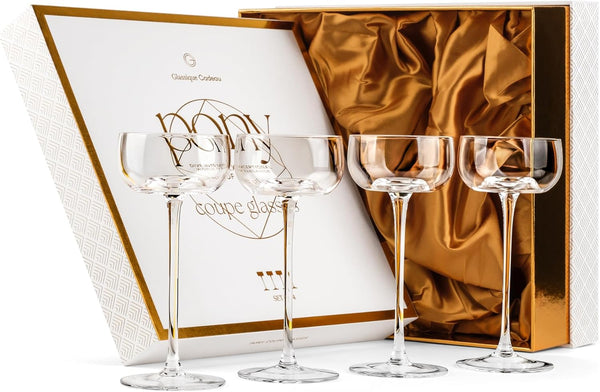
Buy the glass for the drinks you actually make, not the ones you photograph. Every set arrives in our signature satin-lined gift box with a cocktail recipe printed on the lid, and orders over $89 ship free.
- Lead-free, hand-blown crystal
- 30-day satisfaction guarantee
- Arrives gift-ready in a satin-lined box


