
Tips · 8 min read
What Is a Nick & Nora Glass? The Bartender's Coupe
Named for a 1934 detective couple and revived at the Rainbow Room in 1987, the 4-5 oz Nick & Nora is the glass bartenders actually reach for – here's why.

 Arthur BulotaCo-founder & CEO, Glassique Cadeau
The first time I watched a working bartender reach past the big martini glass for a small bell-shaped one, I had to know why. I want you to understand that glass, because it quietly solves a problem every home bar has.
Email me if you have any questions: shop@glassiquecadeau.com. I answer every email personally.

The little glass that retired the swimming-pool martini.
Watch a working bartender build a Manhattan and pay attention to the glass. Odds are it holds five ounces, curves like a bell, and spills exactly nothing on the trip from the strainer to your coaster. That glass has a name – two, actually – and a better origin story than most cocktails.
TL;DR: What is a Nick and Nora glass? A small stemmed cocktail glass with a rounded, bell-shaped bowl, usually 4–5 oz (120–150 ml), named after Nick and Nora Charles of the 1934 film The Thin Man. Bartenders use it for stirred, ice-free drinks like Martinis and Manhattans because it keeps them colder and never sloshes. See the shape in our Nick & Nora collection.
The Thin Man, 1934: Where the Name Comes From
The glass is named for Nick and Nora Charles of 1934's The Thin Man – Dale DeGroff coined the name in 1987.
Nick and Nora Charles were the leads of Dashiell Hammett's 1934 novel The Thin Man and the MGM film that premiered in May of that year – five months after Prohibition ended on December 5, 1933. William Powell and Myrna Loy played a retired detective and his heiress wife who solved murders between rounds of Martinis, and they did their drinking from small, elegant stemware. Powell's most quoted scene has Nick coaching a row of bartenders on rhythm: a Manhattan shaken to fox-trot time, a dry Martini always to waltz time.
The glass itself got its name much later. In 1987, while building the cocktail program for the relaunched Rainbow Room in New York, Dale DeGroff found the small bell-shaped glass in an old Minners Designs catalog and ordered a run. He named it for the Charleses, and the name stuck. When Audrey Saunders opened Pegu Club in 2005, the Nick & Nora became the unofficial uniform of the cocktail revival. PUNCH has called it the defining glass of that era. Hard to argue.
The Shape: What Makes a Nick and Nora Glass
Three features define it: 4–5 oz capacity, a rounded bell bowl curving inward, and a stem that keeps hands off.
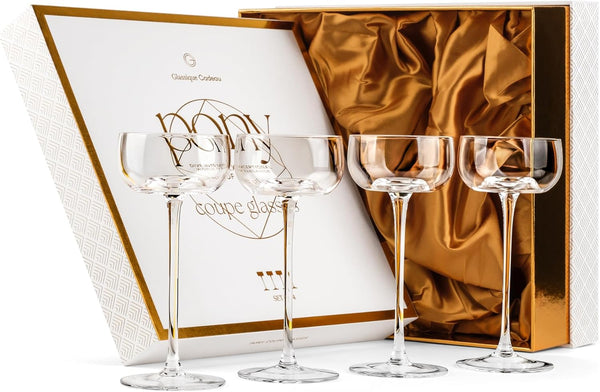
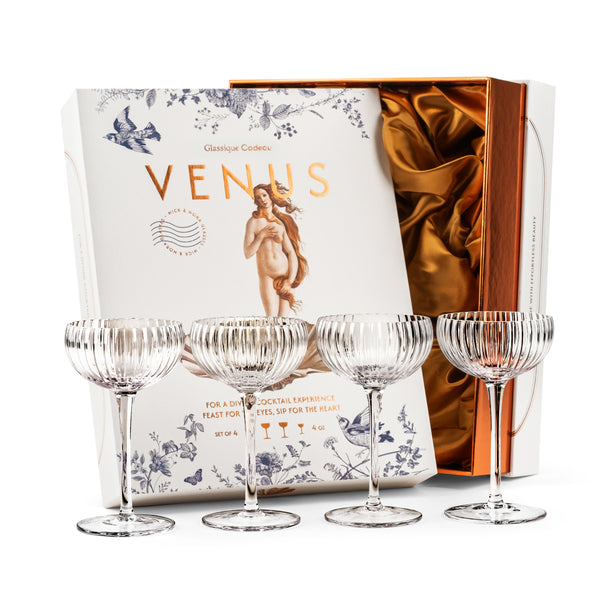
Three features define the glass. First, capacity: 4–5 oz (120–150 ml), sized for a 3–4 oz cocktail with a little air at the rim. Second, the bowl: a rounded bell or tulip that curves inward slightly rather than flaring out. Third, a stem long enough to keep your hand off the bowl entirely. Our ribbed Art Deco Nick and Nora glasses follow that blueprint. The exact numbers:
- Capacity – 5 oz (148 ml)
- Height – 5.9 inches (15 cm)
- Rim diameter – 3 inches (7.6 cm)
Compare that to the oversized V-shaped martini glasses of the 1990s, which crept up to 8–12 oz and forced bartenders to pour drinks too big to stay cold. A Nick & Nora holds a properly built stirred drink – 2.5 oz of spirit and vermouth that lands near 4 oz after dilution – with no dead space and no excuse for over-pouring. Our Nick & Nora set of 4 ($39.99) runs 5 oz (148 ml), built for exactly that 4 oz pour.
Why Bartenders Prefer the Nick & Nora
The narrow mouth exposes the least liquid to warm air of any up glass, and the inward curve never spills.
Here's our take: this is the most practical cocktail glass ever drawn, and the reasons are physics, not fashion.
A stirred Martini leaves the mixing glass at roughly 28–30°F. Every second after that is a fight against room temperature, and surface area is the enemy. A wide coupe or martini V exposes a broad face of liquid to warm air; the Nick & Nora's narrow mouth exposes the least of any up glass. Smaller volume also means you finish the drink before it warms – the old bartender logic that a second cold Martini beats one large warm one.
Then there's the walk test. A V-shaped glass filled to the rim is a spill waiting for a rug. The Nick & Nora's inward curve holds the liquid through a crowded room. No slosh. Bartenders who carry three drinks at a time notice these things, which is why the glass took over the Martini and Manhattan side of the menu.
Nick and Nora Glass vs Coupe vs Martini Glass
The Nick & Nora spills least and stays cold longest; the coupe wins shaken drinks; the V-glass wins presentation.
The three up glasses get confused constantly, so here is the honest breakdown. (For the full family tree, our guide to the types of cocktail glasses covers all of them.)
| Feature | Nick & Nora | Coupe | Martini glass |
|---|---|---|---|
| Capacity | 4–5 oz | 5–8 oz | 6–12 oz |
| Bowl shape | Rounded bell, curves inward | Wide, shallow saucer | Open V-shaped cone |
| Spill risk | Lowest | Moderate | Highest |
| Keeps drinks cold | Longest | Middle | Shortest |
| Best for | Stirred, spirit-forward drinks | Shaken drinks, sparkling wine | Classic Martini presentation |
The coupe is the oldest of the three – English glassmakers were producing the saucer shape by the 1660s – and it still wins for shaken drinks and champagne. We wrote a full coupe glasses guide if that silhouette is calling you. The martini V, usually traced to 1920s Paris, remains the most photogenic and the least forgiving. The Nick & Nora splits the difference: the romance of a coupe, the focus of a martini glass, the practicality of neither's downsides.
What Is a Nick and Nora Glass Used For?
Anything stirred, strained and served without ice – Martini, Manhattan, Boulevardier, Vesper.
Anything stirred, strained, and served without ice. The short list:
- Martini – gin or vodka, this is the glass's home turf. Some call it a Nick and Nora martini glass for a reason.
- Manhattan – the rounded bowl flatters whiskey's aromatics better than a flat coupe.
- Boulevardier – Erskine Gwynne's 1927 Paris invention sits perfectly at 4 oz.
- Vesper – Fleming wrote it into Casino Royale in 1953; it deserves period-correct glass.
- Gimlet, Daiquiri, Bee's Knees – shaken drinks work too, though purists keep those in coupes.
If your drink has ice, bubbles, or more than 5 oz of liquid, reach for something else. That's not the glass being precious – it's the glass knowing its job. Shorter version: stirred and boozy goes in the Nick & Nora, shaken and citrusy goes in the coupe, and nothing goes in a 10 oz martini cone except regret.
How to Choose the Best Nick and Nora Glasses
Judge four things: lead-free crystal, a thin fire-polished rim, a light bowl over an anchoring foot, and your bar's style.
Four things separate a good Nick & Nora from a $2 banquet glass. (Want the shortlist instead? We ranked the best Nick and Nora glasses set by set.)
Material. Lead-free crystal carries more clarity and a finer ring than soda-lime glass, without the lead oxide old crystal used. Every glass in our Nick & Nora lineup is hand-blown, lead-free crystal.
Rim. Thin rims read as quality on the lip. Machine-made glasses often carry a rolled bead at the edge; hand-blown ones are cut and fire-polished flat.
Weight and balance. The bowl should feel nearly weightless; the foot should anchor it. A top-heavy stemmed glass tips. Honestly, this is the first thing to test when you unbox a set.
Style. Plain crystal suits modern bars. Etched vintage patterns – the kind on our Art Deco Nick & Nora set ($49.99) – nod to the 1934 origin without costume-party kitsch. Hosting more than four people? The Retro set of 6 ($59.99) keeps the table matched, and sets of 2, 4, and 6 across our classics collection make it easy to scale up later.
All of ours are top-rack dishwasher safe, though we recommend hand-washing anything with a gold rim.
Shop this guide
All 54 pieces
Perfect for Her
Gift Ready

Most Gifted
New Arrival
Nick & Nora Glass FAQ
Why do they call it Nick and Nora glass?
It is named after Nick and Nora Charles, the Martini-drinking detective couple played by William Powell and Myrna Loy in the 1934 film The Thin Man. Bartender Dale DeGroff coined the name in 1987 when he revived the glass shape at New York's Rainbow Room.
Where does the name come from?
Nick and Nora Charles are the leads of Dashiell Hammett's 1934 novel The Thin Man and the MGM film that premiered five months after Prohibition ended. William Powell and Myrna Loy played the Martini-drinking detective couple, who did their on-screen drinking from small, elegant stemware. The glass borrowed their names when bartenders revived the shape decades later.
What are Nick and Nora glasses for?
Use it for cocktails that are stirred with ice, then strained and served up – no ice in the glass. Martinis, Manhattans, Boulevardiers, and Vespers are the core lineup. The 4–5 oz bowl suits drinks that total around 3–4 oz after dilution.
What is the difference between Nick and Nora and coupe glass?
A Nick and Nora has a smaller, rounded bell-shaped bowl (4–5 oz) that curves inward, while a coupe is a wider, shallower saucer (5–8 oz). The Nick and Nora spills less and keeps drinks cold longer; the coupe holds bigger shaken drinks and doubles as a champagne glass.
What do you drink out of a Nick and Nora glass?
Spirit-forward, ice-free cocktails: gin and vodka Martinis, Manhattans, Negroni variations served up, Gimlets, and Daiquiris. It also handles a 4 oz pour of champagne in a pinch, though a dedicated coupe or flute does that job better.
How many ounces is a Nick and Nora glass?
Most run 4–5 oz (120–150 ml). Ours hold 5 oz (148 ml), which fits a standard 2.5 oz stirred recipe after it picks up roughly 1–1.5 oz of water from stirring. The drink should sit just below the rim with no awkward empty space.
Are Nick and Nora glasses dishwasher safe?
Ours are top-rack dishwasher safe. For gold-rimmed sets we recommend hand-washing – detergent abrasion dulls metallic rims over time. Store them upright, and avoid stacking anything inside the bowl.
Pair with: Nick & Nora glasses, Art Deco & Gatsby era glassware, cocktail party sets, anniversary gifts, wedding & engagement gifts, all drinkware.
The Thin Man got one thing exactly right: the drink matters less than the company, but the glass sets the tone. Every set arrives in our signature satin-lined gift box with a cocktail recipe printed on the lid, and orders over $89 ship free.
- Lead-free, hand-blown crystal
- 30-day satisfaction guarantee
- Arrives gift-ready in a satin-lined box


