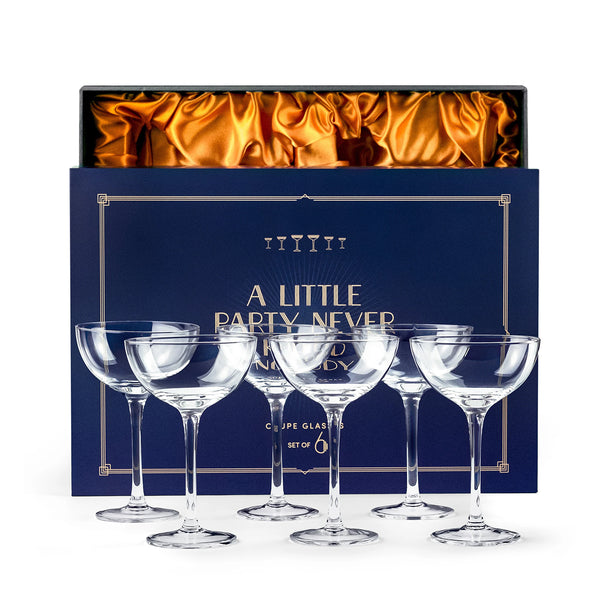
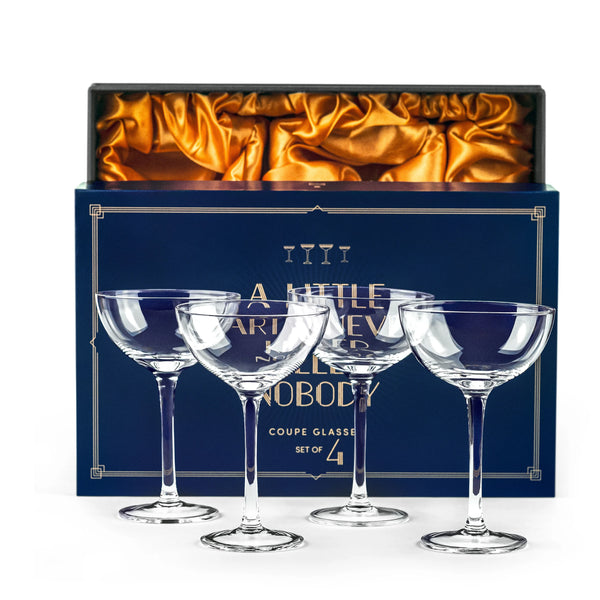
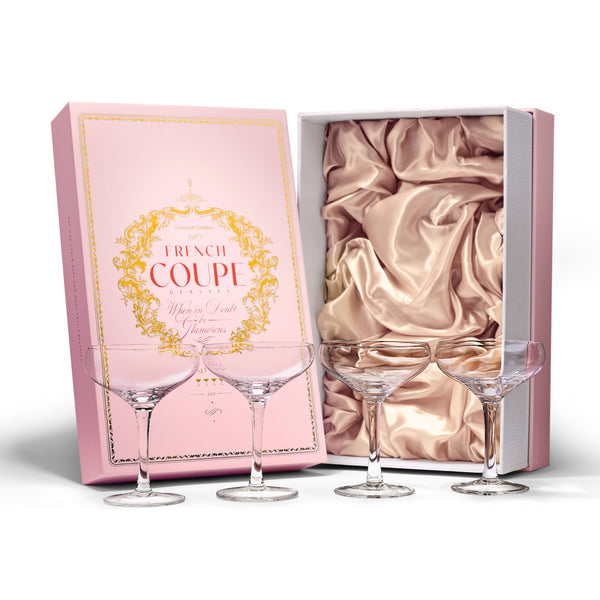
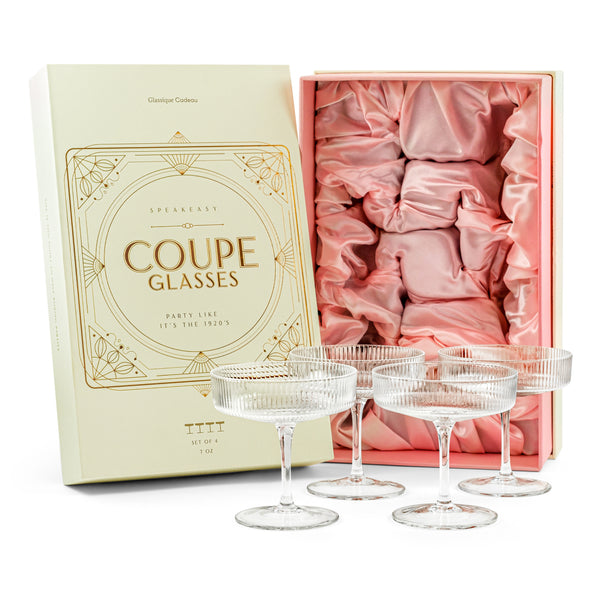
The champagne coupe is the glass that refuses to retire. Three and a half centuries after Venetian glassmakers shaped the first tazza, the shallow saucer is back on wedding tables, hotel bars and bar carts – filled, stacked and photographed. This page is the champagne-specific companion to our full coupe glasses collection: every set here is hand-blown, lead-free crystal, gift-boxed, and sized for sparkling wine at 5–8 oz (150–240 ml). For the full buying walkthrough, read our coupe glass guide.
From tazza to Gatsby – a short history
The coupe descends from the tazza, a shallow saucer on a stem produced around 1663 by Venetian glassmakers working in England – decades before sparkling champagne itself became fashionable. The famous legend that the bowl was modelled on Marie Antoinette's anatomy is a myth: the glass predates her birth by nearly ninety years. The shape peaked twice. Victorians made it the polite glass for sweet champagne. Americans made it the default – from the 1930s to the early 1980s the coupe was the champagne glass of hotel ballrooms and home cabinets, until the flute displaced it. The craft-cocktail revival of the 2010s brought it back, first for Martinis and Daiquiris, then for champagne itself.
Coupe vs flute – the physics
The two glasses solve different problems. A flute's narrow column minimises the wine's exposed surface, so carbonation lasts longer – the right call for a slow tasting of fine champagne. A coupe's wide bowl does the opposite: more surface means faster bubble dissipation, but also faster aroma release and easier drinking. The coupe wins on the two counts a flute cannot match – you smell more of the wine, and you can stack it. If you want both in the cupboard, pair these sets with our champagne flutes.
The champagne tower
Coupes are the only champagne glass you can stack. The wide, flat rim and low centre of gravity carry the weight of the layers above – a flute topples before the second storey. The classic tower is a square pyramid: a 30-glass tower uses a 4 × 4 base of 16 glasses, then 3 × 3 (9), 2 × 2 (4) and a single glass on top. Pour into the top glass only and let it cascade. The Vintage Roaring 20s' Champagne Coupes (set of 6) – also available as a set of 4 – are the house pick for towers, and sit naturally in our wedding and engagement collection.
Hand-blown, lead-free, made to be used
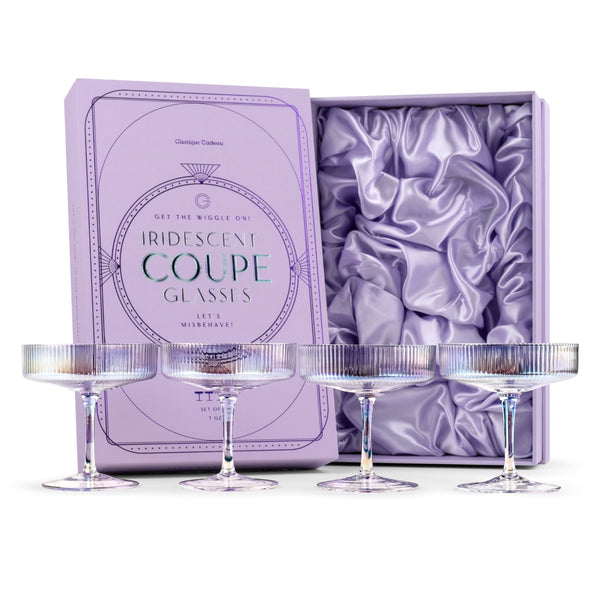
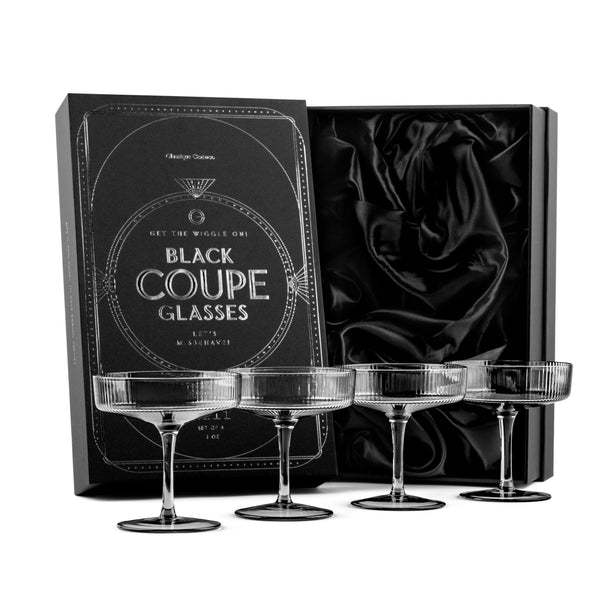
Every set in this collection is hand-blown from lead-free crystal – thinner walls, clearer glass, and small human variations that machine-pressed glass cannot show. The French Champagne Coupes keep the 17th-century silhouette; the Art Deco Iridescent Coupes and Art Deco Smoke Black Coupes take it somewhere moodier. Care is simple: upper rack on the gentle cycle in the dishwasher, and hand-wash any piece with a gold rim to protect the metallic finish. Sets of 4 and 6 arrive in the signature gift box.
What is a champagne coupe?
A champagne coupe is a shallow, broad-bowled stemmed glass holding 5–8 oz (150–240 ml). It served as the standard champagne glass from the Victorian era until the flute overtook it in the 1980s, and it doubles as a cocktail glass for drinks served up.
What is a champagne coupe called?
Three names, one glass: coupe (the modern term), champagne saucer (the mid-century English name) and tazza (the 17th-century Italian original). Vintage listings usually say saucer; bartenders say coupe.
Is champagne better in a flute or coupe?
It depends what you are optimising for. The flute preserves carbonation longest – its narrow column exposes less wine to the air. The coupe gives more aroma, easier drinking and a steadier grip in a crowd. For a tasting, the flute; for a toast or a party, the coupe is our favourite.
Why drink champagne from a coupe?
Four reasons: the open bowl releases more aroma than a flute; three centuries of history sit behind the shape; it is the only champagne glass that stacks into a tower; and a 5–8 oz (150–240 ml) pour looks generous in it. The 1920s photographs did not lie – champagne looks right in a saucer.