
Tips · 6 min read
The Best Whiskey Glasses, Ranked by How You Actually Drink
The best whiskey glasses for neat pours, rocks, and cocktails – tulip tasting glasses, heavy lowballs, and snifters, ranked by how you drink.

 Arthur BulotaCo-founder & CEO, Glassique Cadeau
People ask me for the one best whiskey glass, and the honest answer is that there is a best glass per pour. I want you to match tulip, lowball and snifter to how you actually drink, not to how the shelf looks.
Email me if you have any questions: shop@glassiquecadeau.com. I answer every email personally.

The whiskey is the point. The glass is the argument.
| Glass | Size/Spec | Best for |
|---|---|---|
| Tulip tasting glass | 4 oz, stemmed, rim narrows – built for a 2 oz pour | Single malt, cask-strength bourbon, rye neat, tasting flights |
| Stemless tasting glass | Same tulip chimney, steadier base | Armchair drinking over lab-style tasting |
| Heavy lowball (rocks glass) | 9–12 oz, weighted base | Bourbon or rye on the rocks, the nightly pour |
| Larger lowball | 10–12 oz – room for big ice and an orange peel | Old Fashioned, Sazerac, Boulevardier |
| Snifter | 15 oz bowl, 2 oz pour, palm-warming | Peated Scotch, sherry-bomb single malts, slow sipping |
Walk into any serious whiskey bar and count the glass shapes behind the counter. You'll find at least three. That's the honest answer to "what's the best whiskey glass" – it depends entirely on whether you're nosing a single malt, drowning a Tuesday bourbon in ice, or building an Old Fashioned. Here's how bartenders and distillers actually divide the job.
First, the shape science (in one paragraph)
A rim that narrows concentrates aroma and disperses ethanol burn; wide straight walls soften the nose for ice and cocktails.
Whiskey is 40–60% alcohol, and ethanol evaporates aggressively. A glass that narrows toward the rim – the tulip shape – concentrates the aroma compounds while letting the sharp ethanol vapors disperse at the edges. A wide, straight-walled tumbler does the opposite: it lets everything escape equally, which softens the nose and suits ice and cocktails. That single trade-off explains every glass on this list. (The Glencairn, introduced in 2001 and now the industry-standard tasting glass in Scotland, is built entirely on this principle.)
For tasting and neat pours: the tulip glass
A 4 oz tulip tasting glass with a 2 oz pour leaves headspace where the aroma collects.
If you drink whiskey to actually taste it, the tulip-shaped tasting glass beats everything else. Our Whiskey, Bourbon & Scotch Tasting Glasses – hand-blown, lead-free crystal, 4 oz, set of 4 – follow the copita profile used in distillery labs: a bowl wide enough to swirl a 2 oz pour, a chimney that narrows toward the rim, and a stem that keeps hands (and their warmth) off the whiskey.
Why 4 oz for a 2 oz pour? Headspace. The empty half of the glass is where the aroma collects before it reaches your nose. Fill a tasting glass to the rim and you've deleted the feature you paid for.
Best for: Single malt Scotch, cask-strength bourbon, rye neat, any side-by-side tasting flight.
Prefer no stem? The Stemless Whiskey Tasting Glasses keep the tulip chimney with a steadier base – the pick for armchair drinking over lab-style tasting.
For whiskey on the rocks: the heavy lowball
A weighted 9–12 oz lowball gives ice its width and the pour its heft – weight is the whole game.
Ice changes the assignment. Now the glass needs width for a big cube, weight so it doesn't tip, and walls that feel substantial in hand. That's the lowball – also sold as a rocks glass, an Old Fashioned glass, or a whiskey tumbler, all naming the same 9–12 oz footprint.
Our benchmark is the Art Deco Speakeasy Lowball – 9 oz, hand-blown crystal with a weighted base and the ribbed geometry of a 1920s hotel bar. Honestly, weight is the whole game here: a thin-walled rocks glass makes even good bourbon feel like a hotel minibar. Sets start at $36.99 – under $10 a glass – and the full range is in our lowball collection.
Best for: Bourbon or rye on the rocks, Japanese whisky with one big cube, the nightly pour.
For whiskey cocktails: the same lowball, working harder
Stirred whiskey cocktails live in a 10–12 oz lowball with room for one large cube and an orange peel.
The Old Fashioned, the Sazerac, the Boulevardier – the stirred whiskey canon lives in a lowball over one large cube. If cocktails are the main event, size up toward 10–12 oz so the ice and the orange peel have room. The Old Fashioned, Negroni & Whiskey Sour collection groups the glasses we build for exactly this. For sours served up, a coupe takes over – but that's a different article (see our whiskey sour recipe for the split).
For slow sipping: the snifter
A 15 oz snifter cradled in the palm warms a 2 oz pour open over twenty minutes.
The snifter migrated from cognac to whiskey for one reason: palm-warming. Cradle the bowl and the spirit opens up over twenty minutes. Our Brandy & Cognac Snifter (15 oz, set of 2) treats a 2 oz pour of sherry-cask Scotch the way it treats an XO – slowly. We wrote the full physics in our snifter glass guide.
Best for: Peated Scotch, sherry-bomb single malts, anything you plan to hold for a while.
The brand question: Glencairn, Norlan, Riedel, Waterford
Buy shapes, not logos – hand-blown crystal at $9–12 a glass covers 95% of whiskey drinking without trophies.
Worth saying, because these four names dominate every "best whiskey glasses" search. The Glencairn is a genuinely good tasting glass and the industry standard – machine-made, around $10–15 each. Norlan's double-walled glass looks striking but divides drinkers on feel. Riedel makes superb wine stems; their whiskey line is fine, not special. Waterford is heavy cut crystal at $40–80 a glass – beautiful, and mostly bought as trophies.
Here's our take: hand-blown, lead-free crystal at $9–12 a glass – tulip for tasting, weighted lowball for everything else – covers 95% of whiskey drinking without a single trophy purchase. Buy shapes, not logos.
How many whiskey glasses do you need?
Two shapes cover a home bar – four tasting glasses plus four lowballs, roughly $75–80 total.
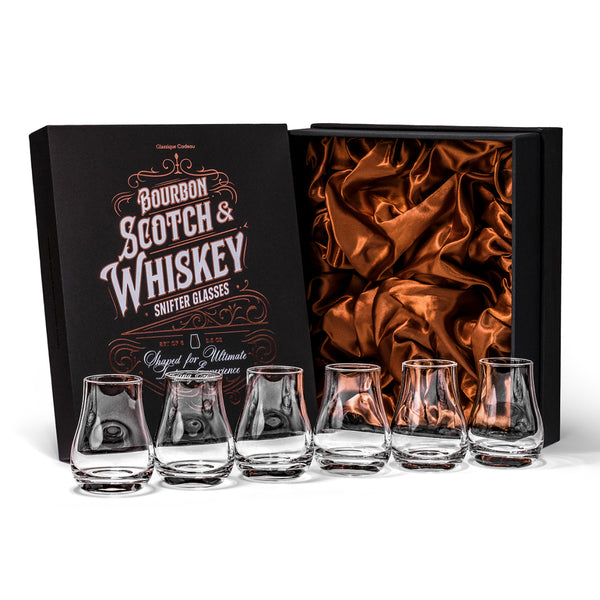
A working home bar needs two shapes: a set of 4 tasting glasses and a set of 4 lowballs. Eight glasses, two jobs, and with one cordial set added the order clears free shipping on orders over $89. 30-day satisfaction guarantee on all of it. Everything ships in the satin-lined gift box with a recipe on the lid, which is why half our whiskey sets leave as gifts. (If that's you, the whiskey drinker gift guide and bourbon lover gift guide do the choosing for you – or browse the Whiskey, Brandy & Grappa collection and the Father's Day shelf.)
Shop this guide
All 54 pieces
Perfect for Him
Gift Ready

Limited Edition

Our Pick
Frequently asked questions
What is the best glass for drinking whiskey neat?
A tulip-shaped tasting glass, around 4 oz, with a rim that narrows. It concentrates aroma and disperses ethanol burn – the same profile distillery labs use for quality control.
What's the difference between a rocks glass and a whiskey glass?
A rocks glass (lowball) is one type of whiskey glass – the wide, heavy 9–12 oz tumbler built for ice and cocktails. Tasting glasses and snifters are whiskey glasses too, built for neat pours.
Why are whiskey glasses shaped differently from wine glasses?
Alcohol strength. At 40–60% ABV, whiskey throws far more ethanol vapor than wine, so whiskey glasses use smaller bowls and narrower rims to filter the burn out of the nose.
Is a Glencairn glass worth it?
For tasting, yes – it's the industry standard and fairly priced. For rocks pours and cocktails it's the wrong tool: no room for ice, and the narrow rim fights the drink.
How many ounces should a whiskey glass hold?
Tasting glasses: about 4 oz for a 2 oz pour. Lowballs: 9–12 oz to fit a large ice cube. Snifters: 15–21 oz, of which you fill two.
What whiskey glasses make the best gift?
A set of 4 heavy crystal lowballs is the safest whiskey gift – used nightly, impossible to outgrow. Tasting sets suit the drinker who owns more bottles than mixers.
Sources and further reading
The Glencairn whisky glass history on Wikipedia covers the 2001 introduction; our own how to taste whiskey primer covers what to do once the glass is right.
Pair with: lowball glasses, whiskey nosing glasses, brandy snifters, birthday gifts for him, highball glasses.
- Lead-free, hand-blown crystal
- 30-day satisfaction guarantee
- Arrives gift-ready in a satin-lined box


