
Tips · 11 min read
What Is a Snifter Glass? Brandy, Cognac, and Beyond
Why a 2 oz pour belongs in a 15-21 oz bowl: the palm-warming physics of the snifter, balloon vs tulip shapes, and what to drink from one.

 Arthur BulotaCo-founder & CEO, Glassique Cadeau
The first time I handed someone a snifter, they hesitated at the two ounces rolling around a bowl built for twenty. I want you to understand that the empty space is doing a job, and that the shape still earns its shelf.
Email me if you have any questions: shop@glassiquecadeau.com. I answer every email personally.

A glass shaped like a question: why is there so much room in here?
Hand someone a snifter for the first time and watch them hesitate. Two ounces of cognac rolling around a bowl that could hold twenty. It looks like a pouring error. It isn't – every inch of that empty space is doing a job, and in 2026 the balloon still earns its place on the shelf.
TL;DR: What is a snifter glass? A short-stemmed glass with a wide balloon bowl that narrows toward the rim, used for brandy, cognac, and other aged spirits. The shape lets your palm warm the spirit while the tapered rim traps aromas above a small 1.5–2 oz pour. See the shape in our snifter collection.
What Is a Snifter Glass, Exactly?
A snifter is a short-stemmed glass whose wide bowl tapers to a narrower rim – built for sniffing before sipping.
The snifter goes by half a dozen names – brandy balloon, brandy bowl, brandy glass, cognac glass, balloon glass. All describe the same architecture: a short stem, a foot, and a bowl that swells wide at the bottom and tapers to a narrower opening at the top.
Three numbers define it. Capacity runs anywhere from 6 to 21 oz depending on the style. The pour stays small – 1.5 to 2 oz. And the rim opening is deliberately tighter than the bowl's widest point, usually by a third or more. That taper is the whole trick. The wide bottom maximizes the surface area of the spirit; the narrow top funnels everything that evaporates straight to your nose. The name is literal: this is a glass built for sniffing first, sipping second.
The word is older than the glass. In English slang, a snifter meant a small drink of liquor – a quick nip – from an English dialect verb for sniff or snort, first recorded in 1844. The glassware borrowed the word, not the other way around, and both senses survive: order a snifter in a British pub and context decides whether you get a glass or a dram.
The Palm-Warming Physics
Cupping the bowl warms the spirit toward body temperature, releasing the volatile esters and fruit aromatics a cold pour keeps asleep.
Here's why the stem is short. With a wine glass, you hold the stem to keep body heat away from the liquid. A snifter inverts the logic: you cradle the bowl in your palm, fingers around the stem, and let your hand do the work. Your skin sits near 98.6°F; a bottle stored in a 65°F room has flavor compounds still half-asleep. A few minutes of palm contact raises the spirit several degrees, and those volatile esters and fruit aromatics start lifting off.
Swirling gets the same result faster – more liquid painted on the glass wall means more evaporation – but go gently. Alcohol evaporates faster than the aromatics you actually want, and an aggressive swirl fills the bowl with ethanol burn instead of orchard fruit. Most bartenders would say rest the glass, tilt it, roll it once, and give it time. The drink has usually waited a decade or more already.
One honest caveat: skip the cognac-warmer gadgets with the little flame. Direct heat pushes the spirit past fragrant into boozy fumes. Your hand is the right tool because it tops out at body temperature.
Why a 2 oz Pour Sits in a 15–21 oz Bowl
The empty space is the working part – roughly 13 oz of air concentrates aromas above a 2 oz pour.
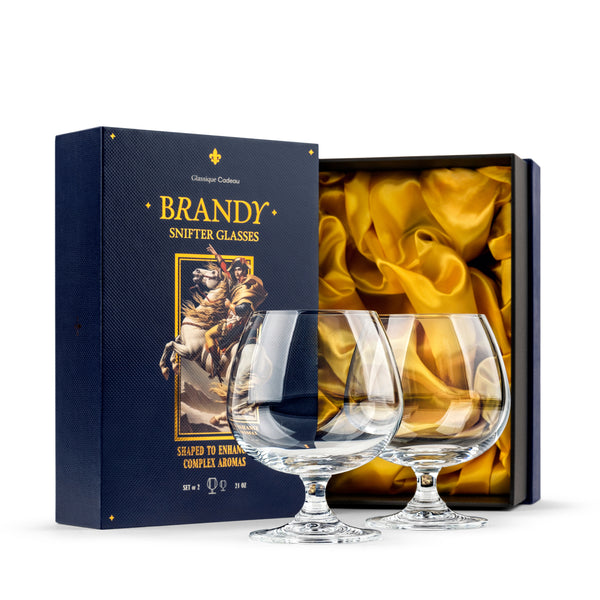
The empty space is the working part. A 2 oz pour in our 15 oz brandy and cognac snifter ($39.99) leaves roughly 13 oz of air above the liquid – that's the collection chamber where aromas concentrate before each sip. Fill a snifter halfway and you've broken it: no headspace, no nose, just an oversized gulp of brandy.
Old bar rooms had a test for the correct pour: tip the snifter on its side, and the liquid should reach the rim without spilling. On most balloon shapes that works out to that same 1.5–2 oz. If you like the grand-hotel look – the truly wide bowl you can warm between both palms – our large 21 oz snifter ($39.99) is the full-theater version, and the pour stays exactly the same.
Snifter vs Glencairn vs Tulip: Which Shape?
Balloon for the after-dinner ritual, tulip for critical tasting, Glencairn for analytical whisky nosing – three tools, not rivals.
Worth saying: the giant balloon is not the only orthodoxy anymore. Many cognac professionals now prefer a smaller tulip shape, arguing the balloon's huge surface area amplifies alcohol vapor along with the good stuff. There's truth in it, and there's also truth in the balloon being more pleasure to hold. Here's the honest comparison:
| Shape | Capacity | Character | Best for |
|---|---|---|---|
| Balloon snifter | 15–21 oz | Maximum surface area, palm-warming, classic armchair ritual | Brandy, cognac, aged rum after dinner |
| Tulip / copita | 4–7 oz | Tighter aroma focus, less ethanol burn, the taster's pick | Critical tasting of cognac, Armagnac, whisky |
| Glencairn | ~6 oz | Tapered nosing glass, thick solid base that deliberately blocks hand-warming | Analytical whisky tasting – the industry standard |
| Small sniffer | 3 oz | Precise, long-stemmed, built for delicate aromatics | Grappa, eau-de-vie, fruit brandies |
The Glencairn deserves its own verdict – snifter vs Glencairn is the most common bar-cart standoff. A Glencairn is a roughly 6 oz tapered nosing glass with a thick, solid base built so your hand never warms the whisky. That is deliberate: blenders designed it for analysis at cellar temperature, and it became the standard tasting glass across Scotland's distilleries.
So the split is clean. Nosing whisky analytically, comparing drams, judging a cask – Glencairn. Settling in after dinner with brandy, cognac, or aged rum, where palm warmth is half the pleasure – balloon snifter. One blocks your hand on purpose; the other invites it. Different tools, not rivals.
We make all three on purpose. The 4 oz cognac copita set ($59.99) is the professional tulip; the 3 oz grappa sniffer set of 6 ($59.99) handles the delicate end. Balloon for the ritual, tulip for the analysis. Owning both is not excess – it's two different jobs.
Types and Materials
Beyond balloon and tulip, crystal clarity, hand-blown construction, and thin rims decide how a snifter feels in the hand.
One variant beyond the big three is worth knowing: the pipe snifter, a novelty shape with a pipe-style bowl set sideways off the stem – you sip from the raised opening while the spirit rests in the bowl. A conversation piece more than a tasting tool.
The material choices matter more. Balloon vs tulip is ritual vs analysis – palm warmth and comfort against focused aroma. Crystal vs ordinary glass decides clarity and the clean ring at the rim. Hand-blown vs machine-made decides the rest: a hand-blown bowl has no mold seams and walls thin enough that the rim almost disappears against your lip. Every choice shows up in the hand before it reaches the palate.
Snifter Sizes in Oz
Snifters run from 3 oz grappa sniffers to 21 oz balloons, yet the spirits pour stays at 1.5–2 oz.
Size is the fastest way to tell the types apart. The bowl grows or shrinks; the pour barely moves.
| Glass | Capacity | Typical pour |
|---|---|---|
| Brandy balloon | 15–21 oz (classic standard 6–8 oz) | 1.5–2 oz |
| Tulip / copita | 4–7 oz | 1.5–2 oz |
| Grappa sniffer | 3 oz | 1.5–2 oz |
| Glencairn | ~6 oz | 1.5–2 oz |
| Beer snifter | 10–16 oz | 8–10 oz |
| Rule of thumb: tip the glass on its side – a correct spirits pour reaches the rim without spilling. | ||
What Do You Drink From a Snifter?
Brandy, cognac, Armagnac, dark rum, añejo tequila, calvados, and high-ABV beers – anything aged and aromatic served neat.
Brandy first. The word comes from the Dutch brandewijn – burnt wine – a 16th-century trader's term for distilled grape spirit. Cognac is the famous regional version, protected by French AOC rules since 1936: VS means at least 2 years in oak, VSOP at least 4, and XO at least 10 (the XO minimum rose from 6 years in 2018). The older the spirit, the more a snifter has to say about it.
Beyond cognac and Armagnac, the glass earns its shelf space with anything aged and aromatic: dark rum, añejo tequila, calvados, bourbon or single malt when you want a softer presentation than a Glencairn. Craft beer bars borrowed the shape decades ago for imperial stouts and barleywines at 9–12% ABV – same logic, bigger pour. And a snifter makes a fine house for neat pours generally, which is why it lives next to the whiskey and neat-spirits collection and our tasting glasses rather than with the cocktail stemware. If mixed drinks are tonight's program, start with our guide to the types of cocktail glasses instead – or the coupe glasses guide if stems are calling.
Beer Snifters: Same Physics, Bigger Pour
A beer snifter holds 10–16 oz and suits styles above 8% ABV – imperial stout, barleywine, double IPA.
Craft beer took the snifter and scaled it. A beer snifter runs 10–16 oz and serves the styles that behave like spirits: imperial stout, Baltic porter, barleywine, double IPA. The rule of thumb: once a beer crosses 8% ABV, it carries enough aroma and alcohol to justify the tapered bowl. Below that, a pint glass loses nothing.
The pour follows the same headspace logic as brandy. 8–10 oz in a 16 oz bowl leaves room for the head to settle and the esters – dark fruit, roast, barrel vanilla – to collect above the beer. Serve these styles at 50–55°F, warmer than the fridge, and cup the bowl if the stout is too cold to speak.
How to Use One Properly
Pour 1.5–2 oz, cradle the bowl for two or three minutes, roll once, nose with mouth open, sip small.
No ceremony required, just sequence. Pour 1.5–2 oz. Cradle the bowl in your palm for two or three minutes. Tilt and roll the glass once to coat the wall. Nose it with your mouth slightly open – it reads aromas with less burn. Then sip small and let it sit on the tongue a moment before swallowing.
Room temperature is correct for brandy and cognac: 68–72°F, never chilled, never microwaved (people ask). Port and sherry run cooler, which is why those get their own copitas and schooners. Wash snifters by hand or top rack only, and store them upright – resting a thin crystal rim under its own weight for months is how rims chip.
Shop this guide
All 54 pieces
Our Pick
Most Gifted

Most Gifted

Most Gifted
Snifter Glass FAQ
What is the purpose of a snifter glass?
To concentrate aroma. The wide bowl maximizes the spirit's surface area so more evaporates, and the narrow rim traps those vapors where your nose can find them. The short stem encourages you to cup the bowl, warming the spirit with your palm to release more aromatics.
Why is it called a snifter?
From sniffing. The glass is engineered for smelling the spirit before tasting it, and the name follows the function. The same shape also answers to brandy balloon, brandy bowl, balloon glass, and cognac glass – five names, one job.
Which glasses for cognac?
Two correct answers: a classic balloon snifter (15–21 oz) for relaxed after-dinner drinking, or a 4–7 oz tulip-shaped copita for focused tasting. Many cognac houses now favor the tulip because it concentrates aroma with less alcohol burn. Pour 1.5–2 oz in either.
Why do people swirl their brandy?
Swirling coats the inside of the bowl with a thin film of spirit, which evaporates quickly and loads the headspace with aroma. Do it gently – hard swirling releases ethanol faster than the fruit and oak notes you want, and the nose turns harsh.
What is another name for a snifter glass?
Brandy balloon, brandy glass, brandy bowl, balloon glass, or cognac glass. In Spanish bar books it appears as the copa de coñac. All refer to the same short-stemmed, wide-bowled, narrow-rimmed shape.
How much do you pour in a snifter?
1.5 to 2 oz, regardless of bowl size. The traditional check: lay the glass on its side, and the liquid should just reach the rim without spilling. The remaining space is the aroma chamber – that's the part you're actually paying for.
What does snifter mean in slang?
A small drink of liquor. The slang sense is older than the glassware – it comes from an English dialect word meaning to sniff or snort, first recorded in 1844. The glass borrowed the name later. In British usage, a snifter can still mean a quick nip of whisky or brandy rather than the balloon-shaped glass itself.
Can you still buy snifters?
Yes – snifters never left production, and quality varies more than shape. Four checks separate a good one: crystal vs pressed glass (crystal reads clearer and rings when tapped; pressed glass looks cloudy and thuds), hand-blown vs machine-made (hand-blown means no mold seams and thinner walls), the rim taper ratio (the opening should sit a third narrower than the bowl), and stem length (short enough that cupping the bowl feels natural). Browse our brandy snifter glasses for the full range, or start with a hand-blown crystal snifter set.
Pair with: snifter glasses, whiskey & neat spirit glasses, tasting glasses, port & sherry glasses, his birthday gifts, all drinkware.
A snifter slows the evening down on purpose – that's the point of the shape. Every set arrives in our signature satin-lined gift box with a cocktail recipe printed on the lid, and orders over $89 ship free.
- Lead-free, hand-blown crystal
- 30-day satisfaction guarantee
- Arrives gift-ready in a satin-lined box


