
Tips · 9 min read
How to Throw a Speakeasy Party (Prohibition-Era Guide)
A period-correct guide to hosting a speakeasy party: passwords, jazz, Prohibition-era gin cocktails, and the heavy Art Deco glassware that sets the mood.

 Arthur BulotaCo-founder & CEO, Glassique Cadeau
Prohibition was supposed to make people sober and instead made them inventive, and I find that story too good not to host around. I want you to recreate secrecy, sound and light, and let the mood do the rest.
If you have any questions, feel free to email me shop@glassiquecadeau.com

Knock twice, whisper the word, and step back into 1926 – where the drinks were illegal and the glassware was gorgeous.
Prohibition was supposed to make Americans sober. Instead it made them inventive. From January 1920 to December 1933, the sale of alcohol was banned across the United States under national Prohibition – and roughly 30,000 illegal bars, the speakeasies, bloomed in basements and back rooms to serve it anyway. A speakeasy party borrows that whole world: the secrecy, the jazz, the smoke-and-candlelight glamour. Done right, it's the most atmospheric theme you can host. And you don't need a basement – you need a password, the right lighting, and glasses that look like they've seen a few secrets.
What actually made a speakeasy a speakeasy
The name says it. You "spoke easy" – quietly – so the cop on the corner wouldn't hear. Entry ran through a locked door with a sliding peephole, a whispered password, and often a fake storefront out front (a florist, a soda fountain, a tailor). Inside: dim light, a jazz combo, and bartenders pouring drinks made from whatever liquor could be smuggled or cooked up at home.
That's your blueprint. Recreate three things and the rest falls into place – secrecy, sound, and light. Everything else is garnish.
Text guests a secret word with the invite and make them say it at the door. A peephole and a theatrical doorman seal the theatre.
Kill every overhead. Warm bulbs (2700K or lower), scattered tea lights, and a lamp draped in amber gauze do the rest.
Hot jazz and early swing – Armstrong, Ellington, Bessie Smith. Conversation volume early, climbing as the gin does its work.
Gin-forward and built to hide rough liquor – citrus, honey, mint – poured into coupes and heavy faceted lowballs.
Set the scene: the password, the door, the theatre
The single best trick in speakeasy theme party hosting costs nothing. Text guests a password with the invite ("The oyster is open" works beautifully) and make them say it at the door. Rig a peephole from cardboard if you're feeling committed. Honestly, watching a grown adult whisper nonsense to get into a party is half the fun.
Then kill the overhead lights. Prohibition rooms were lit by candles, table lamps, and the glow of a cigarette – nothing brighter. Use warm bulbs (2700K or lower), scatter tea lights, and drape a lamp or two with amber gauze. Add a few Art Deco touches: fan motifs, gold and black, geometric lines. If you want a shortcut to the look, the Art Deco & Gatsby collection is built entirely around that 1920s geometry.
"Recreate three things and the rest falls into place – secrecy, sound, and light. Everything else is garnish."
Best for: small apartments – dim light hides a cramped room and makes six people feel like a secret society.
The sound: jazz, and only jazz
The 1920s were the Jazz Age – the phrase is F. Scott Fitzgerald's. Build a playlist around hot jazz and early swing: Louis Armstrong, Duke Ellington, Bessie Smith, Django Reinhardt. If you can stretch to a live sax or a pianist for the first hour, do it. Keep it at conversation volume early, then let it climb as the gin does its work.
A note on The Great Gatsby, since every prohibition party leans on it: the novel was published in 1925. Baz Luhrmann's champagne-soaked film came out in 2013 (there was an earlier Robert Redford version in 1974). The book is the source of the aesthetic – the parties, the excess, the green light – so a Gatsby-leaning dress code fits the era perfectly.
The cocktails that hid rough liquor
Here's the part most hosts get wrong. Speakeasy cocktails weren't fancy for fancy's sake – they were built to disguise harsh, unaged spirits. Bootleg "bathtub gin" was often raw grain alcohol cut with water and flavorings, mixed in large containers (the tap-filling myth is roughly true – big vessels didn't fit under a sink faucet). It tasted brutal. So bartenders drowned it in citrus, honey, and mint.
Serve these three and you're historically bang on:
- Bee's Knees – gin, fresh lemon, honey syrup. The honey was there to mask cheap gin. Shaken, served up in a coupe (Difford's Guide has the classic build).
- Southside – gin, lime, sugar, and a fistful of muddled mint. Bright, sharp, forgiving of bad liquor.
- Gin Rickey – gin, fresh lime, soda water, no sugar. Long, dry, and refreshing over ice in a highball.
Speakeasy Cocktails
Bee's Kneesgin · lemon · honey
Southsidegin · lime · mint · sugar
Gin Rickeygin · lime · soda
The Batched Punchhost's choice · serves all
Batch the syrups ahead (honey syrup is just 1:1 honey and warm water). For a crowd, a punch bowl is period-correct and keeps you out from behind the bar. A decent bottle of gin runs about the price of a nice lunch out – you don't need top-shelf here, which is rather the point.
The glassware: heavy lowballs and shallow coupes
This is where a speakeasy party is quietly won or lost. The era had a distinct hand-feel: substantial, faceted tumblers for spirits on ice, and wide, shallow coupes for anything shaken and served up.

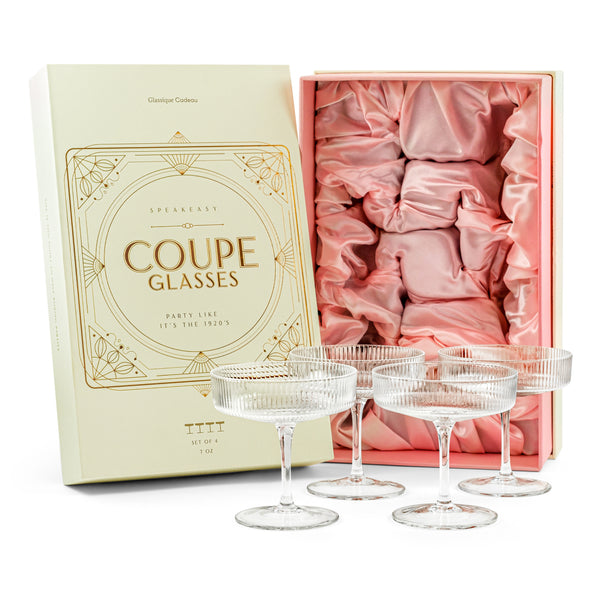
The coupe is the signature 1920s glass. It traces back to around 1663 in England – and no, it was not molded from Marie Antoinette's breast (she wasn't born until 1755; the story is a charming myth, nothing more). A coupe holds roughly 5 to 7 ounces, its wide bowl built for the shaken sours that ruled the speakeasy. For those, the coupe glasses and dedicated champagne coupe glasses ranges cover both cocktails and bubbles.
For spirit-forward and highball serves, you want weight in the hand. Our Art Deco Speakeasy Lowball Glasses (set of 4, 9 oz) are named for exactly this occasion – heavy-based, faceted crystal that catches candlelight and feels like the real thing. Pair them with the broader lowball collection if you're hosting more than four. For long drinks like the Gin Rickey, a taller pour suits a 1920s highball glass (a highball runs about 10–12 oz, versus roughly 5 oz for a Nick & Nora).
Best for: the host who wants one glass to do double duty – a 9 oz lowball handles an old fashioned, a rickey, or a neat pour with equal ease.
A period detail worth stealing: the Nick & Nora
If you want to reward the cocktail nerds in the room, add a few Nick & Nora glasses. This stemmed, 5 oz glass is named for Nick and Nora Charles, the endlessly-martini-drinking couple from The Thin Man (1934) – so it's era-adjacent and impeccably on-theme. It spills less than a coupe and looks the part. See the Nick & Nora set of 4 for the shape.
How to throw a speakeasy party: the run of show
- Send the invite with a password. One to two weeks out. Include a dress code (drop-waist dresses, feathers, suspenders, waistcoats) and the secret word.
- Rig the door. A peephole, a doorman (recruit the most theatrical friend), and a rope or curtain to hide the "real" room.
- Dim everything. Warm bulbs, candles, amber gauze. Kill every overhead light.
- Cue the jazz. Low at first, climbing through the night.
- Prep three cocktails and one punch. Bee's Knees, Southside, Gin Rickey, plus a batched bowl. Syrups made ahead.
- Set the glassware out on display. Coupes and faceted lowballs on a tray catch the light and signal the era before anyone takes a sip.
- Feed them era food. Deviled eggs, oysters, cheese, olives, a tray of canapés. Small, savory, easy in one hand.
In our view, the tray of glassware does more scene-setting than any banner or balloon. It's the one prop guests actually hold all night.
Three 1920s cocktail recipes
Ever wondered what real flappers and gents sipped from their chic coupes? Here are a few of our favorite giggle water recipes. Choose one tiny and mighty or try them all.Gin n’ Jazz
2 oz. Gin
½ oz. Lemon juice
½ oz. Hibiscus syrup
¾ oz. Combier Orange Liqueur
Club soda
Shake first four ingredients over ice and strain into coupe glass. Top with club soda.
Dollface
¾ oz. Cointreau
¾ oz. Gin
¾ oz. Lillet Blanc
¾ oz. Fresh Lemon Juice
Dash of Absinthe
Combine all ingredients in a mixing glass. Shake vigorously with ice and strain into a chilled Art Deco cocktail coupe.
Fancy Nuts
1½ oz. Cognac
½ oz. Sherry
½ oz. Fresh Lemon Juice
¼ oz. Dry Curaçao
¼ oz. Amaretto
¼ oz. Simple Syrup
Shake ingredients in a cocktail shaker with ice and strain into a coupe glass.
Shop this guide
All 47 pieces
Limited Edition

Perfect for Her
Bestseller
Frequently asked questions
What is a speakeasy party?
A speakeasy party recreates the atmosphere of a Prohibition-era (1920–1933) underground bar: a hidden entrance with a password, dim candlelight, live or recorded jazz, 1920s dress, and gin-forward cocktails served in period glassware like coupes and heavy lowball tumblers.
What drinks do you serve at a prohibition party?
Gin cocktails built to soften rough bootleg liquor: the Bee's Knees (gin, lemon, honey), the Southside (gin, lime, mint, sugar), and the Gin Rickey (gin, lime, soda). A batched punch keeps the host out from behind the bar. Whiskey serves like the Old Fashioned also fit the era.
What glasses should I use for a speakeasy theme party?
Two shapes cover almost everything: a shallow coupe (about 5–7 oz) for shaken drinks served up, and a heavy, faceted lowball (around 9 oz) for spirits over ice. A taller highball (10–12 oz) handles long drinks like the Gin Rickey. Faceted crystal that catches candlelight sells the period best.
Why was 1920s cocktail glassware so heavy and decorative?
The Art Deco style of the 1920s favored bold geometry, faceting, and weight – and heavy, cut glass also caught the low candlelight of a dim speakeasy beautifully. The look signaled glamour in rooms that were, by necessity, dark and hidden.
What should guests wear to a speakeasy party?
Lean 1920s: drop-waist flapper dresses, fringe, feathers, and long beads for some; waistcoats, suspenders, and slicked hair for others. A Great Gatsby (the 1925 novel) reference point keeps everyone in the right decade.
Is the champagne coupe really shaped from Marie Antoinette's breast?
No – that's a myth. The coupe dates to around 1663 in England, nearly a century before Marie Antoinette was born (1755). It's a delightful story, but the shape predates her entirely.
How many glasses do I need for a speakeasy party?
Plan for at least two glasses per guest so you're not washing mid-party – one coupe and one lowball each is ideal. Sets of four to six let you mix shapes for different cocktails without running short.
Pair with: the Art Deco & Gatsby collection for the full 1920s table, anchored by the Art Deco Speakeasy Lowball Glasses (set of 4, 9 oz) and a set of vintage Art Deco coupes. Browse the wider Art Deco cocktail glasses and martini ranges to round out the bar.
- Lead-free, hand-blown crystal
- 30-day satisfaction guarantee
- Arrives gift-ready in a satin-lined box


