
Tips · 8 min read
Crystal Glassware Compared: Glassique Cadeau vs Riedel vs Zwiesel
Three crystal glassware brands, one honest matrix – price per glass, hand-blown vs machine, gift packaging, and who wins which job.

 Arthur BulotaCo-founder & CEO, Glassique Cadeau
Comparing your own brand to Riedel is either confidence or madness, and I decided the only fair way was one matrix with honest verdicts. I want you to pick by job, not by reverence, even if that means someone else wins.
Email me if you have any questions: shop@glassiquecadeau.com. I answer every email personally.

Comparing your own brand to Riedel is either confidence or madness. Here's the table; you decide.
Search any list of crystal glassware brands and you'll meet the same names arranged by reverence rather than use. We'd rather do this the way a bartender would: three brands, one matrix, honest verdicts. Glassique Cadeau versus Riedel versus Schott Zwiesel – price per glass, how the glass is actually made, what survives a dishwasher, and which box you'd hand someone wrapped.
TL;DR: Among crystal glassware brands, Riedel wins varietal wine stemware, Schott Zwiesel wins high-volume durability, and Glassique Cadeau wins hand-blown cocktail glassware bought as gifts – $36.99 to $69.99 a boxed set, $9.25 to $20 a glass, sixteen coupe silhouettes deep.
Three Crystal Glassware Brands, Three Different Jobs
Riedel owns wine stemware, Schott Zwiesel owns restaurant durability, Glassique Cadeau makes hand-blown cocktail glass sold as gift-boxed sets.
Riedel (Austria, glassmaking since 1756) built the modern wine-glass category: in 1973 the Sommeliers series introduced stemware shaped to specific grape varieties, and the wine world never went back. Schott Zwiesel (Bavaria; the Zwiesel glassworks date to 1872) engineered Tritan – titanium- and zirconium-reinforced crystal glass – and became the restaurant industry's default stem. We started later and narrower: hand-blown, lead-free crystal for cocktails and spirits, sold as gift-boxed sets of 2, 4, or 6 across a 47-piece catalog.
Three real specialties. The only dishonest move in this category is pretending one brand wins all three.
The Matrix
The matrix compares the three on production, material, price per glass, core strength, gift packaging, dishwasher safety, and who to buy for.
| Glassique Cadeau | Riedel | Schott Zwiesel | |
|---|---|---|---|
| Production | Hand-blown | Machine-made lines; hand-made top series | Machine-made |
| Material | Lead-free crystal | Crystal glass; varies by line | Tritan crystal glass |
| Price per glass | $9.25–$20 | Mid to very high, by line | Mid |
| Core strength | Cocktail and spirits shapes | Varietal wine stemware | Break resistance at volume |
| Gift packaging | Satin-lined box, recipe on lid, standard | Brand box, mostly retail-grade | Utility packaging |
| Dishwasher | Top rack (hand-wash gold rims) | Yes on machine lines | Yes, famously |
| Buy it for | Gifts, home bars | Wine cellars | Restaurants, daily stems |
The go-to: the Nick & Nora at $39.99, a set of 4 for the stirred-cocktail standard. The splurge: the Art Deco Coupe at $69.99, a set of 4 and the ceiling of our catalog.
Where Riedel Wins, Without Argument
Riedel wins varietal wine stemware – half a century shaping grape-specific bowls that hold up in blind pours.
Varietal wine stemware. If the brief is "make this 2016 Barolo taste like itself," Riedel has spent half a century shaping bowls for exactly that, and the results hold up in blind pours. Their grape-specific logic – wide Burgundy balloons, tighter Bordeaux tulips – is the standard the rest of the industry argues with. Buying serious wine glasses from anyone else requires a reason; we don't sell one.
Worth saying: that authority is wine-deep, not bar-wide. The cocktail and barware side of the catalog is competent rather than definitive – a sideline run by a wine company.
Where Schott Zwiesel Wins
Schott Zwiesel wins attrition economics – Tritan glass shrugs off thousands of commercial dishwasher cycles, uniform and effectively immortal.
Attrition economics. Tritan glass shrugs off thousands of commercial dishwasher cycles, which is why sommeliers spec it for restaurants and why it's the right answer for a household that treats stemware like cutlery. Uniform, replaceable, effectively immortal short of a tile floor.
The trade is character. A machine that produces a million identical glasses produces a million identical glasses. Nothing about a Zwiesel stem says occasion – which is irrelevant on a Tuesday and decisive on an anniversary.
Where Glassique Cadeau Wins
Glassique Cadeau wins on cocktail geometry – sixteen coupe silhouettes and more – and the gift transaction, every set boxed with a recipe.
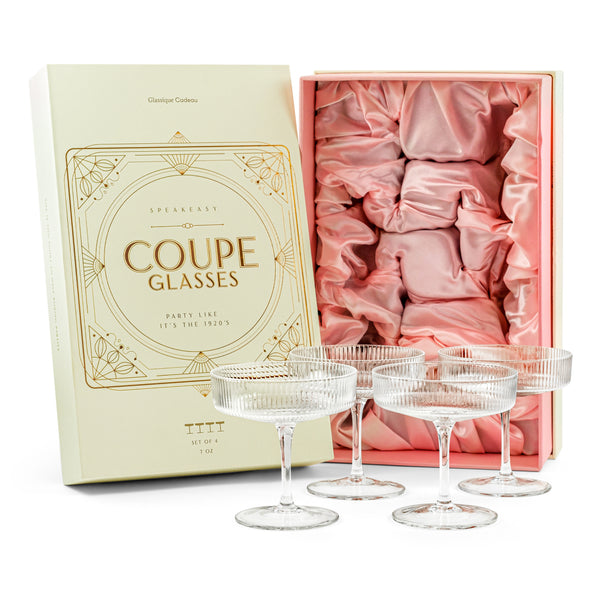
Two places. First, cocktail geometry: coupes, Nick & Noras, lowballs, snifters, and copitas are our entire catalog, not a back page. Sixteen coupe silhouettes alone – Art Deco facets, blush pink, smoke black, iridescent – against the handful the big houses bother with. Second, the gift transaction: every set ships in a satin-lined box with a cocktail recipe printed on the lid. No wrapping, no explaining, done.
And the price-per-glass table reads differently when the glass is hand-blown:
- Nick & Nora, 5 oz, set of 4 – $39.99 – $10 a glass for the stirred-cocktail standard.
- Art Deco Nick & Nora, 5 oz, set of 4 – $49.99 – $12.50 a glass.
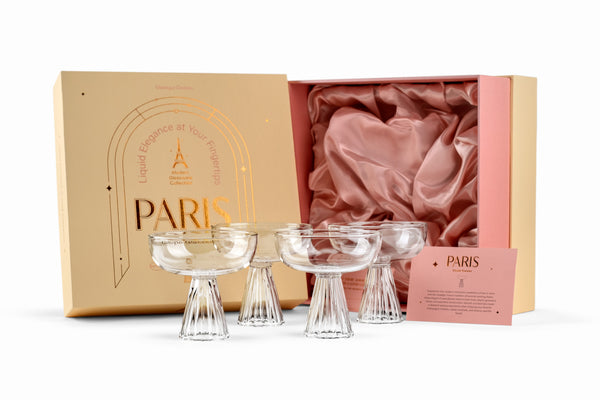
- Paris Coupe, 8 oz, set of 4 – $49.99 – $12.50 a glass, champagne and cocktails both.
- Venus Seashell Coupe, 8 oz, set of 4 – $49.99 – $12.50 a glass.
- Prestige Gold Rim Coupe, 5 oz, set of 4 – $49.99 – $12.50 a glass (hand-wash the rims).
- Roaring 20s Coupe, set of 4 – $59.99 – $15 a glass.
- Art Deco Coupe, 6 oz, set of 4 – $69.99 – $17.50 a glass, the ceiling of our catalog.
- Ribbed Lowball, set of 4 – $42.99 – about $10.75 a glass.
- Whiskey Tasting Tulips, 4 oz, set of 4 – $46.99 – about $11.75 a glass.
- Snifter, 15 oz, set of 2 – $39.99 – $20 a glass, our most expensive per-glass math.
Riedel's hand-made series cost several times any line above, per stem; their machine lines land closer but stay wine-shaped. Zwiesel undercuts nobody on charm. We're the only one of the three where "hand-blown" and "under $20 a glass" appear in the same sentence – that's the whole position.
What "Crystal" Means Here, Briefly
Crystal once meant lead oxide – the industry now uses lead-free titanium, barium, or zinc, the only spec worth insisting on for drinking.
Traditional lead crystal earned its name from lead oxide, which boosted sparkle and made glass easier to cut. The industry has since moved to lead-free formulations – titanium, barium, zinc – that keep the clarity and drop the metal. All three brands in this comparison sell lead-free for daily use; ours is lead-free across the catalog. If you're gifting glasses someone will drink from weekly, lead-free is the only spec worth insisting on.
Run the Gift Test
Picture the recipient opening the box – ours gives satin lining, hand-blown coupes, and a lid recipe, so the gift explains itself.
Here's a test that settles most crystal glassware brand debates in under a minute. Picture the recipient opening the box. With a restaurant-grade stem, they see bubble wrap and a barcode – a fine glass with the charisma of a printer cartridge. With a heritage house, they see the name and feel the price, which works at the very top and gets awkward in the middle. With ours, they see a satin-lined box, four hand-blown coupes, and a cocktail recipe printed inside the lid telling them what to make first. The gift explains itself. That was the design brief.
The set logic matters too. Wine brands sell stems in singles and pairs because cellars grow one varietal at a time. Cocktails are social, so we sell sets of 2, 4, and 6 – a pair of snifters for a couple, four coupes for a dinner table, six Nick & Noras for the host who actually uses the word "aperitif." Two sets clear our $89 free-shipping line with room to spare, which is how most gift orders ship.
And a practical note the spec sheets skip: thin hand-blown rims are why the drink feels better. A 1 mm rim delivers the cocktail; a 3 mm pressed rim announces itself first. Riedel built an empire on that observation for wine. We apply the same physics to the 4 oz Manhattan – see our coupe glasses guide for the long version.
Which to Buy, by Scenario
Wine cellar, buy Riedel; dishwasher-nightly stems, buy Zwiesel; gifts and a photogenic home bar, buy our hand-blown sets.
Building a wine cellar: Riedel, no debate. Outfitting stems that face a dishwasher nightly: Zwiesel. Gifting an anniversary, wedding, or housewarming – or building the home bar you photograph – the hand-blown sets in our Nick & Nora, lowball, and tasting collections do what neither competitor is built for. (For the shapes themselves, our guide to types of cocktail glasses sorts the whole zoo.)
Plenty of serious home bars own all three brands. That's not indecision; that's reading the matrix correctly.
Shop this guide
All 54 pieces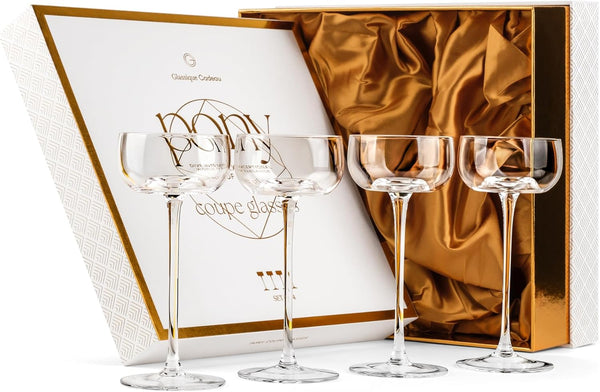
Gift Ready
Bestseller

Perfect for Her
Limited Edition
Crystal Glassware Brands: FAQ
What are the best crystal brands?
By job: Riedel for varietal wine stemware, Schott Zwiesel for durable everyday crystal glass, Baccarat and Waterford for heirloom cut crystal, Glassique Cadeau for hand-blown cocktail and coupe sets at $36.99 to $69.99. The best brand depends on what's being poured.
How do I identify crystal glass brands?
Check the base for an etched or molded maker's mark, the original box, and the silhouette – many houses have signature shapes. Weight, ring (crystal chimes when flicked), and rim thinness separate crystal from ordinary soda-lime, but pinning the brand usually takes the mark.
What are some high-end glassware brands?
Baccarat, Lalique, and Moser at the art-object tier; Waterford for formal cut crystal; Riedel at the top of wine stemware. High-end increasingly means hand work – which is why small hand-blown houses sit in the conversation despite friendlier prices.
What crystal glassware is worth money?
Documented pieces from heritage houses – Baccarat, Lalique, early Waterford – plus rare patterns with provenance. Most household crystal resells modestly; its real value is use. A $59.99 set poured from weekly beats a locked cabinet on every measure except auction day.
Is Riedel better than Schott Zwiesel?
For wine accuracy, Riedel. For surviving years of dishwasher cycles, Zwiesel's Tritan. They're adjacent specialists, not rivals on the same axis – and neither focuses on cocktail glassware, which is the lane hand-blown sets like ours occupy.
Is lead-free crystal real crystal?
Yes by every modern standard. Lead-free crystal keeps the clarity, weight, and ring that defined leaded glass, using titanium or barium instead. It's the correct choice for glasses that see actual drinking rather than display – there's no lead to migrate, ever.
Pair with: coupe glasses, Nick & Nora glasses, whiskey and neat spirit glasses, champagne and sparkling, the classics collection, bestsellers.
Read the matrix, buy by job, and let each house do what it's good at. Every Glassique Cadeau set arrives in our signature satin-lined gift box with a cocktail recipe printed on the lid, and orders over $89 ship free.
- Lead-free, hand-blown crystal
- 30-day satisfaction guarantee
- Arrives gift-ready in a satin-lined box


