
Tips · 11 min read
Gatsby Glassware: The Art Deco Coupes & Cocktail Glasses Guide
Gatsby glassware, decoded: the real 1920s shapes, gold-rim and faceting details, crystal vs costume glass, and how to build a Deco bar cart. Shop the collection.

 Arthur BulotaCo-founder & CEO, Glassique Cadeau
Say Gatsby and everyone pictures the same frame: a champagne tower, gold everywhere, confetti falling. I want you to know the real 1920s shapes and details, so your bar cart looks like the decade rather than a costume of it.
If you have any questions, feel free to email me shop@glassiquecadeau.com

The Jazz Age never really left – it just went looking for the right glass.
Say "Gatsby glassware" and most people picture the same frame. A champagne tower. Gold everywhere. A coupe held at arm's length while confetti falls. That image is doing a lot of work – and most of it is right. But there's a real difference between glass that looks Deco in a photo and glass that actually belongs to the era. This guide sorts one from the other.
The good news: getting it right is not complicated. It comes down to four shapes and a handful of finishing details. Learn those, and you'll never mistake a costume-party prop for the real thing again. Honestly, most hosts overthink the theme and underthink the glass – which is backwards, because the glass is the one thing every guest actually holds.
What makes glassware genuinely 1920s
The 1920s were a strange, brilliant moment for the American cocktail. US Prohibition ran from 1920 to 1933, which meant the drink went underground – into speakeasies, private clubs, and apartments with the curtains drawn. Bad bathtub gin needed dressing up. So the era leaned hard into presentation: stemware that made a rough drink feel like an occasion, glass cut to catch low, gold-tinted light.
Art Deco was the visual language of all of it. Think geometry over floral. Symmetry, bold lines, stepped patterns borrowed from skyscrapers and Egyptian revival. When F. Scott Fitzgerald published The Great Gatsby in 1925, he wasn't inventing that aesthetic – he was reporting on it. (The Baz Luhrmann film arrived in 2013; there was an earlier 1974 version too, but it's the newer one that fixed the coupe-and-gold look in the modern imagination.)
So "genuinely 1920s" isn't a vibe. It's specific. The right Art Deco glassware carries three signatures at once: a period-correct shape, a period-correct finish, and enough weight in the hand to feel like it was made to last a century. Miss any one and the illusion cracks.
The shapes: a buyer's guide, one glass at a time
Four shapes carry the era. Get these and you can serve almost anything from the period canon – a French 75, a Bee's Knees, a Sidecar, an Old Fashioned, a Tom Collins.
The coupe – the icon
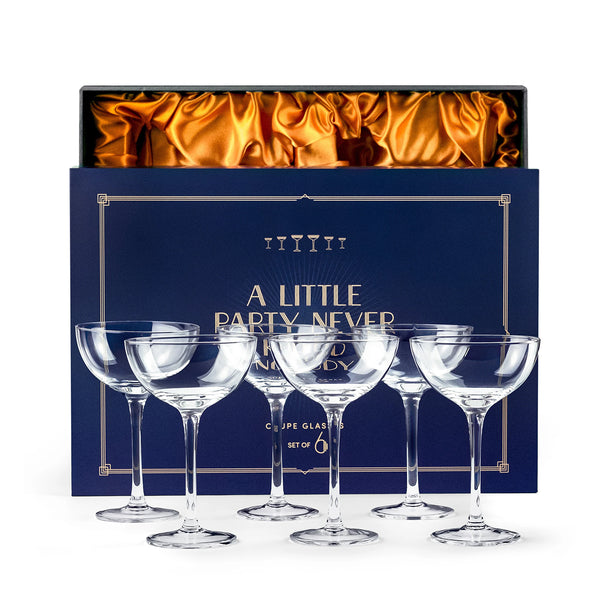
The coupe is the shape people mean when they say "Gatsby glass." Wide, shallow, saucer-like bowl on a slender stem. It holds roughly 5 to 7 oz, which is exactly right for a stirred-or-shaken drink served up, no ice.

One myth to kill first. The story that the coupe was molded from Marie-Antoinette's breast is charming and completely false – the shape traces back to around 1663 in England, decades before she was born. Say it at your next party and you'll be the most interesting person at the bar. The coupe's real heyday came with Champagne service in the early 1900s and then the Jazz Age, when its open bowl made every toast photogenic.
Best for: Champagne, French 75s, daiquiris, anything you want to sip slowly and be seen holding. Start with a coupe set – our vintage Art Deco coupe glasses (set of 4, 6 oz) hit the classic size, and the champagne coupe set of 6 is built for a table full of guests.
The Nick & Nora – the connoisseur's coupe
The Nick & Nora is the coupe's more disciplined cousin. Tulip-shaped bowl, ~5 oz, with walls that curve slightly inward. That inward curve matters: it traps aromatics and – this is the practical bit – it spills far less than an open coupe when you're moving through a crowded room.

The name comes from Nick and Nora Charles, the martini-drinking couple from The Thin Man (1934). The glass is period-adjacent and thoroughly Deco in spirit, which is why serious cocktail people reach for it first.
Best for: Manhattans, martinis, any spirit-forward drink where aroma is half the pleasure. Browse the Nick & Nora collection, or go straight for our Art Deco Nick & Nora glasses (set of 4, 5 oz) – the pick if you host people who care what they're drinking from.
The lowball – the workhorse
Short, sturdy, heavy-bottomed. The lowball (or rocks glass) is where Deco design gets to show off, because the thick base and straight walls give the cutter room to work – faceting, stepped bevels, geometric panels that throw light like a chandelier.

Best for: Old Fashioneds, Negronis, whiskey neat or over a single big cube. Browse the full lowball collection, or go straight for the Gatsby lowball set. Want a touch more capacity and a bolder cut? The speakeasy lowball (set of 4, 9 oz) and the Art Deco rocks lowball set both earn their place on the cart.
The highball – the tall pour
The highball stretches everything upward. Ten to twelve ounces, tall and narrow, built for long drinks with ice and mixer. This is your Tom Collins glass, your gin fizz glass, your dark-and-stormy glass. On a Deco highball, vertical faceting reads like a miniature skyscraper – which is the whole point.

Best for: Collins drinks, gin and tonics, highballs, anything effervescent and served long. The 1920s highball glasses (set of 4) anchor this category. For a rounder silhouette, the gin and tonic balloon glasses give aromatics room to bloom over ice.
| The glass | Best for | Capacity | Era note |
|---|---|---|---|
| Coupe | Champagne, French 75, daiquiri – served up | 5–7 oz | The Jazz Age icon; open bowl made every toast photogenic |
| Nick & Nora | Manhattans, martinis – spirit-forward | ~5 oz | Inward tulip curve traps aroma, spills less; period-adjacent (1934) |
| Lowball | Old Fashioneds, Negronis, whiskey on the rocks | 8–10 oz | Thick base gives the cutter room for stepped, faceted geometry |
| Highball | Tom Collins, gin & tonic, long effervescent drinks | 10–12 oz | Vertical faceting reads like a miniature skyscraper |
The details that separate real Deco from costume glass
Shape gets you in the door. Detail is what closes it. Four finishes did the heavy lifting in the 1920s, and they're still the fastest tell.

Gold and platinum rims. A hand-applied metallic band at the lip – gold for warmth, platinum for cool restraint. On genuine pieces the line is even and continuous, not a thick painted smear. It catches candlelight and does more for a table than any centerpiece.
Faceting and geometric cuts. The Deco fingerprint. Diamond panels, stepped bevels, sunburst bases, vertical flutes. Real cut crystal has crisp edges you can feel with a fingernail; molded costume glass has soft, rounded imitations of the same pattern. Run your thumb along it – you'll know in a second.
Smoke and colored glass. The 1920s loved a tinted bowl – smoke grey, amber, soft green. It photographs beautifully and hides a multitude of sins in the drink itself (useful, back when the gin was questionable).
Iridescent finishes. That oil-on-water shimmer across the surface. Done well it's subtle, shifting from pink to gold as the glass turns. Done badly it looks like a novelty-store trinket. This is the single most-faked Deco detail, so it's worth buying from someone who understands it. Every set in our Art Deco & Gatsby collection is built around getting these four right.
Why crystal beats costume glass
Here's where the money page earns its keep. In our view, crystal versus costume glass is the decision that actually matters – more than shape, more than finish.

Crystal contains mineral oxides that raise its refractive index. In plain terms: it bends light harder, so cut patterns sparkle instead of sitting flat. It's denser, so it feels substantial in the hand and rings with a clear, sustained note when you tap it (costume glass gives a dull, short "tunk"). And because crystal is harder, cutters can carve finer, sharper geometry – which is the entire Art Deco language.
Costume glass photographs fine for one party. Then the gold rim wears thin in the dishwasher, the "faceting" clouds, and the whole thing feels like what it is. Real crystal is an heirloom. Buy the shape once. A quality four-piece coupe or lowball set generally lands in the $40–$80 range – roughly the cost of two rounds out – and it outlives the trend by decades.
"Costume glass photographs fine for one party. Real crystal is an heirloom. Buy the shape once."
How to build a Deco bar cart
A great bar cart is a small stage. Here's the build, in order.

Step one – pick your metal. Gold or brass reads warmer and more Gatsby; chrome or silver reads cooler and more Machine-Age. Choose one and commit. Mixing metals is the fastest way to lose the period feel.
Step two – lay the three core sets. A coupe set for anything served up. A lowball set for spirit-forward and on-the-rocks. A highball set for long drinks. Those three cover roughly ninety percent of what you'll ever pour. Add a martini set if you host martini people, and a snifter or two for after-dinner brandy.
Step three – add reflective surfaces. A mirrored tray, a polished cocktail shaker, a glass ice bucket. Deco was obsessed with light bouncing off metal and mirror – lean into it.
Step four – edit ruthlessly. A Deco cart is composed, not crowded. Two or three bottles with good labels, your glass sets, one bud vase or a single orchid. Negative space is part of the look.
Step five – light it low and warm. Skip overhead light. A small lamp or candle at cart height makes the gold rims and faceting come alive. This is the step everyone forgets and the one that changes the room.
The Deco Bar Cart Checklist
✓ One metal, chosen and committed – gold/brass or chrome/silver, never both
✓ A coupe set for anything served up
✓ A lowball set for spirit-forward and on-the-rocks
✓ A highball set for long drinks
✓ A reflective surface – mirrored tray, polished shaker, glass ice bucket
✓ Two or three bottles with good labels, edited ruthlessly
✓ Low, warm light at cart height – a small lamp or candle
Best for hosts who want the cart to look intentional whether or not anyone's drinking from it. Start the build with the champagne coupe collection and the coupe glasses, then fill in from there.
Glassique's collection as the answer

We built the Art Deco & Gatsby collection to remove the guesswork. Every set is real crystal, cut with genuine geometric faceting, finished with even metallic rims and – where the era called for it – smoke and iridescent tones that shift in the light. Period-correct shapes, in the exact capacities the drinks actually need: 5–7 oz coupes, 5 oz Nick & Noras, 9 oz speakeasy lowballs, tall 1920s highballs.
You're not assembling a costume. You're setting a table your grandchildren will fight over. That's the difference we sell.
Shop this guide
All 47 pieces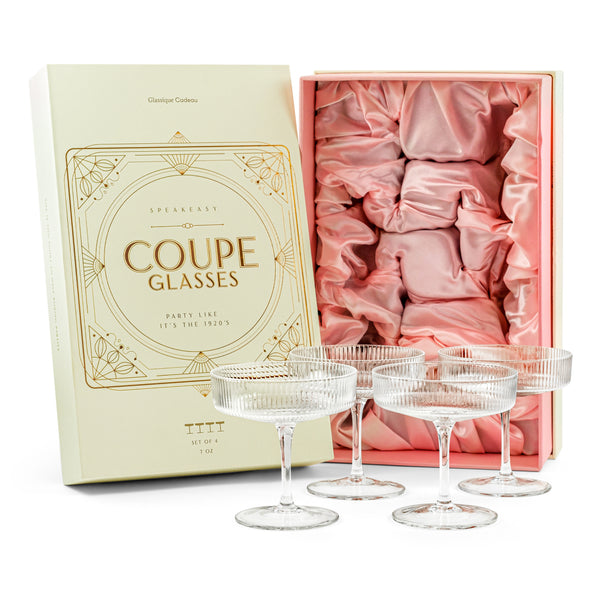
Bestseller
Bestseller

Perfect for Her

Limited Edition
Frequently asked questions
What glasses did they use in The Great Gatsby?
The signature glass is the coupe – the wide, shallow, saucer-shaped stem used for Champagne and cocktails served up. The 2013 film leaned heavily on gold-rimmed coupes and faceted lowballs, both core Art Deco shapes from the 1920s Jazz Age the novel (published 1925) depicts.
Is a coupe glass really shaped like Marie Antoinette's breast?
No – that's a myth. The coupe traces to around 1663 in England, decades before Marie-Antoinette was born. It became the standard Champagne glass in the early 1900s and the icon of the Prohibition-era cocktail (1920–1933). Charming story, but not true.
What is the difference between a coupe and a Nick & Nora glass?
A coupe has a wide, open, saucer-like bowl (~5–7 oz). A Nick & Nora – named for the couple in The Thin Man (1934) – has a smaller tulip-shaped bowl (~5 oz) that curves inward, which concentrates aromatics and spills far less. Choose the coupe for flair, the Nick & Nora for spirit-forward drinks.
Is crystal glassware better than regular glass for cocktails?
For Art Deco glassware, yes. Crystal's higher refractive index makes cut faceting sparkle, it feels heavier in the hand, it rings with a clear tone, and it takes sharper geometric cuts. Costume glass looks flat by comparison and wears out faster.
How many types of glasses do I need for a Gatsby bar cart?
Three core sets cover almost everything: a coupe set (drinks served up), a lowball set (spirit-forward and on the rocks), and a highball set (~10–12 oz, for long drinks). Add a martini set and a snifter if you host those drinkers specifically.
What makes glassware authentically Art Deco?
Four finishing details: hand-applied gold or platinum rims, crisp geometric faceting and stepped cuts, smoke or colored glass, and subtle iridescent surfaces. Combine any of those with a period shape and real crystal weight, and you have the genuine 1920s look.
What size glass is a highball?
A highball holds roughly 10–12 oz – tall and narrow, built for long drinks over ice with mixer, like a Tom Collins or a gin and tonic. On a Deco highball, vertical faceting mimics a skyscraper, which is exactly the effect the era was after.
Pair with: Start at the Art Deco & Gatsby collection for the full range, then build your cart around the 6 oz Art Deco coupes for drinks up, the 5 oz Nick & Nora set for the spirit-forward pours, the Gatsby lowballs for the rocks, and the 1920s highballs for anything long and effervescent.
- Lead-free, hand-blown crystal
- 30-day satisfaction guarantee
- Arrives gift-ready in a satin-lined box


