
Tips · 8 min read
Hand-Blown vs Machine-Made Glassware: Honest Differences
Seams, pontil marks, rim finish, weight variance – how to spot hand-blown glassware, and an honest accounting of where machine-made wins.

 Arthur BulotaCo-founder & CEO, Glassique Cadeau
We sell hand-blown glass, and I noticed how easily sellers like us oversell the romance and skip the trade-offs. I want you to know how to spot the difference with your own hands, and where machine-made honestly wins.
Email me if you have any questions: shop@glassiquecadeau.com. I answer every email personally.

One glass came from a lung. The other came from a production line. Both have a case.
Every glass on your shelf was shaped by one of two forces: a person's breath through a steel pipe, or a machine stamping out identical units by the thousand per hour. Sellers of hand-blown glassware (we are one) tend to oversell the romance and skip the trade-offs. Let's not. Here is the honest version.
TL;DR: What is hand blown glass? Glassware shaped by a glassblower inflating molten glass on a blowpipe, finished by hand – no mold seams, fire-polished rims, slight piece-to-piece variance. Machine-made glass wins on uniformity, price, and ruggedness; hand-blown wins on thin rims, balance, and character. Our entire catalog is hand-blown, lead-free crystal, so you know where we stand.
What Hand-Blown Actually Means
Hand-blown glass is inflated on a blowpipe at around 2,000°F, shaped and finished by hand, then annealed slowly.
The technique is older than most empires. Glassblowing emerged in the 1st century BC along the Syro-Palestinian coast and spread through the Roman world because it was fast, cheap, and endlessly flexible compared to casting.
The process hasn't fundamentally changed: a worker gathers molten glass at around 2,000°F on the end of a blowpipe, inflates it into a bubble (the parison), and shapes it – freehand, or blown into a mold for consistency. A second rod, the punty, holds the piece while the rim is cut, opened, and fire-polished smooth. Stems and feet are attached as separate gathers, by hand, in seconds, while everything is still moving. Then the piece anneals slowly in a cooling oven so it doesn't tear itself apart with internal stress.
"Hand-blown" covers a range, worth knowing: free-blown (no mold, every piece unique) and mold-blown (blown by a person into a form, so shapes repeat but finishing stays manual). Most fine drinkware, ours included, is mold-blown and hand-finished – human breath, consistent silhouette.
1903: The Machine Learns to Blow
Michael Owens's 1903 automatic bottle machine mechanized glassblowing, adding tempering, calibrated volumes, and rolled rims hand work can't offer.
Machine-made glass has its own birthday. In 1903, Michael Owens of Toledo, Ohio commercialized the first fully automatic bottle-blowing machine, and within two decades hand shops making everyday glass were finished. Modern descendants of that idea – press-and-blow and blow-and-blow lines – turn out tumblers at rates no human crew can approach, every one within a gram of its siblings.
Machine glass also gets tricks hand work can't offer: tempering for chip resistance, perfectly calibrated volumes for bar pours, and rims with a rolled bead of glass that shrugs off dishwashers and clumsy stacking. None of that is cheating. It's engineering, and for some jobs it's the right answer.
How to Tell Them Apart in Ten Seconds
Check for mold seams, the base finish, a thin fire-polished rim, and slight piece-to-piece variance across the set.
Pick the glass up and check four things:
- Seams. Run a finger up the sides. Machine-molded glass usually carries faint vertical mold seams; hand-blown glass has none, because the bubble never sat in a two-part press.
- The base. Hand-blown pieces may show a pontil mark – the small scar where the punty detached – though on quality stemware it's ground and polished into a smooth dimple. Machine glass shows a perfectly uniform base, sometimes with a faint mold ring.
- The rim. Machine tumblers often end in a slightly thickened rolled edge. Hand-finished rims are cut and fire-polished – thin, flat, and clean on the lip. This is the difference you can feel blindfolded.
- Variance. Line up four glasses from one set. Hand-blown pieces differ by a hair – a few grams of weight, a millimeter of height. Machine sets are clones. (A tiny seed bubble in the wall is the same signature: a fingerprint, not a defect.)
The Honest Comparison
Hand-blown glass has no seams, thinner rims, and character; machine-made wins on uniformity, tempered durability, and price.
| Feature | Hand-blown | Machine-made |
|---|---|---|
| Mold seams | None | Usually visible |
| Rim finish | Cut and fire-polished, thin | Rolled or beaded, thicker |
| Wall thinness | Can go very thin, especially in crystal | Limited by process |
| Piece-to-piece uniformity | Slight variance (grams, millimeters) | Effectively identical |
| Durability in daily abuse | Good, but treat with respect | Better – can be tempered |
| Price per glass | Higher (skilled labor) | Low |
| Replacement | Match the set, allow variance | Identical unit, any year |
| Character | Each piece individual | By design, none |
Where Machine-Made Wins, Full Stop
Machine glass wins on uniformity, tempered toughness, and price – the right answer for restaurant wells and everyday tumblers.
Three honest concessions. First, uniformity: if you run a restaurant and need 200 identical 12 oz tumblers with identical pour lines, machine glass is the only sane answer. Second, toughness: a tempered machine tumbler will survive years of commercial dishwashing and the occasional counter drop that would end a fine-rimmed crystal piece. Third, price: nobody hand-finishes a glass for the cost of a coffee, and nobody should pretend otherwise.
Most bartenders would say the same thing: machine glass for the well, hand-blown for the drinks that deserve a stage. Your kitchen probably wants the same split – sturdy machine tumblers for water and juice, hand-blown crystal for the cocktail hour.
Where Hand-Blown Earns the Money
Hand-blown glass earns its price with thinner rims, hand-weighted balance, crystal clarity, and the individuality of human work.
Now the case for breath. A hand-finished rim can be pulled thinner than any rolled machine edge, and rim thickness changes how a drink actually lands – less glass between you and the liquid reads as precision. Balance is the second argument: a hand-attached stem and foot get weighted by feel, which is why a good hand-blown coupe stands steady while feeling nearly weightless. Third, optics: hand-blown lead-free crystal carries a clarity and a fine ring that pressed soda-lime glass doesn't reach. And fourth – honestly the one people buy – individuality. The faint asymmetries are evidence a person made it.
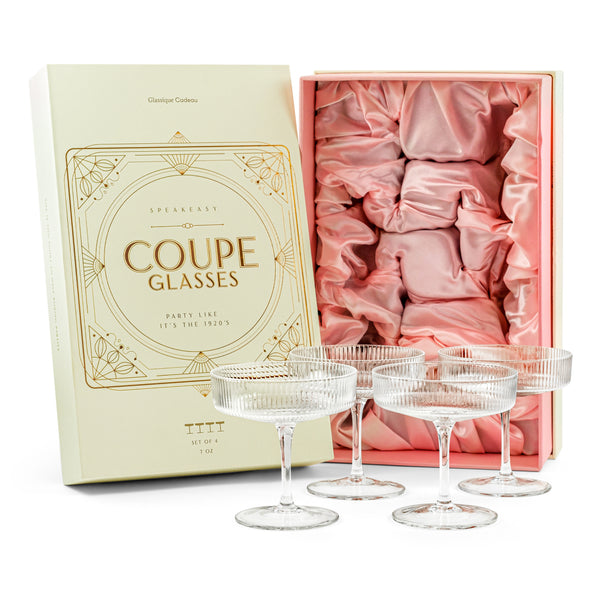
That's the philosophy behind our shelves: the Venus Seashell Coupe ($49.99, set of 4) carries molded texture no press line could finish cleanly, and the Santorini Lowball ($36.99, 10 oz set of 4) shows what a hand-finished rim does for a simple whiskey glass. Sets of 2, 4, and 6 across our coupes and lowballs, all hand-blown, all dishwasher-tolerant on the top rack (hand-wash the gold rims). For which shape does which job, start with our guide to the types of cocktail glasses or go deep on the coupe.
Living With Hand-Blown Glass
Avoid sudden temperature swings, wash on the top rack, hand-wash gold rims, and store upright – nothing more delicate required.
Ownership is less delicate than the price tag suggests, but the rules differ from machine glass in three places. Temperature shock is the real enemy – don't pour boiling water into a cold crystal glass or carry one straight from a hot dishwasher to an ice bucket; a 100°F swing in seconds is how thin walls crack. Washing is simpler than people fear: top rack, gentle cycle, no overcrowding, and hand-wash anything with a gold rim because detergent abrasion dulls metallic finishes. Storage upright, never hanging by the foot or stacked bowl-into-bowl, since rims carry the least material and take the worst of careless contact.
Do that much and hand-blown glass ages the way it should: slowly, visibly loved, occasionally chipped by a guest you've since forgiven.
Shop this guide
All 54 pieces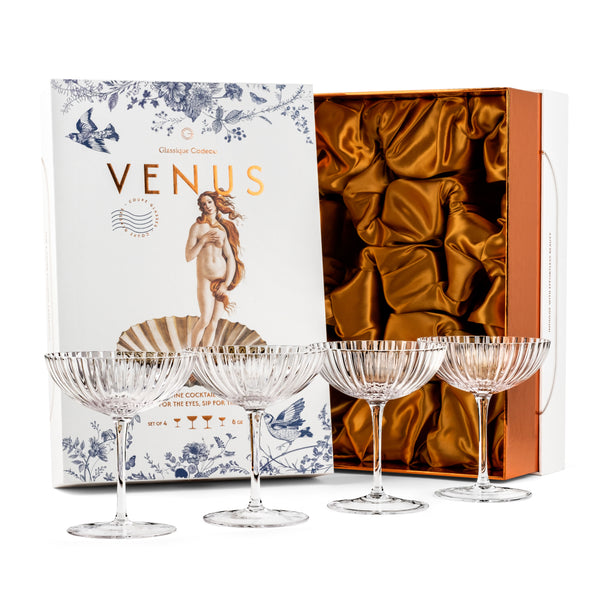
New Arrival
Bestseller

Gift Ready
Hand-Blown Glass FAQ
What is a hand blown glass?
A glass shaped by a glassblower inflating molten glass through a blowpipe, then finished by hand – rim cut and fire-polished, stem and foot attached manually. It may be free-blown or blown into a mold, but the shaping force is human breath rather than a pressing machine.
How can you tell if a glass is hand blown?
Check for the absence of mold seams on the walls, a thin fire-polished rim instead of a rolled edge, a polished pontil dimple on the base, and slight variation between pieces in a set. An occasional tiny seed bubble in the wall also points to hand work.
Does all hand blown glass have a pontil mark?
No. The pontil scar is usually ground and polished smooth on quality drinkware, leaving at most a faint dimple. A missing pontil mark doesn't mean machine-made – and some molded glass fakes a rough base. Judge by seams and rim finish together.
Is hand blown glass heavy?
It depends on the style. Rustic artisan tumblers often run thicker and heavier than machine glass. Fine hand-blown crystal stemware goes the other way – thinner walls and lighter bowls than pressed equivalents, with the weight concentrated in the foot for balance.
Is hand blown glass expensive?
More than machine glass, for a clear reason: skilled labor touches every piece several times. Our hand-blown crystal sets run $36.99–$69.99 for 4–6 glasses, against a couple of dollars for a machine tumbler. Whether the rim, balance, and clarity justify that is a fair personal question.
Is hand blown glass more valuable?
Generally yes, both new and secondhand. Hand work costs more to produce, and collectors pay premiums for documented makers and intact sets. That said, value follows quality and condition – a chipped hand-blown glass is worth less than a perfect machine one.
Pair with: hand-blown coupe glasses, lowball glasses, the classics collection, housewarming gifts, anniversary gifts, bestsellers.
Machines make good glasses; people make particular ones. Keep both, pour accordingly. Every set arrives in our signature satin-lined gift box with a cocktail recipe printed on the lid, and orders over $89 ship free.
- Lead-free, hand-blown crystal
- 30-day satisfaction guarantee
- Arrives gift-ready in a satin-lined box


