
Tips · 8 min read
The Copa de Balón: Spain's Gin & Tonic Glass
Spain rebuilt the gin and tonic around a balloon glass in the mid-2000s – what a copa de balón is, the aromatics physics, and how to build a Gin Tonica.

 Arthur BulotaCo-founder & CEO, Glassique Cadeau
My first gin tonica in Spain came in a glass that looked like a wine glass that had won an argument, and it changed how I think about the drink. I want you to understand why the shape works and build one at home.
Email me if you have any questions: shop@glassiquecadeau.com. I answer every email personally.

Spain looked at the gin and tonic and decided it deserved a bigger stage.
Somewhere in the mid-2000s, Spanish bartenders stopped serving gin and tonic in tall, narrow glasses and started pouring it into something that looks like a wine glass that won an argument. The drink got colder, smelled better, and became a national ritual. The glass has a name worth learning.
TL;DR: What is a copa de balon? A Spanish balloon glass – a large rounded bowl, usually 17–25 oz, on a stem – built for gin and tonic. The wide bowl holds plenty of ice and concentrates the gin's botanicals, while the stem keeps hand heat off the drink. See ours in the gin & tonic collection.
What Is a Copa de Balon?
A copa de balón is a stemmed Spanish balloon glass, 17–25 oz, built for gin and tonic.
Copa de balón translates as "balloon cup," and that's an accurate drawing: a generous, nearly spherical bowl that tapers slightly toward the rim, set on a tall stem. Capacities run large – our Copa de Balón set of 2 ($39.99) holds 25 oz, and that is not a typo. The drink inside stays modest: 2 oz of gin, 4 oz of tonic. Everything else is ice and air, both of which are doing real work.
You'll also hear it called a copa glass, gin balloon, or balloon glass. Same shape, same job. The silhouette descends from the rounded wine glasses of northern Spain – Basque country drinkers had been using balloon-shaped copas for red wine long before anyone put gin in one.
From Basque Wine Glasses to the Gin Tonica Boom
Spanish bartenders in mid-2000s San Sebastián and Barcelona turned the gin-tonic into a craft ritual that spread worldwide.
The gin and tonic itself is a 19th-century artifact: British officers in India taking bitter quinine against malaria and softening it with gin, sugar, and lime. Erasmus Bond patented the first commercial tonic water in 1858, and the drink followed the empire home.
Spain's contribution came much later, and it was a renovation. In the mid-2000s, bartenders and chefs in San Sebastián and Barcelona – fine-dining country – began treating the gin-tonic (one word there: el gin-tonic) as a craft object. Oversized wine copas from the dining room, mountains of clear ice, botanical garnishes matched to each gin, tonic poured gently down a bar spoon. The after-dinner gin-tonic became the chef's nightcap of choice, and the ritual spread from kitchen crews to the whole country. PUNCH has chronicled how the balloon glass became shorthand for the whole movement. By the mid-2010s, Spain was drinking more gin per capita than nearly anywhere in Europe, and the copa had crossed borders into every serious gin bar from London to Melbourne.
Honestly, the Gin Tonica wave is one of the rare bar trends that earned its keep. It wasn't a gimmick. It was a country deciding a two-ingredient drink deserved the same attention as a tasting menu.
The Aromatics Physics: Why the Balloon Works
The bowl concentrates botanicals, the volume holds ice that slows dilution, and the stem keeps hand heat off the drink.
Gin is an aroma delivery system. Juniper, citrus peel, coriander, angelica – most of what you "taste" in a gin and tonic arrives through your nose. The copa is shaped around that fact, three ways.
The bowl concentrates botanicals. The wide surface lets aromatics evaporate freely, and the slight inward taper at the rim collects them where you drink. Every sip comes with a built-in nose-full of juniper. A straight-sided glass lets all of that drift off sideways.
The volume holds serious ice. A 25 oz bowl takes four or five large cubes without crowding the liquid. Counterintuitive but true: more ice means less dilution, because a big frozen mass holds the drink at a lower temperature and melts slower than two lonely cubes swimming in warm tonic. Spanish bartenders fill the copa to the top with ice. So should you.
The stem protects the temperature. Your hand never touches the bowl, so a drink built at near-freezing stays there. With an iced drink, palm contact is pure loss – the exact opposite of the snifter logic, where warming is the point.
One honest trade-off: a wide bowl sheds carbonation faster than a narrow one. A highball glass keeps a G&T fizzier for longer; the copa trades some sparkle for aroma and cold. Spain made its choice. (If maximum fizz is your priority, our highball collection argues the other side.)
Copa de Balon vs Highball vs Wine Glass
The copa wins on aroma and ice capacity, the highball on carbonation – the wine glass is the emergency stand-in.
| Feature | Copa de balón | Highball | Red wine glass |
|---|---|---|---|
| Capacity | 17–25 oz | 10–14 oz | 12–18 oz |
| Shape | Balloon bowl on a stem, tapered rim | Tall, narrow, straight-sided | Rounded bowl, thinner walls, taller stem |
| Aroma delivery | Strongest | Weakest | Strong |
| Carbonation hold | Moderate | Best | Moderate |
| Ice capacity | 4–5 large cubes | 3–4 cubes, stacked | 2–3 cubes (and the glass will complain) |
Can you use a wine glass for a gin-tonic? In a pinch, yes – that's how the Spanish started. But wine glasses are thinner-walled, smaller-mouthed for swirling rather than sipping over ice, and most aren't built to carry a half-pound of frozen water. The copa is the wine glass redesigned for the job. For the rest of the stemware family tree, our guide to the types of cocktail glasses maps it out – and if the smaller coupette caught your eye, the coupe glasses guide covers that cousin.
How to Build a Spanish Gin Tonica
Chill the copa, fill it with ice to the top, add gin, then pour tonic slowly down a bar spoon.
The Spanish method, in order. No shortcuts – the order is the recipe.
- Chill the copa. Fill it with ice and soda water for a minute, then dump everything.
- Refill to the top with the largest, hardest cubes you have. To the top. A half-iced copa is a warm drink scheduled for later.
- Express a citrus peel over the bowl, wipe the rim with it, drop it in.
- Pour 2 oz of gin over the ice.
- Pour 4 oz of cold tonic slowly down a bar spoon to keep the bubbles intact.
- Garnish to match the gin's botanicals – juniper berries, a rosemary sprig, pink peppercorns, cucumber ribbon. One or two. This is a drink, not a terrarium.
Total build time: ninety seconds. Best consumed during sobremesa – the unhurried Spanish hour after dinner when nobody leaves the table.
Choosing a Copa: Size, Crystal, Style
Hand-blown, lead-free crystal with thin walls, real clarity, and a sturdy stem carries a fully iced copa best.
A copa lives or dies on clarity and balance. Hand-blown, lead-free crystal gives the thin walls and clean transparency that make a properly built gin-tonic look like an aquarium of light – which is half the pleasure. Heft matters too: a loaded copa carries a lot of ice, so the stem and foot need real structure.
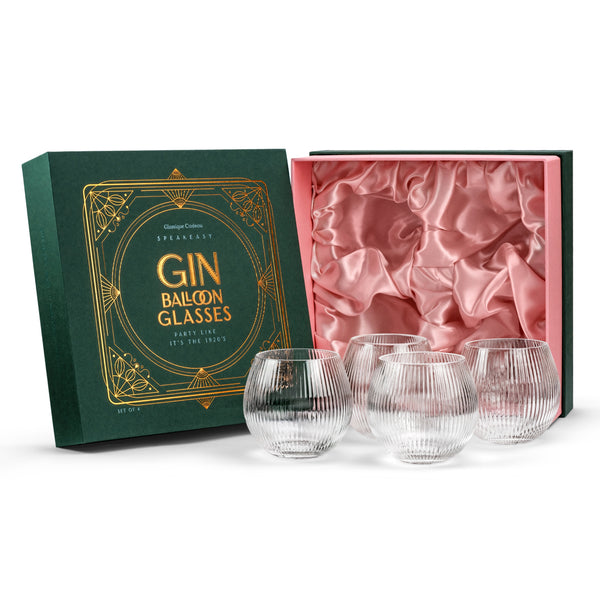
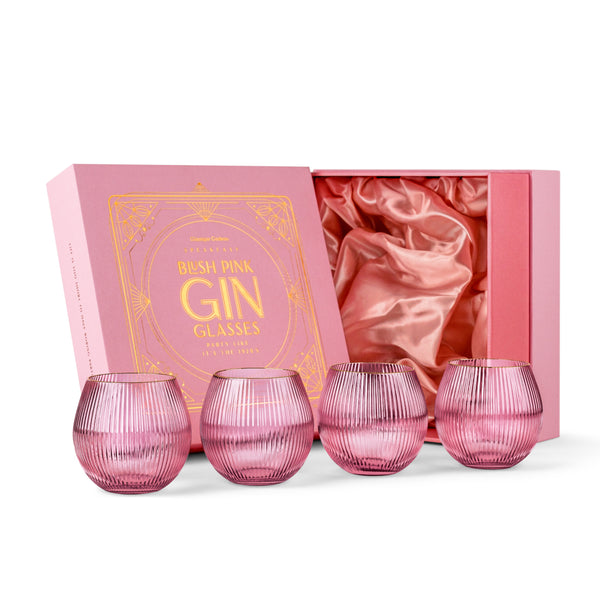
Our 25 oz Copa de Balón ($39.99 for a set of 2) is the full Spanish format. If you want the balloon effect with vintage manners, the Art Deco G&T balloon set of 4 ($49.99) adds etched geometry, and the Blush Pink G&T set ($46.99, 13.5 oz) runs smaller for sessions that involve more than one round. All top-rack dishwasher safe; hand-wash anything with a gold rim. They share shelf logic with our spritz glasses – big bowls, stems, drinks built on ice and aromatics.
Shop this guide
All 54 pieces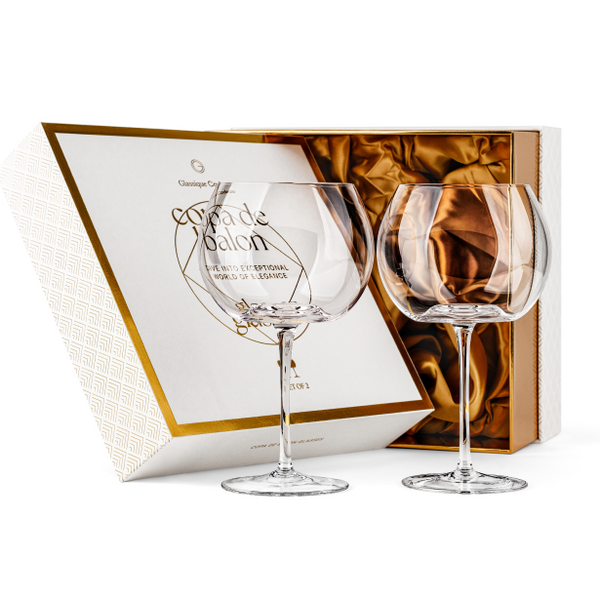
Our Pick
Bestseller
Perfect for Her
Copa de Balón FAQ
What is a copa de balon glass?
A Spanish balloon glass for gin and tonic: a large rounded bowl of 17–25 oz on a stem, with a slight taper at the rim. The size accommodates abundant ice and traps the gin's botanical aromas above the drink. The name translates as "balloon cup."
What do you drink in a balloon glass?
Gin and tonic is the headline act, built Spanish-style with 2 oz gin, 4 oz tonic, and a full load of ice. The shape also suits spritzes, Hugo cocktails, sangria by the glass, and any tall aromatic drink served over ice.
What wine do you drink in balloon glasses?
Balloon bowls suit aromatic, lighter-bodied reds – Pinot Noir is the textbook case – because the wide bowl gives swirling room and the taper concentrates the nose. The copa de balón borrowed exactly this logic from wine and applied it to gin.
Why is gin and tonic served in a balloon glass?
Three reasons: the bowl concentrates the gin's botanicals so the drink smells stronger, the volume holds enough ice to keep it cold with minimal dilution, and the stem keeps warm hands away. Spain popularized the serve during its Gin Tonica movement in the mid-2000s.
How big is a copa de balon?
Typically 17–25 oz. The drink itself stays around 6 oz – 2 oz gin and 4 oz tonic – with the remaining space filled by ice and aroma. Bigger bowl, same pour: the extra room is engineering, not encouragement.
Is a copa de balon the same as a wine glass?
Close relatives, not twins. A copa has a sturdier build, a wider mouth for drinking over ice, and more capacity than most red wine glasses. A wine glass works in an emergency, but it's thinner-walled and not designed to carry 4–5 large cubes.
Pair with: gin & tonic glasses, highball & Collins glasses, Aperol & spritz glasses, cocktail party sets, housewarming gifts, all drinkware.
The copa de balón is what happens when a country takes a simple drink seriously – worth copying at home. Every set arrives in our signature satin-lined gift box with a cocktail recipe printed on the lid, and orders over $89 ship free.
- Lead-free, hand-blown crystal
- 30-day satisfaction guarantee
- Arrives gift-ready in a satin-lined box


