
Recipes · 8 min read
How to Make a Gimlet: Gin, Lime, Nothing to Hide
The gimlet two ways: fresh lime and syrup, or the Royal Navy's Rose's cordial original – with the 1867 scurvy history and the right small stemware.

 Arthur BulotaCo-founder & CEO, Glassique Cadeau
The gimlet is the most honest drink in the gin family, and it deserves better than the syrupy version most people have met. I want you to try it both ways and decide for yourself which one you believe in.
Email me if you have any questions: shop@glassiquecadeau.com. I answer every email personally.

Gin, lime, sugar – a drink the Royal Navy invented by accident and Raymond Chandler argued about on purpose.
The gimlet is the most honest drink in the gin family. No bitters, no vermouth, no bubbles to hide behind – just spirit and lime in close formation. Here's how to make a gimlet both ways: the modern fresh-lime build and the Navy original that started the whole thing.
TL;DR: Shake 2 oz gin, 3/4 oz fresh lime juice, and 3/4 oz simple syrup with ice for 10 to 12 seconds, then strain into a chilled coupe or Nick & Nora from our gimlet & daiquiri collection. Garnish with a lime wheel. Traditionalists swap the lime and syrup for 1 oz of Rose's lime cordial.
What Makes a Gimlet a Gimlet
Gin, lime, and sweetness at 2 oz, 3/4 oz, 3/4 oz – tart, clean, no distractions.
Three things: gin, lime, and sweetness, served cold with no distractions. It runs on the sour template – two parts spirit, one part sour, one part sweet – tightened in practice to 2 oz gin, 3/4 oz lime, 3/4 oz syrup. The drink should land tart and clean, with the gin's botanicals doing the talking and the lime keeping time.
Its nearest relative is the daiquiri – same skeleton, rum traded for gin, and a useful reminder that most classics are siblings wearing different coats.
The spec, at a glance:
| Component | Spec |
|---|---|
| Gin | 2 oz (60 ml) |
| Fresh lime juice | 3/4 oz (22 ml) |
| Simple syrup | 3/4 oz (22 ml) |
| Glass | Chilled coupe or Nick & Nora |
| Method | Shaken hard, 10 to 12 seconds |
| Garnish | Thin lime wheel |
| Navy variation | 2 oz gin + 1 oz Rose's lime cordial, stirred |
Two Schools: Fresh Lime or Rose's Cordial
Fresh lime and syrup is today's standard; Rose's cordial is Chandler's canon – keep both, never mix the arguments.
This is the gimlet's great divide, and both sides have a case.
The fresh school – today's standard – uses fresh-squeezed lime and simple syrup. Brighter, sharper, more alive. This is what a good bar pours when you say "gimlet" in 2026.
The cordial school uses Rose's lime juice cordial, the preserved, sweetened lime that defined the drink for a century. It tastes rounder and more candied, with a cooked-lime note that fresh juice can't imitate – and for purists, that note is the gimlet. Raymond Chandler put the hard line in print in The Long Goodbye (1953): a real gimlet, his character insists, is half gin and half Rose's lime juice and nothing else.
Here's our take: learn the fresh version, keep a bottle of Rose's for history nights, and never mix the two arguments at the same dinner table. Chandler's spec drinks sweet by modern standards – try it once at 2:1 gin to cordial and you'll understand both the devotion and the dissent.
How to Make a Gimlet, Step by Step
Shake gin, lime, and syrup hard for 10–12 seconds, strain into a chilled glass – stir the cordial version.
- Chill your glass in the freezer for 10 minutes.
- Add 2 oz gin, 3/4 oz fresh lime juice, and 3/4 oz simple syrup to a shaker.
- Fill with ice and shake hard for 10 to 12 seconds, until the tin frosts.
- Strain into the chilled glass – double-strain if you want it jewel-clear.
- Garnish with a thin lime wheel.
For the Navy build: stir 2 oz gin with 1 oz lime cordial over ice and strain. Stirring suits the cordial version – there's no fresh juice to aerate, so it can stay silky and transparent, more martini than sour in temperament.
The Navy Story: Scurvy, 1867, and a Patent
The 1867 Merchant Shipping Act plus Lauchlan Rose's patented cordial gave naval officers the gimlet – and the name limey.
The gimlet exists because of a disease. Scurvy hollowed out long-haul crews until the British figured out citrus, and 1867 made it law and logistics in the same year: the Merchant Shipping Act required lime rations on British vessels, and a Scottish merchant named Lauchlan Rose patented a method of preserving lime juice without alcohol – Rose's Lime Cordial, the world's first commercially produced fruit concentrate. Naval officers, sensibly, mixed their ration with their gin. The gimlet is what happened next, and it's why American sailors started calling their British counterparts "limeys."
The name itself has two competing etymologies: the gimlet, a small hand tool for boring holes (the drink bores in similarly), or Surgeon Rear-Admiral Sir Thomas Gimlette, said to have prescribed the mix to his crews. The record is genuinely unsettled – pick the story that suits your audience.
The Glass: Nick & Nora or Coupe
A gimlet stays small and served up – a 5 oz Nick & Nora keeps it cold and concentrated.
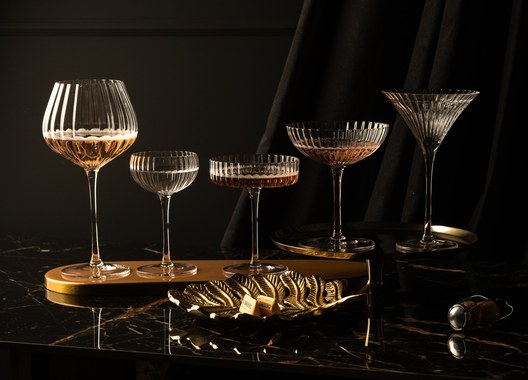
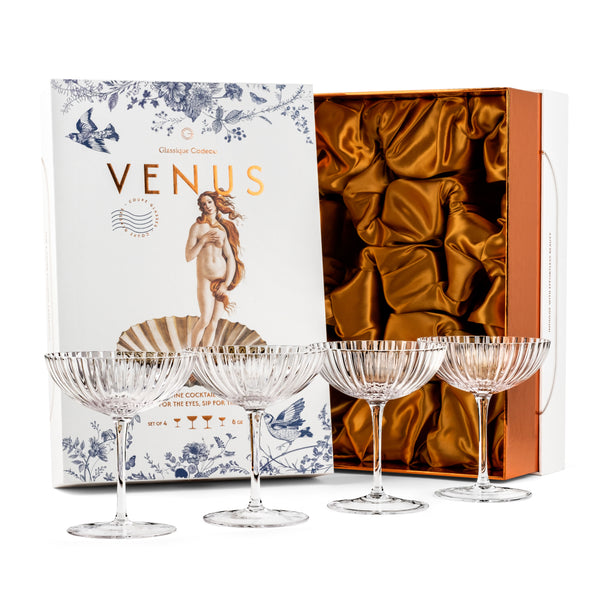
A gimlet is served up and stays small – which makes it the natural resident of a Nick & Nora, the tulip-shaped 5 oz glass that keeps a short drink cold and concentrated. Our Nick & Nora set of 4 ($39.99, 5 oz) is the workhorse choice, hand-blown in lead-free crystal. If your gimlets trend more theatrical, the Venus Seashell Coupe set of 4 ($49.99, 8 oz) gives the lime something sculptural to arrive in.
Browse the full Nick & Nora collection if the proportions win you over – they tend to. Small stemware keeps "up" drinks at temperature better than any oversized bowl.
Which Gin to Pour
A London dry at 40–47 percent you already like – save the rare bottle for a martini.
The gimlet is gin showcase territory, so the bottle matters more than usual. A classic London dry gives you the canonical drink – juniper forward, dry finish, lime as a counterpunch. Citrus-led gins double down on brightness and make a gimlet that drinks like summer. The contemporary, floral styles work too, but taste as you go; soft botanicals can disappear under 3/4 oz of lime. The honest answer: the gin you already like, at 40 to 47 percent, with nothing precious about it. Save the rare bottle for a martini, where dilution is gentler and the gin gets the whole stage.
The Freezer-Door Gimlet
Batch 8 oz gin, 3 oz lime, 3 oz syrup, 2 oz water and store it in the freezer.
The gimlet batches better than nearly anything with citrus in it, and there's a trick worth stealing. For a bottle: 8 oz gin, 3 oz lime juice, 3 oz simple syrup, plus 2 oz of water to stand in for shaking dilution. Cap it, shake it once, and keep it in the freezer – the alcohol keeps it from freezing solid, and it pours at a viscous, ice-cold ribbon whenever someone deserves one. Use it within a day or two; the lime is still on a clock, even at 0°F. For longer-term readiness, the cordial version keeps for weeks, which is precisely why the Navy liked it.
Vodka Gimlets and Other Variations
Vodka, French with St-Germain, and cucumber all keep the ratio – past four ingredients, it's not a gimlet.
Vodka gimlet: same build, vodka for gin – 2 oz vodka, 3/4 oz lime, 3/4 oz syrup. Cleaner and quieter; it's the version for people who find juniper argumentative.
French gimlet: swap the syrup for St-Germain elderflower liqueur. Floral, slightly drier, very good before dinner.
Cucumber gimlet: muddle three or four cucumber slices in the shaker first. Garden-party engineering, and the rare variation that improves on hot days rather than apologizing for them.
All three keep the gimlet's defining ratio. The moment a recipe drifts past four ingredients, you've left gimlet territory and should name the drink something else.
Shop this guide
All 54 pieces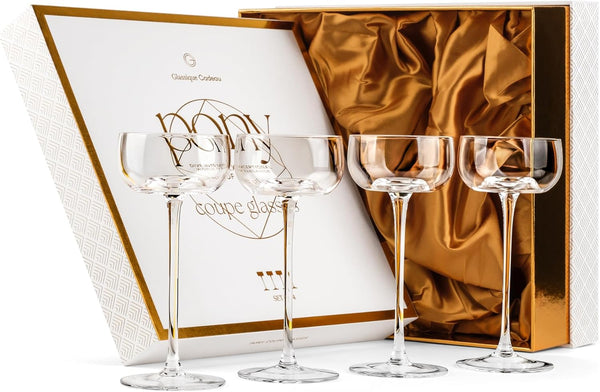
Gift Ready
New Arrival

Perfect for Her
Gimlet FAQ
What are the ingredients of a gimlet drink?
Gin, lime, and sweetener – either 2 oz gin with 3/4 oz fresh lime juice and 3/4 oz simple syrup, or the traditional 2 oz gin with 1 oz Rose's lime cordial. Lime wheel to garnish, always served cold.
What makes a gimlet a gimlet?
The gin-and-lime core with no citrus other than lime and no other modifiers. Change the spirit and it needs a new first name (vodka gimlet); add bubbles or extra juices and it stops being a gimlet entirely.
What's the difference between a gimlet and a Tom Collins?
Citrus, format, and fizz. A gimlet is lime-based, short, and served up with no soda. A Tom Collins is lemon-based, tall, and lengthened with sparkling water over ice. Same gin, very different afternoons.
How do you make a gimlet with vodka?
Identically to the gin version: 2 oz vodka, 3/4 oz fresh lime juice, 3/4 oz simple syrup, shaken hard with ice and strained into a chilled glass. The vodka gimlet is smoother and less botanical – a fair trade, not an upgrade.
Is a gimlet served up or on the rocks?
Up, traditionally – in a chilled coupe or Nick & Nora. On the rocks is acceptable at lunch and in hot climates; use one large cube so the dilution stays slow.
Why is it called a gimlet?
Two theories: the gimlet hand tool, which bores holes the way the drink bores through formality, or Surgeon Rear-Admiral Sir Thomas Gimlette, said to have prescribed the mix to his crews. Neither is proven. Both are good stories.
Pair with: gimlet & daiquiri glasses, Nick & Nora glasses, coupe glasses, the classics collection, cocktail party sets, our bestsellers.
A drink with nothing to hide deserves a glass with nothing to prove. Every Glassique Cadeau set arrives in our signature satin-lined gift box with a cocktail recipe printed on the lid, and orders over $89 ship free.
- Lead-free, hand-blown crystal
- 30-day satisfaction guarantee
- Arrives gift-ready in a satin-lined box


