
Recipes · 8 min read
How to Make a Margarita Without the Mix
A real margarita is 2 oz tequila, 1 oz Cointreau, 1 oz fresh lime – the 2:1:1 spec, the half-moon salt rim, and the glass that isn't a sombrero bowl.

 Arthur BulotaCo-founder & CEO, Glassique Cadeau
Most margaritas are ruined before the tequila arrives, by sour mix, by syrup, by a blender. I want you to make one from three real ingredients and discover it was a sharp, salted, grown-up sour all along.
Email me if you have any questions: shop@glassiquecadeau.com. I answer every email personally.

Three real ingredients. Zero green bottles with handles.
Most margaritas in America are ruined before the tequila arrives – by sour mix, by syrup, by a blender full of regret. Learning how to make a margarita from actual ingredients takes four minutes and changes the drink completely. It stops being a slushy and becomes what it was in Mexico all along: a sharp, salted, grown-up sour.
Margarita Ingredients (No Mix Involved)
2 oz of 100% agave blanco, 1 oz Cointreau, 1 oz hour-fresh lime – mix is the original sin.
- Blanco tequila – 2 oz (60 ml). 100% agave, stated on the label. "Mixto" tequila – up to 49% non-agave sugar – is the reason people think they hate tequila. Blanco keeps the drink bright; a reposado adds vanilla roundness if you prefer it softer.
- Orange liqueur – 1 oz (30 ml). Cointreau is the benchmark; any dry triple sec works. This is the margarita's sweetener AND its perfume. Skip the bottled "margarita mix" – its job is replacing both this and the lime with corn syrup.
- Fresh lime juice – 1 oz (30 ml). Squeezed within the hour. One decent lime yields about 1 oz. Bottled lime juice is cooked, and tastes like it.
- Kosher salt + a lime wheel. For the rim and the garnish.
That's the entire list. If a recipe adds sour mix, orange juice, or "a splash of Sprite," it isn't teaching you how to make a margarita. It's teaching you how to hide one.
The spec, at a glance:
| Component | Spec |
|---|---|
| Blanco tequila (100% agave) | 2 oz (60 ml) |
| Orange liqueur (Cointreau or triple sec) | 1 oz (30 ml) |
| Fresh lime juice | 1 oz (30 ml) |
| Agave syrup (optional) | ¼ oz (7 ml) |
| Glass | Lowball on the rocks, or chilled coupe served up |
| Method | Shake with ice 10–15 seconds, strain over fresh ice |
| Garnish | Lime wheel; half-moon kosher salt rim, outside only |
The Ratio: 2:1:1, and the 3-2-1 Confusion
Pour 2:1:1 – the 3-2-1 rule flatters cheap tequila; adjust sweetness with ¼ oz agave, not more liqueur.
Our house spec is 2:1:1 – two parts tequila, one part orange liqueur, one part lime. It puts the agave in front and lets the citrus and sweetness frame it. In metric: 60 ml, 30 ml, 30 ml.
You'll also see a "3-2-1 rule" – 3 parts tequila, 2 parts orange liqueur, 1 part lime. It makes a sweeter, boozier drink with less acid. Honestly, it flatters cheap tequila and flattens good tequila, which tells you who it was written for. Start at 2:1:1; if your limes are aggressive, add ¼ oz (7 ml) of agave syrup rather than more liqueur. Sweetness and orange flavor are separate dials – the agave lets you adjust one without touching the other.
How to Make a Margarita, Step by Step
Salt the rim, shake all three hard 10–15 seconds, strain over fresh ice, lime wheel.
- Salt the rim first (technique below) and set the glass aside with fresh ice in it.
- Add 2 oz tequila, 1 oz orange liqueur, and 1 oz lime juice to a shaker.
- Fill the shaker with ice and shake hard for 10–15 seconds, until the tin frosts.
- Strain over the fresh ice in the glass – never over the ice you shook with, which is spent.
- Garnish with a lime wheel on the rim.
Serving it up instead? Double-strain into a chilled coupe and skip the ice entirely. Same spec, more formal posture.
The Salt Rim: Half-Moon, Outside Only
Salt the outside edge only, and only half the rim – kosher salt, never iodized.
Two rules separate a bar rim from a beach-resort rim.
First, salt the outside of the glass only. Run a lime wedge around the outer edge of the rim, then roll the glass at a 45° angle through a plate of kosher salt. Salt inside the glass ends up in the drink, and by the last third you're sipping seawater.
Second, salt half the rim – the half-moon. Your guest decides, sip by sip, whether they want salt in the equation. It's a small courtesy that reads as competence. Worth saying: use kosher or flaky salt, never iodized table salt, which turns bitter against lime.
Mistakes That Kill a Margarita
Bottled mix, mixto tequila, spent ice, over-sweetening, and a 30-second shake are the five killers.
- Bottled mix. The original sin. It replaces lime, orange, and sugar with one beige syrup.
- Mixto tequila. If the label doesn't say 100% agave, the hangover says it instead.
- Old ice. Straining the drink over the shaker's ice keeps diluting it. Fresh cubes in the glass, always.
- Over-sweetening. A margarita should land tart-first. If it drinks like limeade, pull back the liqueur before you blame the lime.
- The 30-second shake. Ten to fifteen seconds is the window. Past that you're just adding water.
Batching for a Crowd
Batch the tequila and liqueur a day ahead – lime goes in within 2 hours of serving.
Margaritas scale honestly because every ingredient is shelf-stable except the lime. For 8 drinks: 16 oz tequila, 8 oz orange liqueur, 8 oz fresh lime juice. Combine the tequila and liqueur in a pitcher up to a day ahead; squeeze and add the lime within 2 hours of serving, because lime juice starts dulling noticeably after that.
Don't add ice to the pitcher. Shake each serve over ice for 10 seconds, or – the lazier honest route – stir the full batch with 6 oz of cold water and pour over fresh ice in pre-salted glasses. Either way, every guest gets the 2:1:1 drink, not the watery bottom of a melting bowl. Two limes per person is the shopping math.
The Glass: Lowball or Coupe, Not the Sombrero Bowl
A 5 oz drink belongs in a 10 oz lowball or a 9 oz coupette – skip the 16 oz sombrero bowl.
The giant terraced "margarita glass" holds 16 oz of mostly melt. Skip it. A real margarita is about 5 oz of liquid plus ice, and it belongs in something with weight and restraint.
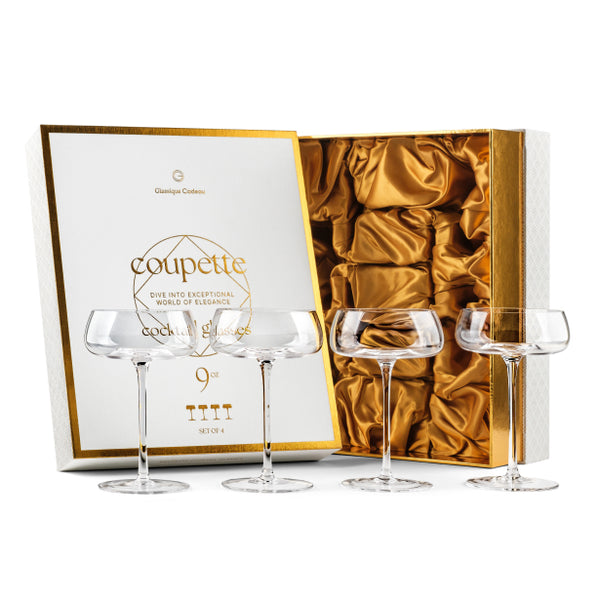
On the rocks, use a solid lowball – our Art Deco Gatsby Lowball Glasses, 13 oz, set of 4 ($42.99) take a fistful of ice and a half-moon rim with room to spare. Served up, the Crystal Coupette, 9 oz, set of 4 ($46.99) is the closer cousin of the glass Mexican bars actually use – hand-blown, lead-free crystal with enough bowl for the citrus to breathe. Our cocktail glass guide covers when each serve makes sense.
And if you're pouring a tequila worth tasting on its own, a set from the tequila glass collection – built for blancos, reposados, and añejos neat – belongs next to the shaker.
Disputed Origins: Mexico, 1930s–40s
Born in 1930s–40s Mexico, first printed by Esquire in 1953 – most likely a tequila Daisy renamed.
The margarita has no single birth certificate, and anyone who tells you otherwise is selling a tour. What's solid: it emerged in Mexico somewhere in the 1930s–40s, with competing claims from Tijuana, Ensenada, and a handful of hotel bars, none proven. The first widely cited printed recipe ran in Esquire in 1953, by which point the drink was already crossing the border on its own.
The most convincing theory is structural rather than personal: "margarita" is Spanish for daisy, and the Daisy was a popular pre-war cocktail family – spirit, citrus, orange liqueur. A tequila Daisy, translated, is a margarita. The drink may simply be an old template wearing a local name, which would explain why so many bartenders "invented" it at once. The competing stories are cataloged on Wikipedia's margarita page; pick your favorite, hold it loosely.
Shop this guide
All 54 pieces
Gift Ready
Our Pick

Gift Ready

Bestseller
Margarita FAQ
What are the ingredients for a margarita?
Three: 2 oz blanco tequila (100% agave), 1 oz orange liqueur such as Cointreau, and 1 oz fresh lime juice. Optional: ¼ oz agave syrup if your limes run sharp, plus kosher salt for the rim.
What is the 321 rule for margaritas?
A ratio shorthand: 3 parts tequila, 2 parts orange liqueur, 1 part lime juice. It produces a sweeter, stronger margarita than the 2:1:1 spec most bartenders pour. Use it if you like the drink rich; skip it if you like it bright.
What is the secret to a good margarita?
Fresh lime juice and 100% agave tequila. Those two choices outweigh everything else. After that: shake hard with plenty of ice, strain over fresh cubes, and keep the salt on the outside of the rim.
What are some common margarita mistakes?
Bottled mix, mixto tequila, iodized salt, straining over spent shaker ice, and over-sweetening. A margarita should finish tart, not syrupy.
How do you make a margarita on the rocks?
Shake 2 oz tequila, 1 oz orange liqueur, and 1 oz lime juice with ice, then strain over fresh ice in a salt-rimmed lowball. The rocks version dilutes as you drink, so it starts slightly stronger than the up version.
What is the margarita recipe in ml?
60 ml tequila, 30 ml orange liqueur, 30 ml fresh lime juice – shaken with ice 10–15 seconds. Add 7 ml agave syrup only if needed.
Should a margarita be blended?
The frozen margarita is its own drink – fine on a 100°F afternoon, but the blender dilutes flavor by design. Shaken over rocks is the version worth learning first.
Pair with: margarita & daiquiri glasses, tequila tasting glasses, lowball glasses, Cinco de Mayo barware, cocktail party sets, coupe glasses.
Squeeze the limes. It's the whole trick. Every Glassique Cadeau set arrives in a satin-lined gift box with a cocktail recipe printed on the lid, and shipping is free over $89.
- Lead-free, hand-blown crystal
- 30-day satisfaction guarantee
- Arrives gift-ready in a satin-lined box


