
Tips · 11 min read
The Best Coupe Glasses for Every Kind of Cocktail
Six hand-blown crystal coupe glasses ranked by job – best overall, budget, gifting, splurge, Gatsby parties, and showpiece – with prices and capacities compared.

 Arthur BulotaCo-founder & CEO, Glassique Cadeau
Which coupe should I buy is the question I hear more than any other, and the honest answer always depends on what goes into it. I want you to choose by the job, whether that is a Manhattan, a toast or a Gatsby party.
Email me if you have any questions: shop@glassiquecadeau.com. I answer every email personally.

Wide bowl, long stem, no ice – the coupe is the one glass that pours a Manhattan and a toast equally well.
"Which coupe should I buy?" is the question we hear more than any other, and the honest answer depends on what is going into it. The best coupe glasses share three things: a shallow bowl that opens up aroma, a stem long enough to keep your palm off the drink, and a capacity built for a 3 to 4 oz pour, not a 12 oz mixer. We make sixteen coupe silhouettes across Art Deco, Nick & Nora, and modern lines – this guide ranks the range by the job you need done, with real prices and real capacities from our own shelves.
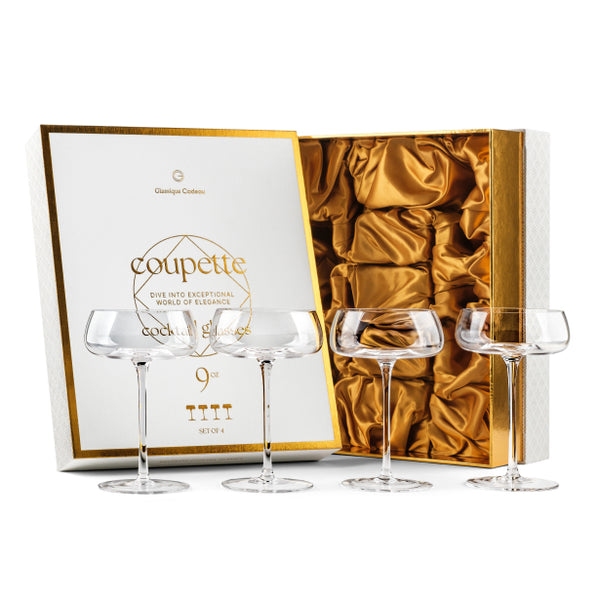
TL;DR: The best coupe glasses for most people are the Art Deco Champagne and Cocktail Coupe Glasses ($69.99, set of 4, 7 oz) – a hand-blown crystal bowl that handles everything from a Daiquiri to a champagne toast. On a tighter budget, the Crystal Cocktail and Champagne Coupettes ($46.99, set of 4, 9 oz) cover the same drinks for less. Browse the full range in our coupe glasses collection.
| Pick | Set | Size | Best for |
|---|---|---|---|
| Art Deco Champagne and Cocktail Coupe Glasses – $69.99 | Set of 4 | 7 oz | Best all-rounder – every up-drink and champagne |
| Crystal Cocktail and Champagne Coupettes – $46.99 | Set of 4 | 9 oz | Best budget all-rounder |
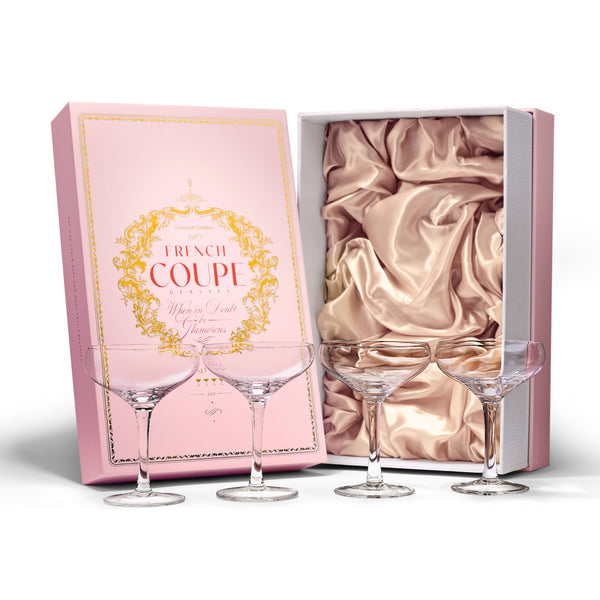
| French Champagne and Cocktail Coupe Glasses – $59.99 | Set of 4 | 6 oz | Weddings and engagement gifts |
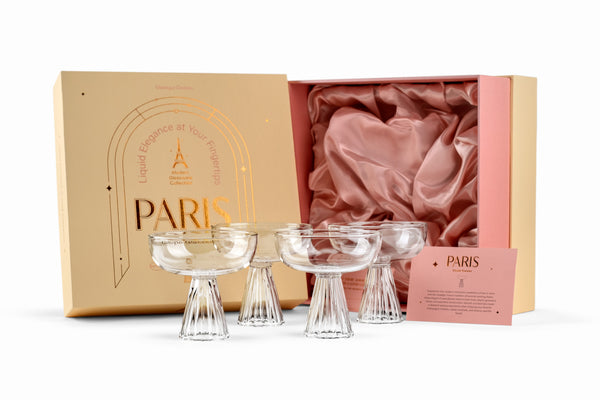
| Paris Coupe Cocktail and Champagne Glasses – $49.99 | Set of 4 | 8 oz | Modern bar carts, longer pours |
| Roaring 20s Coupe Glasses – $69.99 | Set of 6 | 6 oz | Gatsby parties, best per-glass price |
| Roaring 20s Coupe Glasses – $59.99 | Set of 4 | 6 oz | Same shape, smaller set |
| Art Deco Blush Pink Coupes with Gold Rims – $49.99 | Set of 4 | 7 oz | Gifting – bridal, birthday, galentine's |
| Art Deco Iridescent Coupes – $69.99 | Set of 4 | 7 oz | Premium splurge, conversation piece |
| Art Deco Smoke Black Coupes – $69.99 | Set of 4 | 7 oz | Moody bar carts, Negronis and Espresso Martinis |
| Vintage Ritzy Coupe Glasses – $49.99 | Set of 4 | 7 oz | Square-stem retro glamour |
| Prestige Octagonal Coupes with Gold Rims – $49.99 | Set of 4 | 5 oz | Geometric statement, gold rim gifting |
| Venus Seashell Coupe Glasses – $49.99 | Set of 4 | 8 oz | Sculptural showpiece, longer pours |
| Flamingo Belle Coupe Glasses – $59.00 | Set of 4 | Standard | Spritzes, frozen drinks, tropical bar carts |
| Nick and Nora Coupe Cocktail Glasses – $39.99 | Set of 4 | 5 oz | Stirred, spirit-forward classics |
| Art Deco Nick and Nora Coupe Glasses – $49.99 | Set of 4 | 5 oz | Vintage Manhattans and Martinis |
The go-to: the Crystal Cocktail and Champagne Coupettes at $46.99, the budget anchor at $11.75 a glass. The splurge: the Art Deco Iridescent Coupes at $69.99, an electroplated rainbow finish that throws a different color at every angle.
What Is a Coupe Glass?
A coupe is a stemmed glass with a wide, shallow bowl, built for cocktails served "up" – chilled, without ice.
A coupe glass is a stemmed cocktail glass with a wide, shallow bowl, reputedly first made in England around 1663 and originally used for Champagne. Today it holds spirit-forward drinks served up, such as the Manhattan, Daiquiri, and Sidecar. The name comes from the French word for a shallow cup. Say it "koop" – it rhymes with loop, not "koo-pay," which is the car. You will also see the same shape sold as a Champagne saucer, the older name for the identical glass. Browse the full range in our coupe glasses collection to see how the proportions vary across sets.
A Short History: From 1663 Champagne Saucer to the Gatsby Comeback
The coupe predates Marie Antoinette by ninety years, peaked in the 1920s, and came roaring back around 2007.
For most of the 1700s and 1800s the coupe was the Champagne glass – not the flute, the saucer, wide and shallow enough to stack into a fountain at a party. You have probably heard the bowl was molded on Marie Antoinette's breast. It is a great story and it is false: the coupe predates her by roughly ninety years, since she was born in 1755 and the glass in 1663, so the timeline does not survive a second look. The historical record credits English glassmakers, not French anatomy. Charming myth, wrong century.
The coupe hit its cultural peak in the 1920s. Prohibition, speakeasies, the Gatsby set – the saucer was the glass of the era, and it still reads as shorthand for that whole aesthetic. It faded after the 1950s as the flute took over for sparkling wine, then came back with the craft cocktail revival – bars like New York's PDT and Employees Only put it back on the map roughly 2007 to 2012, drinks writers at Punch documented the comeback, and it never left again. If you want the full 1920s look, our Nick & Nora glasses and Art Deco coupes lean into the ribbed, geometric styling of the period.
What to Pour in a Coupe
Anything served "up" belongs here – shaken or stirred with ice, then strained into a chilled glass with none.
A coupe is built for anything served up – shaken or stirred with ice, then strained so no ice reaches the drink. The long stem keeps your palm off the bowl. The wide opening lets aromatics open up before the first sip.
- Manhattan – rye, sweet vermouth, bitters, stirred and strained up.
- Daiquiri – rum, lime, sugar, shaken hard and served without ice.
- Sidecar – cognac, orange liqueur, lemon, often with a sugar rim.
- French 75 – gin, lemon, sugar, topped with Champagne.
- Cosmopolitan and Espresso Martini – 5 to 6 oz drinks that want a slightly bigger bowl.
- Champagne and sparkling toasts – the coupe's original job, still a good one for a short pour.
The editorial world agrees on the "up" rule: Liquor.com lists the coupe as the default vessel for stirred and shaken classics, and Serious Eats recommends a coupe over a martini glass for exactly one reason – the deeper bowl spills less when you carry it. We agree. A V-shaped martini glass looks sharp and behaves like a trap. The coupe holds the same drinks and reaches the table intact, which is the entire case for choosing one.
The Art Deco Family: Vintage Cocktail Coupes
Five finishes, one 6 to 7 oz geometry – ribbed, smoked, iridescent, blush pink, and plain crystal.
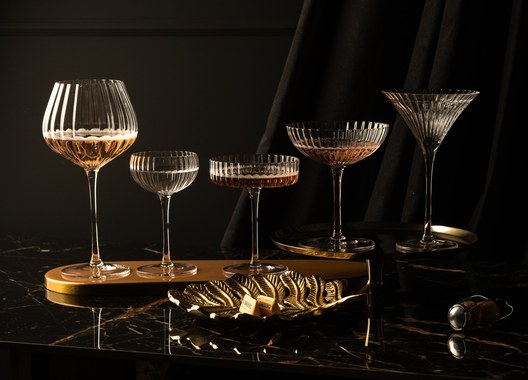
Six to seven ounces is the working sweet spot for a coupe: a stirred Manhattan or a shaken Daiquiri lands at 4 to 4.5 oz after dilution, leaving a comfortable half inch below the rim. Our Art Deco Champagne and Cocktail Coupe Glasses ($69.99, 7 oz) are the workhorse of the range – stepped facets that catch low light, at $17.50 a glass. The Art Deco Smoke Black Coupes ($69.99, 7 oz) run the same geometry in a moody tint built for Negronis and Espresso Martinis. For gifting, the Art Deco Blush Pink Coupes with Gold Rims ($49.99, 7 oz) photograph better than anything clear and arrive in our satin-lined box, though gold rims want a hand wash rather than the dishwasher. The Art Deco Iridescent Coupes ($69.99, 7 oz) are the diva of the catalog – electroplated crystal that throws petrol blue, rose, and gold depending on the angle, hand wash only. And for a full Gatsby table, the Roaring 20s Coupe Glasses set of 6 ($69.99, 6 oz) works out to $11.67 a stem, the best per-glass price in the range – or take the same shape as a set of 4 at $59.99.
Modern and Novelty Coupes
Bigger bowls and sculptural shapes for longer pours, spritzes, and bar carts that skip the vintage look.
Not every bar cart wants ribbed Art Deco glass. The Paris Coupe Cocktail and Champagne Glasses ($49.99, 8 oz) keep a clean, contemporary bowl that suits a longer or more diluted pour. The Venus Seashell Coupe Glasses ($49.99, 8 oz) go further with a scalloped, shell-shaped bowl guests pick up and turn over. The Flamingo Belle Coupe Glasses ($59.00) are built for spritzes and frozen drinks rather than a straight Manhattan – proof a coupe does not have to be beige. For an everyday set, the Crystal Cocktail and Champagne Coupettes ($46.99, 9 oz) are the cheapest way into hand-blown crystal we make – the bowl runs bigger than classic spec, which swallows a full champagne pour or a frozen Daiquiri without complaint. Two more sit between vintage and modern: the Vintage Ritzy Coupe Glasses ($49.99, 7 oz) with a squared retro stem, and the Prestige Octagonal Coupes with Gold Rims ($49.99, 5 oz), a faceted, smaller-format glass for spirit-forward pours.
Nick & Nora: The Coupe's Smaller Cousin
Same idea, narrower rim, less spillage – the bartender's quiet pick for stirred, spirit-forward drinks.
The Nick & Nora is the coupe's smaller cousin, at 5 oz with a narrower rim that spills even less. Named after the cocktail-loving detectives in the 1934 film "The Thin Man," it is the pick for a stirred drink where you want the glass to disappear behind the liquid. Our Nick and Nora Coupe Cocktail Glasses ($39.99, set of 4) keep a clean modern stem, while the Art Deco Nick and Nora Coupe Glasses ($49.99, set of 4) add ribbed period detailing for a full Gatsby table.
| Feature | Coupe | Champagne flute | Nick & Nora |
|---|---|---|---|
| Bowl | Wide, shallow | Tall, narrow | Narrow, deep |
| Capacity | 6–9 oz | 6–9 oz | 5 oz |
| Best for | Cocktails up, toasts | Sparkling wine | Spirit-forward stirred |
| Keeps bubbles | No | Yes, longest | Not intended for bubbles |
The one real trade-off with a coupe is fizz. Its wide bowl exposes more surface area, so Champagne loses its bubbles faster than in a flute. For a cocktail served up, there are no bubbles to protect, so the coupe's only downside disappears – pour the Champagne in a flute if the toast runs long, and pour the French 75 in a coupe.
How to Choose the Right Coupe
Capacity, weight, rim, and material separate a good coupe from a decorative one.
- Capacity: 5 to 7 oz for up-drinks. A standard stirred or shaken cocktail is 4 to 4.5 oz after dilution – you want about an inch of headroom, no more. Go 8 oz and up for champagne service, spritzes, or show.
- Weight and balance. The base should feel planted and the stem should not wobble. Hand-blown glass carries weight better than thin machine-pressed stock.
- Rim. A thin, fire-polished rim feels better against the lip and leaves room to perch a citrus wheel. Thick rolled rims read cheap the moment you drink from one.
- Material. Lead-free crystal gives clarity and light without the health question that came with old leaded crystal, which historically ran up to 24 to 32 percent lead oxide.
Honestly, the biggest mistake is buying on looks alone and ending up with a 4 oz bowl you refill mid-conversation. Size first. Style second.
Caring for Your Coupes
Hand wash gold rims and iridescent finishes – everything else is top-rack dishwasher safe.
All our coupes are hand-blown, lead-free crystal and top-rack dishwasher safe as a rule. The exceptions are gold-rimmed and electroplated finishes, which want a hand wash in warm water to protect the finish. Store coupes upright rather than rim-down, which stresses the most fragile edge of the glass. Chill them in the freezer for ten minutes before serving anything up – a cold coupe keeps the drink colder longer, and it is the single easiest upgrade to a home pour.
Shop this guide
All 54 pieces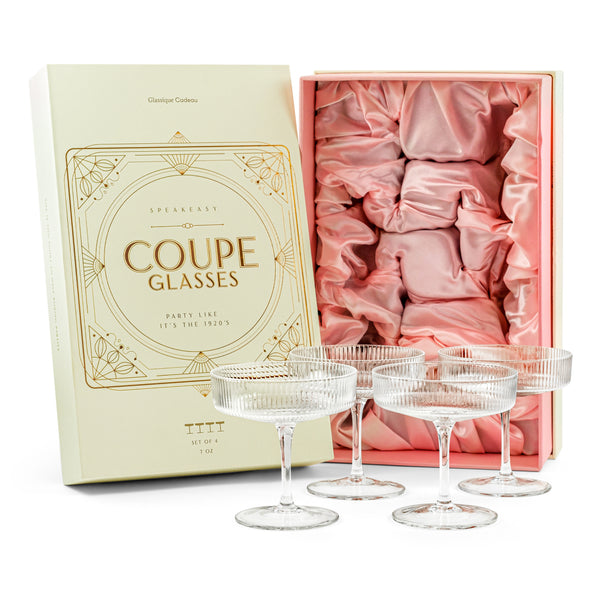
Bestseller
Our Pick
Wedding Favorite
Limited Edition
Best Coupe Glasses: FAQ
What is a coupe glass?
A coupe glass is a stemmed cocktail glass with a wide, shallow bowl, reputedly first made in England around 1663 and originally used for Champagne. Today it holds spirit-forward drinks served up, such as the Manhattan, Daiquiri and Sidecar. The name comes from the French word for a shallow cup.
How do you pronounce coupe glass?
Say "koop," rhyming with loop. It is one syllable, from the French coupe. Avoid "koo-pay," which is the pronunciation for the two-door car, not the glass. "Champagne saucer" means the same thing and sidesteps the question entirely.
What is the best coupe glass size?
For classic cocktails, 5 to 7 oz is best – a 4 to 4.5 oz drink needs about an inch of headroom. For champagne or dual-purpose service, 7 to 9 oz. Our range runs 5 oz Nick & Nora pours up to 9 oz Crystal Coupettes, so pick by how you actually drink.
What is the difference between a coupe and a Nick & Nora glass?
Both are stemmed and served without ice, but the Nick & Nora has a narrower, deeper bowl at around 5 oz, while the coupe is wider and shallower at 6 to 9 oz. The Nick & Nora spills less and suits stirred, spirit-forward drinks; the coupe is the more versatile choice for cocktails and champagne alike.
Do coupe glasses work for champagne?
Yes – it was the original champagne glass before the flute took over in the 1950s. The wide bowl exposes more surface area, so bubbles fade faster than in a flute, but for a short toast or a French 75 that trade-off does not matter.
What is the difference between a coupe and a martini glass?
Both serve cocktails up, but the martini glass has a sharp V-shaped bowl while the coupe has a rounded, shallow one. The coupe's curved bowl spills far less when carried, which is why many bartenders now prefer it for the same drinks. It also doubles as a Champagne glass, which the martini glass cannot.
When were coupe glasses popular?
The coupe was the standard Champagne glass through the 1700s and 1800s, then peaked culturally in the 1920s during Prohibition and the Art Deco era. It faded after the 1950s in favor of the flute, then returned around 2007 to 2012 with the craft cocktail revival. It has stayed in fashion since.
Are these coupe glasses dishwasher safe?
Top-rack dishwasher safe as standard. The two exceptions are gold-rimmed sets and the electroplated Iridescent Coupes, which should only ever be hand washed in warm water to protect the finish.
Pair with: coupe glasses, Nick & Nora glasses, champagne and sparkling glasses.
Pick the coupe that matches how you actually drink, not how you imagine entertaining. Every set arrives in our signature satin-lined gift box with a cocktail recipe printed on the lid, and orders over $89 ship free.
- Lead-free, hand-blown crystal
- 30-day satisfaction guarantee
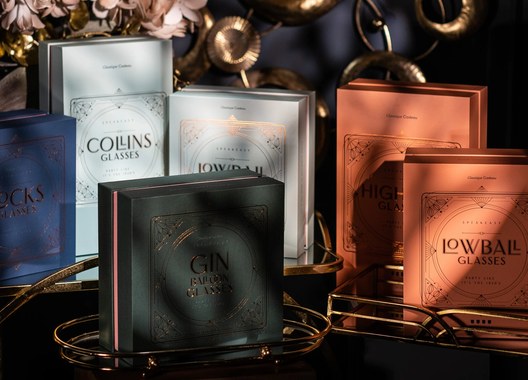
- Arrives gift-ready in a satin-lined box


