
Tips · 8 min read
The Absinthe Ritual: Louche, Spoon, Fountain, Glass
The French drip ritual step by step – reservoir glass, sugar cube, 3:1 to 5:1 iced water – plus the real story behind the thujone myth.

 Arthur BulotaCo-founder & CEO, Glassique Cadeau
No spirit carries more nonsense on its shoulders than absinthe, and underneath the myths sits a four-minute ritual of real beauty. I want you to drip the water slowly, watch the louche, and know that the madness was never in the bottle.
Email me if you have any questions: shop@glassiquecadeau.com. I answer every email personally.

One ounce, one sugar cube, one slow drip – the rest is theater worth doing properly.
No spirit carries more nonsense on its shoulders than absinthe. Hallucinations, madness, banned substances, flaming spoons. Most of it is marketing, some of it is slander, and underneath sits a genuinely beautiful ritual that takes four minutes and one piece of correct glassware.
| Step | What to do |
|---|---|
| 1. Dose the glass | Pour absinthe to the top of the reservoir – about 1 oz |
| 2. Set the spoon | Slotted spoon flat across the rim, sugar cube centered over the slots |
| 3. Drip, don't pour | Ice-cold water drop by drop onto the cube – three to four minutes per glass |
| 4. Watch the louche | The drink blooms from clear green to milky opal, bottom up |
| 5. Hit your ratio | 3:1 water to absinthe for assertive, 5:1 for session strength – first-timers start at 4:1 |
| 6. Stir once, sip slowly | Gentle stir for sugar remnants; the drink reads as chilled anise, fennel, and alpine herbs |
First, the Myth That Won't Die
Absinthe never caused hallucinations – thujone levels in pre-ban bottles were far too low, and the "madness" was plain alcoholism.
Absinthe does not make you hallucinate. It never did. The accused compound, thujone, occurs in the wormwood that gives absinthe its name – and chemical analysis of surviving pre-ban bottles found it in quantities far too small to do anything but flavor the drink. What absinthe actually had was 45 to 74 percent alcohol and a customer base drinking it daily at 5 p.m. The "madness" was alcoholism with better PR.
The panic peaked after 1905, when a Swiss laborer named Jean Lanfray murdered his family after a day of wine, brandy, and two glasses of absinthe – the absinthe took the blame. Switzerland banned the spirit in 1910, the United States in 1912, France in 1915. The US lifted its ban in 2007; bottles sold here today test below 10 parts per million of thujone, which is to say: functionally none. The full saga is worth a read with the drink in hand.
The Belle Époque Ritual
The ritual dilutes a spirit bottled too strong to drink neat – cold water blooms the oils, sugar rounds the wormwood.
Before the bans, absinthe owned an hour of the French day – l'heure verte, the green hour, when Parisian cafés filled with the smell of anise. Verlaine wrote under it, Toulouse-Lautrec painted through it, Van Gogh drank far too much of it. Pontarlier, a town near the Swiss border, was the industry's capital; Henri-Louis Pernod opened his distillery there in 1805, and the town gave its name to the glass this whole ritual runs on. At its peak, the green hour was as fixed in the French schedule as lunch.
The ritual exists for a practical reason dressed in ceremony. Absinthe is bottled too strong to drink and too bitter for most palates straight. Cold water unlocks it – the botanical oils bloom out of solution and the drink turns opalescent, the louche. Sugar rounds the wormwood's edge. The slow drip is simply the gentlest way to combine all three, and watching it happen is the cocktail world's best four minutes of waiting.
What You Need
You need a reservoir glass, a slotted spoon, one sugar cube, ice-cold water, and a verte absinthe.
- A reservoir glass. The Pontarlier shape has a bubble blown into the base that holds exactly one dose – fill the reservoir, stop pouring. Our Belle Époque absinthe glasses run $59.99 for a set of four, hand-blown in the French reservoir profile.
- A slotted absinthe spoon. Flat, perforated, sits across the rim. A fork balanced carefully is the field expedient; the spoon costs little and looks the part.
- One white sugar cube per glass. Skip it for naturally sweeter blanche styles.
- Ice-cold water in anything that pours slowly – a small carafe works. The absinthe fountain (a spigoted urn that drips for you) is the luxury-free way to serve four glasses at once without standing there all evening.
- The absinthe itself. A verte for the classic green-fairy experience; expect 60-70 percent ABV and plan your evening accordingly.
How to Drink Absinthe: The French Drip, Step by Step
Dose 1 oz, set the sugared spoon, drip ice-cold water for three to four minutes, and stop at your ratio.
- Dose the glass. Pour absinthe to the top of the reservoir – about 1 oz. (In a regular glass, measure 1 oz with a jigger.)
- Set the spoon. Rest the slotted spoon flat across the rim, sugar cube centered over the slots.
- Drip, don't pour. Ice-cold water, drop by drop, onto the cube. The sugar erodes through the spoon into the spirit below. A proper drip takes three to four minutes per glass.
- Watch the louche. Somewhere past the first ounce of water, the drink blooms from clear peridot green to milky opal, bottom up. This is the oils emerging. It's the whole show – don't rush it.
- Hit your ratio. Stop at 3:1 water to absinthe if you like it assertive, 5:1 if you want café-session strength. First-timers should start at 4:1 and adjust the second glass.
- Stir once, sip slowly. Any sugar remnants get a gentle stir with the spoon. The finished drink should read as chilled anise, fennel, and alpine herbs – closer to a pastis than a shot.
The Fire Ritual, and Why Bartenders Skip It
Skip the flame – a 1990s Czech tourist gimmick that caramelizes the sugar bitter and burns off the aromatics you paid for.
The flaming sugar cube – soak it in absinthe, light it, drop it in – is the "Bohemian method," and it isn't Bohemian or a method. It surfaced in 1990s Czech bars as a tourist spectacle. Fire caramelizes the sugar into bitterness, burns off the aromatics you paid for, and occasionally sets the entire glass alight, which is how high-proof spirits like to behave. Honestly, the louche is the better magic trick. The slow milky bloom impresses people who've seen everything; the lighter impresses people who haven't seen a Sazerac.
No Fountain? No Sugar? Still Correct.
Drip cold water from any slow-pouring vessel and skip the sugar – good modern absinthe rarely needs either accessory.
How to drink absinthe without a sugar cube: just drip the cold water. Good modern absinthe rarely needs sweetening, and Swiss blanche styles were designed without it. How to drink it without a fountain: a carafe, a measuring cup with a spout, even a water bottle tipped patiently. The fountain is atmosphere, not chemistry.
Can you drink absinthe neat? You can; you shouldn't. At 60-plus percent ABV it numbs the palate inside two sips and the botanicals never open. Water isn't dilution here – it's the second ingredient, the way vermouth is half the point of a martini.
Where Absinthe Goes After the Ritual
After the ritual, absinthe works by the quarter-ounce – a Sazerac rinse in a lowball or Death in the Afternoon in a coupe.
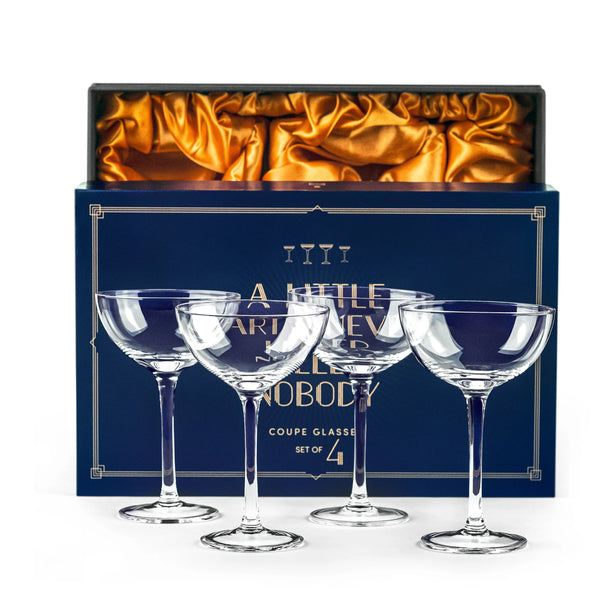
Once the bottle is open, absinthe earns its keep in cocktails by the quarter-ounce. The Sazerac – New Orleans, 1850s, Peychaud's bitters – uses it only as a rinse: swirl a bar spoon of absinthe around a chilled lowball, dump the excess, build the drink inside the perfume. Our Speakeasy Lowball (9 oz, $42.99 for four) is the right stage for it. Hemingway's Death in the Afternoon – his entry in a 1935 celebrity cookbook – pours chilled champagne over 1.5 oz of absinthe in a coupe until it louches; our Roaring 20s coupes ($59.99 for four) handle it with period-correct manners. Browse the coupe collection and the lowball collection for either job, or go full Belle Époque and Art Deco across the bar.
Shop this guide
All 54 pieces
Bestseller

Limited Edition
Most Gifted
How to Drink Absinthe: FAQ
How do the French drink absinthe?
The traditional French method: 1 oz absinthe in a reservoir glass, slotted spoon with a sugar cube across the rim, ice-cold water dripped through until the drink louches – 3:1 to 5:1 water to spirit. No flame, ever.
Should you drink absinthe straight?
No. At 45-74 percent ABV it overwhelms the palate and the aromatics stay locked. Cold water is what opens the botanicals; even a quick 4:1 pour-over beats drinking it neat.
Is real absinthe still illegal in the US?
No. Absinthe returned to the US legally in 2007. Bottles sold here must test below 10 parts per million of thujone, which real pre-ban absinthe essentially matched anyway. What's on the shelf is the real thing.
Does absinthe make you hallucinate?
No. The thujone-hallucination story was a mix of moral panic and competing wine-industry lobbying. Analysis of pre-ban bottles shows thujone levels far too low for any psychoactive effect. Absinthe's only trick is being very strong.
What do you mix absinthe with?
Ice-cold water before anything else. In cocktails: a rinse in the Sazerac, champagne in Death in the Afternoon, soda and crushed ice in the Absinthe Frappé. It's a seasoning spirit – quarter ounces, not shots.
What is the green fairy?
La fée verte – Belle Époque slang for absinthe itself, named for the green spirit and the muse-like devotion it inspired in Paris's café culture from the 1880s until the 1915 French ban.
Pair with: Belle Époque & Art Deco glassware, coupe glasses, lowball glasses, champagne glasses, cordial glasses, and the classics collection.
Pour slow, watch the louche, toast the green hour. Every Glassique Cadeau set arrives in a satin-lined gift box with a cocktail recipe printed on the lid – and orders over $89 ship free.
- Lead-free, hand-blown crystal
- 30-day satisfaction guarantee
- Arrives gift-ready in a satin-lined box


